Nowadays, getting a second passport has been turned into quite a beautiful picture. Social media has largely contributed to this. They “sell” you a beautiful picture with travels, beautiful landscapes, local dishes… Is it really so? No, the reality is a little different. A second passport is not just a platinum travel document or a decoration for your wallet. It is a full-fledged legal contract with another state, complete with its own laws and rules. People who crave freedom often come to our lawyers for consultations, but they do not know that they are closely tied to new obligations. Yes, you will definitely have to take them on! In this article, we will analyze the real pros and cons of dual citizenship so that you clearly understand what awaits you. So, let’s dive into the dry facts without illusions.
In short
- Dual citizenship means you are subject to the laws of two countries at the same time.
- Main benefits: freedom of movement, work and business options in the EU, and a status your children can inherit.
- Main drawbacks: tax reporting (U.S. citizens file with the IRS wherever they live) and possible military service obligations.
- Government careers and security-sensitive jobs may be affected by a second citizenship.
- For people with Lithuanian roots, restoration by descent is usually the most realistic route.
How Dual Citizenship Works
Want to make an informed decision? Then first you must understand the very mechanics of this process. By the way, it is not that simple, especially if you handle everything on your own.
What dual citizenship means in practice
How does dual citizenship work in practice? Legally, this means that you are fully subject to the laws of two different countries. Sounds not as simple as it seemed before, right? Neither of them makes allowances for you. Each state considers you exclusively its citizen on its own territory. If you have problems with local law, the consulate of your second state will no longer be that straw you can clutch at! You get double rights, but at the same time, you bear double responsibility under the laws. Get ready to study the laws of another country, because what was allowed in yours might be a crime in the other.
How to obtain a second passport
And now, as honestly as possible: the process of obtaining a second passport was considered easy only by those people who had not encountered it in practice. For the absolute majority, it means:
- years of naturalization,
- difficult language exams,
- an exhausting search for archival documents to prove your historical origin.
Your final eligibility (the right to obtain the status) depends on the legal route that applies to you; for most people with Lithuanian roots, that is restoration of citizenship by descent.
Benefits of Dual Citizenship
Of course, millions of successful people strive to get this status for a reason. The real advantages beckon like an unattainable dream. The main thing is to be able to adapt to specific conditions, because this shouldn’t be forgotten either.
Advantages of dual nationality and global mobility
The main advantages of dual nationality are freedom of movement. Say goodbye to visa centers! Forget about interviews and red stamps with the word “Denied” (and unreasoned at that!). You just need to buy a ticket to fly anywhere. Moreover, it is your unconditional right to reside. If a sudden crisis begins in your country, you do not look for ways to evacuate — you calmly fly to your second legal home.
Perks of dual citizenship for work, travel, and security
These perks of dual citizenship are especially noticeable for those who conduct international business. You get the opportunity to open accounts in a reliable Lithuanian bank, register your own companies on more favorable terms, and legally work in the EU without work visas. Having an alternative passport is your reliable backup plan in case of a crisis in your home country. The obvious benefits of dual nationality make you an EU citizen in practice.
Disadvantages of Dual Citizenship
But why then do experts sometimes warn of danger? In some cases, a second passport can drag you into a bureaucratic swamp. What should you know about?
Why dual citizenship can be risky or complex
The answer to the painful question of why dual citizenship is bad for some categories of people lies in taxation matters. The most vivid example is US citizens. They are obliged to report to the IRS every year and pay taxes regardless of where they actually live. This turns opening bank accounts in Europe into real hell, because banks are panickily afraid of dealing with FATCA reporting.
Legal, tax, and military obligations
The hidden disadvantages of dual citizenship often include military service. Some states have strict mandatory conscription. Having obtained their passport, you or your children can unexpectedly become liable for military service in a foreign country. There are also serious difficulties with access to state secrets or working in high politics due to a conflict of interest.
| Pros | Cons |
|---|---|
| Visa-free travel and freedom of movement | You must follow the laws of both countries |
| Work, study and run a business in the EU | Tax reporting — U.S. citizens report to the IRS wherever they live |
| Children can inherit EU citizenship | Possible military service obligations in the second country |
| A second home and legal safety net | Can complicate government or security-cleared careers |
Real-Life Scenarios of Dual Citizenship
You definitely want to hear how it works in real life. Let’s look at a few scenarios that demonstrate the real state of affairs.
Living, working, and relocating between countries
Imagine for a moment that you work in North America but have restored your European passport by descent. You decide to move to Europe alone or with your family. Thanks to your second citizenship, you simply buy a ticket, rent an apartment, sign a work contract, and send your children to a local school. No migration process, no quotas for foreigners. You can actually start a new life in comfort.
Business, taxes, and cross-border challenges
Let’s look at another scenario. Suppose you are a startup founder flying between Asia, Europe, and America. Dual citizenship makes crossing borders easier, but your accountant has a new headache. You need to file complex declarations in two countries, take into account international treaties, and calculate the days of stay in each of the jurisdictions so as not to violate tax laws. An unpleasant situation, isn’t it?
Dual Citizenship for Families and Children
The most emotional aspect of a second passport concerns not even you, but specifically your descendants. We always want to give our children something better, something we didn’t have ourselves.
Passing citizenship to future generations
The biggest advantage of dual citizenship is the ability to pass it on to your children as a legacy. For example, restored lithuanian dual citizenship allows your descendants to automatically become citizens of the European Union. This is unhindered access to:
- European education,
- better healthcare,
- an open labor market.
This is a better asset than just the money you can leave to your family.
Is Dual Citizenship Worth It
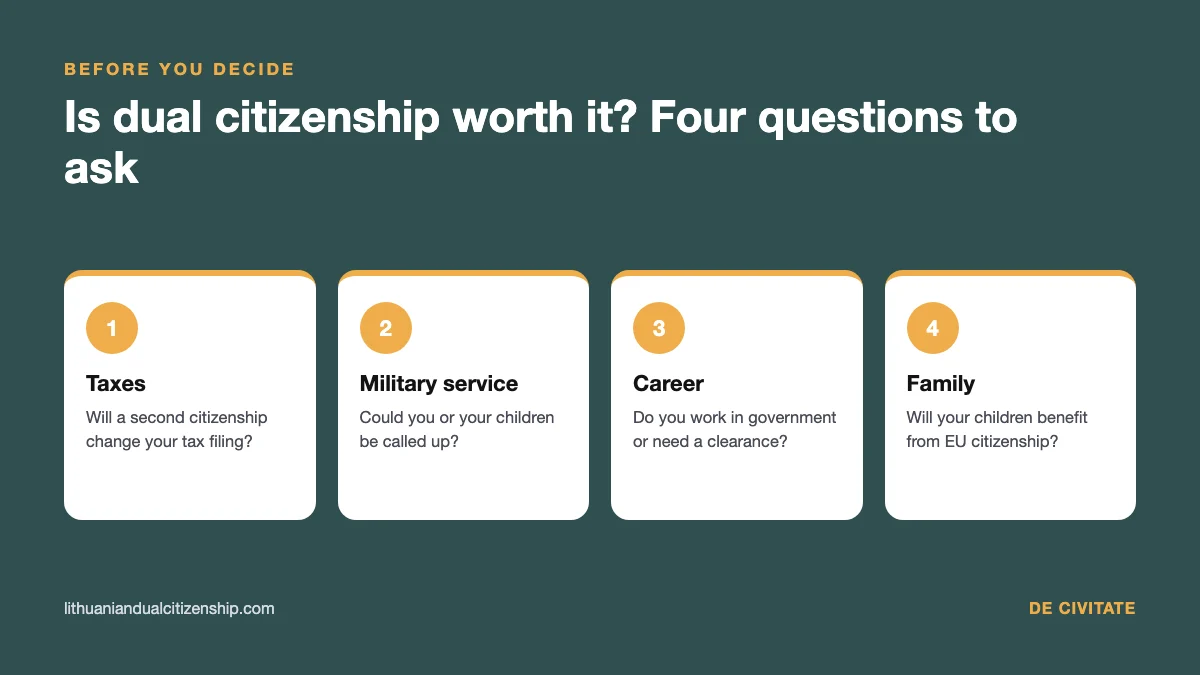
Is the game really worth the candle? This is the main question you must find the answer to even before you hand all your documents over to a lawyer. You must work through this issue alone with yourself in as much detail as possible, considering all the pros and cons.
Who benefits the most
For international entrepreneurs, travel enthusiasts, and people from politically unstable regions, the answer is unequivocal: yes. Freedom of movement and a second legal home in the EU often outweigh the bureaucratic effort.
When dual nationality may not be the best choice
If you are building a career in government or if a second passport entails catastrophic tax consequences, it might be better to limit yourself to a regular permanent residence permit and not complicate your life. This is one of the few scenarios where dual citizenship can cause certain troubles on a personal level.
Final Verdict: Pros and Cons of Dual Citizenship
Remember, a second passport is not a magic wand. It is a powerful tool that opens up many opportunities in a constantly changing world. It can destroy borders, provide a “backup airfield,” and insure the future of your children and even grandchildren. But this tool requires high responsibility and competent planning.
Evaluate all the risks! Know that legal repatriation by right of blood always remains the safest path to a European passport. If you have historical Lithuanian roots, you have no right to lose this unique opportunity. For those who have clearly set a course for obtaining an EU passport, we have collected a lot of useful information on the website https://lithuaniandualcitizenship.com/. In addition, you can check your chances for the right to be called a Lithuanian for free. Our lawyers will help you go through this difficult path and bypass bureaucratic obstacles along the way.
FAQ
What are the main advantages of dual citizenship?
Freedom of movement, the right to work, study and do business in the EU, and a status your children can inherit.
What are the main disadvantages?
You follow the laws of two countries; U.S. citizens keep filing U.S. taxes, and military service obligations may apply in the second country.
Who should think twice about dual citizenship?
People building government careers or those for whom a second citizenship would cause serious tax consequences.
Find out if you qualify — free
Send us your family details and a Lithuanian citizenship specialist will review your case and explain your options.
Start free eligibility check