Lithuanian citizenship by descent can become considerably more complex when an ancestor came from the Klaipėda Region, historically known as the Memel Territory or Memelland. Unlike many other parts of present-day Lithuania, the region passed through different political and citizenship regimes during the first half of the twentieth century.
For descendants living in the United States, a family record stating that an ancestor was born in “Memel,” “East Prussia,” “Germany,” or the “Klaipėda Region” does not by itself establish whether that person was a Lithuanian citizen. The relevant question is usually not simply where the ancestor was born, but what citizenship status the ancestor actually held during the legally relevant period.
Lithuania generally connects restoration claims to an ancestor who possessed citizenship of the Republic of Lithuania before June 15, 1940. The Lithuanian Embassy in the United States explains that an ancestor must generally have been a Lithuanian citizen at some point between February 16, 1918 and June 15, 1940 for this type of restoration analysis.
For Klaipėda or Memel ancestors, determining that status may require reconstructing the political history of the region alongside the ancestor’s individual residence, citizenship choices, migration history, and surviving records.
In short
- The Klaipėda (Memel) Region had a different history from the rest of interwar Lithuania.
- Being born in Memel does not by itself prove that an ancestor was a Lithuanian citizen.
- Residents’ citizenship changed after the region came under Lithuanian control in 1923 and the 1924 Klaipėda Convention.
- In March 1939 the region was transferred to Germany, so records may come from more than one state.
- U.S. records calling the ancestor German need to be read in historical context.
Why Klaipėda and Memel Ancestry Requires a Separate Historical Analysis
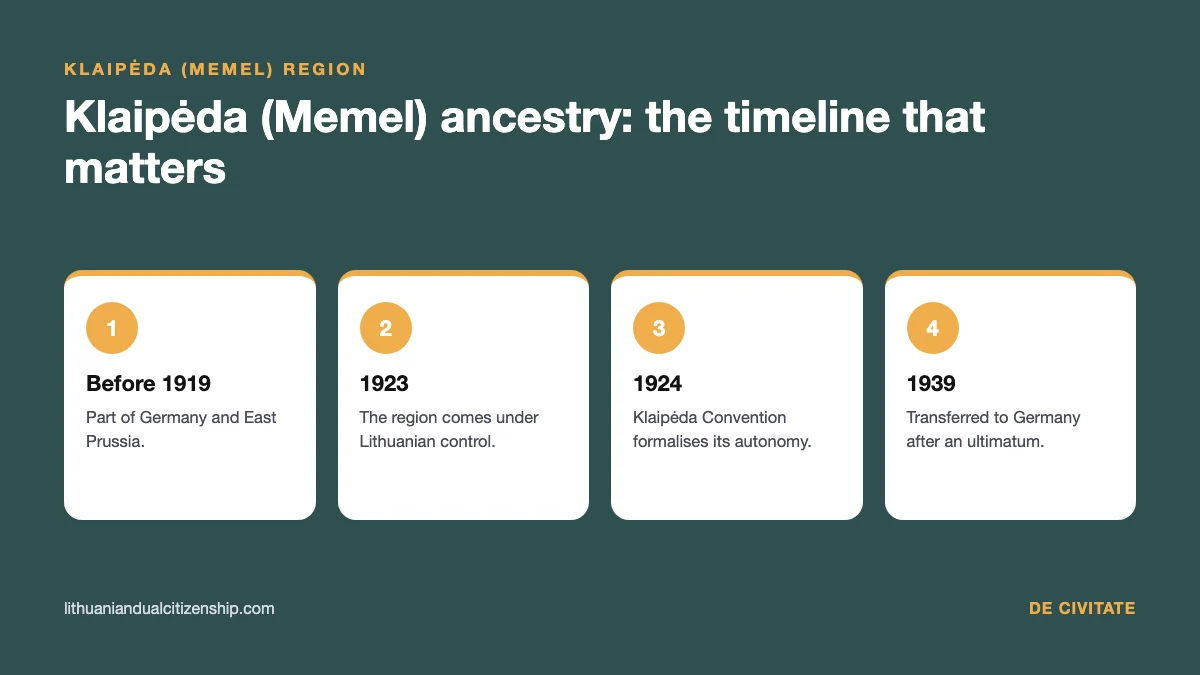
The Klaipėda Region followed a different historical path from most territory controlled by the interwar Republic of Lithuania. Before World War I, the area formed part of Germany and East Prussia. After the war, it was separated from Germany and eventually incorporated into Lithuania as an autonomous territory.
The region came under Lithuanian control in 1923, while its autonomous position within Lithuania was formalized through the Klaipėda Convention in 1924. The arrangement affected not only territorial administration but also the citizenship status of people living there.
This history creates an important distinction for descendants. Being born in a location that is now within Lithuania does not necessarily mean that an ancestor was born a citizen of the Republic of Lithuania. A person born in Memel while the territory was German may originally have held German citizenship and only later have acquired Lithuanian citizenship under the arrangements governing the Klaipėda Region.
Consequently, Lithuanian citizenship through Klaipėda ancestors is usually a question of documented citizenship history rather than modern geography alone.
| Period | Status of the region | What it means for records |
|---|---|---|
| Before World War I | Part of Germany (East Prussia) | Birth records may say Germany or East Prussia |
| After World War I | Separated from Germany | Transitional administrative records |
| 1923 | Came under Lithuanian control | Residents’ citizenship status changed |
| 1924 | Autonomy formalised by the Klaipėda Convention | Lithuanian records of the interwar period |
| March 1939 | Transferred to Germany after an ultimatum | Later German documentation may appear |
Memel Territory and Lithuanian Citizenship in the Interwar Period
The citizenship position of residents changed after the Klaipėda Region became associated with Lithuania. Under the international arrangements governing the territory, certain former German citizens resident in the region acquired Lithuanian citizenship, while mechanisms also existed through which eligible residents could opt for German citizenship. Historical sources therefore distinguish between residence in the region and the particular citizenship status an individual ultimately held.
This distinction can be decisive for descendants researching Lithuanian citizenship by descent Memel cases.
Two people who lived in the same village could have different citizenship histories. One might have become a Lithuanian citizen and retained that status during the relevant period. Another might have exercised an option connected with German citizenship or otherwise had a different legal position.
The ancestor’s actual status therefore needs to be established individually.
Why “Born in Memel” Is Not Enough to Establish Lithuanian Citizenship
American genealogical documents frequently simplify historical geography. Passenger manifests, naturalization files, census records, draft registrations, death certificates, and other documents may identify an ancestor’s birthplace using whichever country or political designation was familiar when the record was created.
The same person might consequently appear as born in Memel, Germany, East Prussia, Lithuania, or another geographic designation across different documents.
Those labels are useful clues, but they are not necessarily proof that the person held Lithuanian citizenship.
A citizenship assessment generally needs to distinguish among three separate questions: where the ancestor was born, where the ancestor resided during the interwar period, and what citizenship the ancestor actually possessed.
This is particularly important for Klaipėda region Lithuanian ancestry because territorial sovereignty changed while many families remained in the same physical location.
The Ancestor’s Residence During the 1920s and 1930s May Matter
Residence can be important when reconstructing Memel Territory Lithuanian citizenship.
Because the region had previously belonged to Germany, historical rules concerning the transfer of the territory addressed the citizenship of residents. The circumstances of particular individuals could therefore depend on factors such as their age, residence in the territory during the relevant period, and whether they exercised a citizenship option.
For descendants, the practical question is often whether surviving records can connect the ancestor to the Klaipėda Region during the period when Lithuanian citizenship could have been acquired or recognized.
A birth record from the nineteenth century may establish identity and family origin, but additional documents may be necessary to establish citizenship during the interwar Republic of Lithuania.
Documents That May Help Reconstruct a Klaipėda Ancestor’s Status
No single document necessarily resolves every Klaipėda ancestor Lithuanian citizenship case. The available evidence often needs to be considered together.
Potentially relevant records can include Lithuanian passports or identity documents, residence records, municipal records, citizenship records, population registers, internal passport materials, military records, archival files, church and civil records, and documentation concerning migration or citizenship choices.
Lithuanian archive records can be especially important where a family no longer possesses original passports or citizenship documents. The Lithuanian Central State Archives holds records created by institutions of the Republic of Lithuania between 1918 and 1940 as well as records from institutions operating in the Klaipėda Region.
For some families, the central problem is therefore not proving that the ancestor existed or lived in Memel, but identifying documentation that establishes what happened to that ancestor’s citizenship after the region’s political status changed.
How to Prove Lithuanian Citizenship Before 1940 Without an Old Passport
Families often assume that the absence of an ancestor’s Lithuanian passport ends the inquiry. In practice, historical citizenship may sometimes be reconstructed through several independent records rather than one surviving passport.
When considering how to prove Lithuanian citizenship before 1940 without an old passport, the focus should be on documents capable of showing the ancestor’s legal connection to the Republic of Lithuania during the relevant period.
For a Klaipėda or Memel ancestor, a useful documentary chain may need to demonstrate identity, residence, family relationships, and citizenship status separately. A residence record, for example, may establish that the person lived in the Klaipėda Region, while another document may be needed to demonstrate that the person acquired or retained Lithuanian citizenship.
The strength of the evidence therefore depends on how the documents work together, not merely on the number of records collected.
Place Names Can Complicate Klaipėda Ancestry Research
Historical place names are a common source of confusion.
A U.S. document may refer to “Memel,” while a later Lithuanian document refers to “Klaipėda.” Smaller towns and villages may also appear under German and Lithuanian versions of their names.
As a result, different dates of birth or place names across records do not automatically mean that the records concern different individuals. They do, however, need to be reconciled sufficiently to establish a reliable documentary chain.
This can be especially important where a U.S. record uses “Germany” as the country of birth while Lithuanian archival material uses Klaipėda or another Lithuanian geographic designation.
Historical geography should therefore be evaluated together with names, dates, relatives, occupations, addresses, and other identifying details.
Name Variations Are Common in Memel Family Records
Families from the Klaipėda Region may appear in German, Lithuanian, or other linguistic forms depending on when and where a document was created.
Name changes in Lithuanian, Polish, Russian, and Yiddish citizenship records are already a frequent issue in citizenship-by-descent research generally, and Klaipėda families can present additional German-language variations.
A surname may have been Lithuanianized, Germanized, shortened after immigration, or spelled differently by U.S. officials. Given names can also vary significantly between European records and later American documents.
The relevant issue is normally whether the documentary evidence can demonstrate that the different versions identify the same person and preserve an identifiable lineage between the ancestor and the present-day applicant.
U.S. Naturalization Records Can Be Important for Memel Descendants
For American families, U.S. naturalization records may help establish when an ancestor arrived in the United States, what nationality or former nationality was reported, where the ancestor was born, and when another citizenship may have been acquired.
These records should not automatically be treated as conclusive evidence of the ancestor’s earlier Lithuanian status. Nevertheless, they can provide valuable chronological evidence when compared with Lithuanian and Klaipėda regional records.
For example, a naturalization petition identifying an ancestor as German may need to be read in its historical context rather than interpreted solely according to today’s borders. Conversely, a U.S. document describing someone as Lithuanian does not by itself prove that the individual formally possessed citizenship of the interwar Republic of Lithuania.
The objective is to reconstruct citizenship history from the complete record.
The 1939 Transfer of the Klaipėda Region Can Affect the Documentary Trail
The political status of the Klaipėda Region changed again shortly before World War II. In March 1939, Lithuania transferred the territory to Germany following a German ultimatum. Historical archival material concerning the region records subsequent changes in the citizenship position of its inhabitants.
For descendants, this means that a Klaipėda ancestor may have records associated with more than one state within a relatively short period.
The existence of later German documentation does not necessarily answer whether the ancestor had previously possessed Lithuanian citizenship. The chronology needs to be reconstructed carefully: when Lithuanian citizenship was acquired or recognized, what happened afterward, when the person emigrated, and what other citizenship status followed.
This is one reason Klaipėda region citizenship history can matter directly to a modern citizenship-by-descent analysis.
Emigration Date Should Be Examined Together With Citizenship History
The date an ancestor left the Klaipėda Region can be highly relevant to understanding the documentary record.
An ancestor who left while the territory was still associated with Germany presents a different historical scenario from someone who lived there during the period of Lithuanian administration. Likewise, a person who remained in the region into the late 1930s may have experienced several successive citizenship regimes without moving far geographically.
The ancestor’s migration timeline should therefore be reconstructed using both European and American records.
Passenger records, U.S. immigration files, naturalization records, censuses, and Lithuanian archival documents can collectively establish a timeline. That timeline can then be compared with the historical status of the territory.
Proving the Family Line From the Memel Ancestor
Even where the ancestor’s Lithuanian citizenship can be demonstrated, the applicant must still establish the family relationship connecting that person to the present generation.
The documentary chain commonly consists of birth, marriage, and other civil-status records for successive generations.
Variations between documents can complicate this process. A surname may change after immigration, a woman may appear under a married surname, a village may have different German and Lithuanian names, or an American record may contain an approximate date of birth.
The goal is to create a coherent evidentiary chain in which the identities and family relationships can be followed from one generation to the next.
Why Relatives With the Same Memel Ancestor Can Receive Different Decisions
Having the same ancestor does not necessarily mean that every descendant has an identical citizenship case.
One sibling or cousin may possess a complete set of documents linking each generation, while another may have discrepancies in birth certificates, marriage records, names, dates, or parentage. Their citizenship histories may also differ if the relevant legal analysis depends on circumstances specific to each applicant.
The authorities may therefore evaluate the documentary basis presented in each case individually.
An earlier favorable decision involving a sibling or another relative can be relevant background, but it should not be treated as an automatic guarantee that another family member will receive the same result.
This is particularly important in historically complex Memel ancestor Lithuanian citizenship cases, where proving the ancestor’s status is only one part of the overall evidentiary chain.
What to Check Before Evaluating a Klaipėda or Memel Ancestry Case
A useful starting point is to reconstruct the ancestor’s history chronologically rather than beginning with the assumption that present-day geography determines citizenship.
First, establish exactly where the ancestor lived and identify both the historical and modern names of that location. Next, determine whether the ancestor remained in the Klaipėda Region during the period when it formed part of Lithuania. Then look for records capable of showing citizenship or legal status rather than relying only on birthplace.
The family should also identify the date of emigration, subsequent residence, U.S. naturalization history, and any evidence of German or another citizenship.
Finally, the documentary chain between the ancestor and the present-day descendant should be checked for missing generations, unexplained surname changes, conflicting birth dates, and inconsistent place names.
When these elements are considered together, it becomes easier to identify whether the principal problem is citizenship history, lineage, missing records, or contradictions between sources.
Frequently Asked Questions
Can descendants of someone from the Klaipėda or Memel Region qualify for Lithuanian citizenship by descent?
They may, depending on the ancestor’s actual citizenship history and the applicable legal basis. Modern Lithuanian territory alone is not sufficient to establish historical citizenship. For a Klaipėda or Memel ancestor, it may be necessary to determine whether the person acquired or possessed citizenship of the Republic of Lithuania during the relevant period and whether the family relationship to the descendant can be documented.
Does a birth certificate from Memel prove that my ancestor was a Lithuanian citizen?
Not necessarily. A birth certificate generally proves birth and parentage rather than automatically proving citizenship. Because the Klaipėda Region was under different political authorities at different times, the date of birth and later citizenship history should be considered separately. Additional records may be needed to establish whether the ancestor became or was recognized as a Lithuanian citizen.
What if U.S. records say my Klaipėda ancestor was German?
A German designation in U.S. records does not necessarily resolve the citizenship question by itself. The description may reflect the ancestor’s birthplace, former nationality, the political status of the region at a particular time, or the terminology used by American officials. The record should be compared with the ancestor’s residence, emigration timeline, Lithuanian or Klaipėda regional documents, and other citizenship evidence.
Can two siblings with the same Memel ancestor receive different citizenship decisions?
Yes, different outcomes can occur because each applicant’s documentary record and individual circumstances may differ. One sibling may have stronger evidence of lineage or fewer discrepancies in names, dates, and civil-status records. A favorable decision for one family member can be useful background but does not automatically guarantee the same decision for another applicant.
Can archival documents be used if the family no longer has the ancestor’s Lithuanian passport?
Potentially. Historical citizenship may sometimes be demonstrated through archival and official records even when the original passport is unavailable. For Klaipėda ancestors, records concerning residence, identity, citizenship, population registration, or other official matters may help reconstruct the ancestor’s legal status. The usefulness of a document depends on what it proves and how it fits with the rest of the evidence.
Why can the same ancestor be described as German, Lithuanian, East Prussian, and Memellander?
These descriptions can reflect different periods, geographic conventions, political borders, languages, or forms of identity. The Klaipėda Region changed political status several times during the twentieth century, while many residents remained in the same location. Citizenship analysis therefore requires a chronological review rather than assuming that every geographic or ethnic label describes formal nationality.
Find out if you qualify — free
Send us your family details and a Lithuanian citizenship specialist will review your case and explain your options.
Start free eligibility check