For Americans researching Lithuanian citizenship through an ancestor, the difficult part is often not identifying a Lithuanian relative but reconstructing what happened after that person arrived in the United States. Immigration files, naturalization records, alien registration forms, and other federal records may contain dates, birthplaces, citizenship information, alternate names, and references to earlier documents.
The USCIS Genealogy Program provides access to several historical record series maintained by U.S. Citizenship and Immigration Services and its predecessor agencies. Depending on when a Lithuanian ancestor immigrated or naturalized, these records may help establish a clearer timeline between departure from Lithuania, arrival in the United States, and acquisition of U.S. citizenship.
USCIS genealogy records should normally be treated as part of a broader documentary investigation rather than as automatic proof of eligibility for Lithuanian citizenship. The significance of a particular U.S. record depends on what it says, how it relates to Lithuanian records, and the legal basis under which citizenship restoration or another citizenship procedure is being considered.
In short
- The USCIS Genealogy Program gives access to historical immigration and naturalization records.
- Main series: C-Files, Alien Registration Forms (AR-2), Visa Files, Registry Files and certain early A-Files.
- Without a file number, use the G-1041 index search; with it, request the record on Form G-1041A.
- USCIS genealogy copies are not certified — check what form of document the Lithuanian procedure needs.
- These records build the U.S. timeline; they do not prove Lithuanian citizenship by themselves.
What Is the USCIS Genealogy Program?
The USCIS Genealogy Program is designed for researchers seeking historical immigration and naturalization records relating to deceased immigrants. Its historical holdings include five principal record series: Naturalization Certificate Files, Alien Registration Forms, Visa Files, Registry Files, and certain early Alien Files.
For Lithuanian citizenship research, these files can be relevant because a U.S. immigration record may preserve information that is difficult to locate elsewhere. A document may identify an ancestor’s original nationality, place of birth, date of entry into the United States, naturalization history, or name used at the time of immigration.
This can be particularly useful when family documents are incomplete or when different records describe the same ancestor in different ways.
Why USCIS Records Can Matter for Lithuanian Citizenship Research
Lithuanian citizenship cases based on ancestry often require applicants to reconstruct a historical family line across two countries. Evidence may need to show who the ancestor was, the connection between generations, the ancestor’s historical ties to Lithuania, and important events in the ancestor’s later citizenship history.
For descendants living in the United States, U.S. naturalization records can therefore become an important part of the research process. A naturalization file may help determine whether an ancestor became a U.S. citizen and when that event occurred.
The date can be particularly significant from a research perspective because citizenship analysis frequently depends on chronology. Researchers may need to compare an ancestor’s Lithuanian status, emigration history, U.S. immigration history, and later naturalization rather than relying on a single document.
USCIS records do not themselves decide whether someone qualifies for Lithuanian citizenship. The Lithuanian Migration Department evaluates documents relating to restoration and other citizenship procedures, and the outcome depends on the applicable legal basis and the evidence submitted in the individual case.
Which USCIS Genealogy Records May Be Useful?
Different ancestors can appear in different USCIS record series depending on when they entered the United States and what occurred after their arrival. The historical period is therefore one of the first factors to check.
Naturalization Certificate Files (C-Files)
Naturalization Certificate Files, commonly called C-Files, cover naturalization and related citizenship records from September 27, 1906, through March 31, 1956. USCIS states that standard C-Files generally contain at least an application document and a duplicate certificate of naturalization or citizenship, while some files contain additional correspondence or supporting material.
For descendants of Lithuanian immigrants, USCIS C-files naturalization records may help identify the date and court of naturalization, the immigrant’s declared birthplace, name variations, arrival information, and other biographical details.
C-Files are especially relevant when a family knows that an ancestor naturalized in the United States but no longer has the original certificate or court documents.
Alien Registration Forms (AR-2)
Alien Registration Forms were created for many noncitizens residing in or entering the United States during the early 1940s. USCIS describes these records as containing extensive biographical information, potentially including name, other names used, date and place of birth, citizenship, arrival information, occupation, and whether citizenship papers had been filed.
For Lithuanian citizenship research, USCIS alien registration records may help connect an ancestor’s U.S. identity with earlier European records, particularly where names or place names changed after immigration.
They can also provide clues about whether naturalization proceedings had already begun.
Visa Files
USCIS Genealogy Program Visa Files cover the period from July 1, 1924, through March 31, 1944.
These records can be relevant for Lithuanian immigrants who entered the United States during that period. Depending on the file, researchers may find identity and immigration information that helps confirm an ancestor’s origins or reconstruct the circumstances of entry.
A Visa File is not necessarily proof of Lithuanian citizenship, but information inside it may help identify additional records in Lithuania or the United States.
Registry Files
Registry Files available through the Genealogy Program cover records from March 1929 through March 31, 1944.
These files concern immigrants whose U.S. immigration status was recorded through historical registry procedures. They may contain biographical or immigration information useful for tracing a person whose earlier entry documentation is incomplete.
Their value for citizenship research depends on the individual file and the historical circumstances of the ancestor.
Historical A-Files
Alien Files, usually called A-Files, became the principal individual immigration case files created or consolidated by immigration authorities beginning in 1944. The USCIS Genealogy Program covers certain early A-Files, while other A-Files may instead be held by USCIS under different access procedures or transferred to the National Archives.
USCIS genealogy A-files can be particularly valuable because an individual file may include several types of documents accumulated over time, potentially including visa materials, photographs, affidavits, correspondence, and immigration records.
For a Lithuanian ancestor, those materials may help researchers compare identity information across multiple stages of immigration history.
| Record series | Most useful for |
|---|---|
| Naturalization Certificate Files (C-Files) | When and how the ancestor became a U.S. citizen |
| Alien Registration Forms (AR-2) | Identity and residence details of non-citizens |
| Visa Files | Immigration and identity information |
| Registry Files | Records of immigrants registered after arrival |
| Historical A-Files | Detailed immigration case files |
What Information Can These Records Reveal?
The usefulness of USCIS ancestor immigration records is not limited to proving that someone entered or lived in the United States. They can help solve several common research problems.
One is chronology. A record may help establish when an ancestor arrived, whether the person remained a noncitizen for a period, and when naturalization occurred.
Another is identity. Lithuanian immigrants may appear under altered spellings, Anglicized first names, shortened surnames, or place names reflecting the political geography of the period. Researchers may therefore need to compare name changes in Lithuanian, Polish, Russian, and Yiddish records rather than assuming that every document will contain identical information.
Birthplace descriptions can also vary. Historical American records may describe locations according to the state or empire controlling the territory at the time. As a result, researchers sometimes encounter situations where U.S. records list the birthplace as Russia, Poland, or Kovno even though the family’s historical connection is to present-day Lithuania.
These discrepancies do not automatically resolve or defeat a citizenship claim. They indicate that the documentary record needs to be interpreted in historical context.
USCIS Genealogy Index Search vs. Record Request
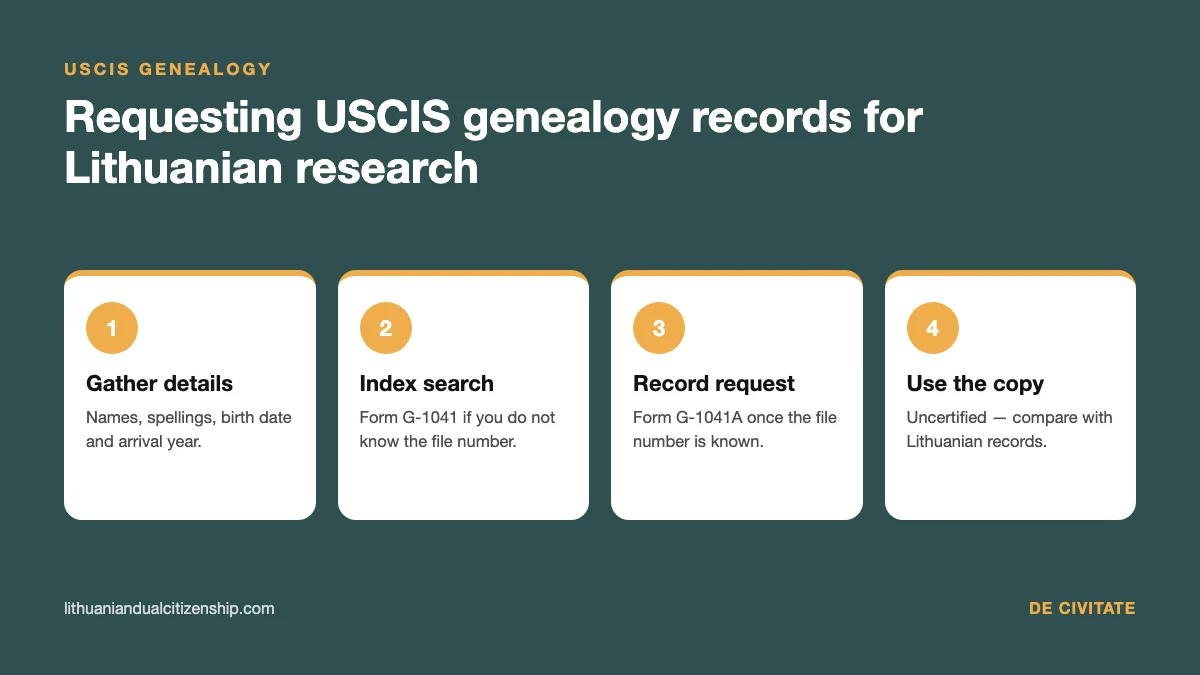
The USCIS Genealogy Program distinguishes between searching its historical indexes and requesting a copy of an identified file.
A USCIS genealogy index search is relevant when the researcher does not already know the correct historical file number. Form G-1041 is used to search USCIS historical databases to determine whether records exist and, when records are located, identify the applicable file number or other record identifier.
If the correct file number is already known, a researcher may use Form G-1041A to request the historical record itself. USCIS states that a valid file number and identification of the immigrant are required for a records request.
This distinction is important. Searching for the ancestor and obtaining the actual historical file are separate stages when the file identifier is not already available.
What Information Should You Gather Before an Index Search?
A USCIS genealogy search is more likely to identify the correct person when the researcher begins with as much biographical information as possible.
Useful starting information can include the ancestor’s full name, alternate spellings, date or approximate year of birth, place of birth, date of immigration, residence in the United States, and names of close relatives.
This is particularly important with common surnames. A “no record” result can sometimes occur when there is not enough information to distinguish one immigrant from others with similar names.
Before searching USCIS databases, it can therefore be useful to assemble census records, passenger records, family certificates, obituaries, court naturalization references, and Lithuanian archive records already found during the research process.
The objective is to establish a consistent identity profile for the ancestor before relying on a federal index search.
How Naturalization Records Fit Into Lithuanian Citizenship Research
Among the USCIS record series, naturalization documentation is often one of the most relevant for descendants researching citizenship.
A C-File may contain a petition, declaration, certificate copy, or other documentation showing when U.S. citizenship was acquired. Beginning April 1, 1956, naturalization documentation was generally incorporated into the individual’s A-File rather than the earlier C-File system.
The important point is not simply whether an ancestor naturalized. Researchers usually need to understand the sequence of events.
For example, USCIS naturalization records genealogy research may help establish whether naturalization occurred before or after another historically important event in the ancestor’s life. That timeline can then be compared with Lithuanian records and the legal criteria applicable to the citizenship procedure being examined.
A separate analysis of how U.S. naturalization records affect Lithuanian citizenship by descent may therefore be necessary after the documents have been located.
Can USCIS Records Prove Lithuanian Citizenship Before 1940?
Usually, a U.S. immigration or naturalization file should not be treated as a substitute for Lithuanian governmental records establishing historical Lithuanian citizenship.
A USCIS record may nevertheless contain useful supporting information. It might identify the person as Lithuanian, provide a Lithuanian birthplace, document an earlier nationality, or contain details that allow researchers to locate records in Lithuanian archives.
The evidentiary value depends on the document and the issue being established.
Where an ancestor’s original Lithuanian passport has been lost, researchers may need to build proof of Lithuanian citizenship before 1940 from several documentary sources rather than expecting one American record to establish the entire case.
USCIS records can be part of that reconstruction, but they should be assessed alongside Lithuanian archival material, civil records, internal passport records, military records, and other available historical evidence.
What If the Ancestor’s Name or Birthplace Is Different?
Discrepancies are common in cross-border genealogy.
An immigrant may have used a Lithuanian surname in Europe and a modified spelling in the United States. A birthplace may appear under a village name in one record and a broader province, city, empire, or later country name in another. Dates may also differ because of transcription errors, calendar conventions, estimates, or information supplied by the immigrant.
These differences should be documented rather than silently standardized.
A useful research approach is to create a chronological record showing every version of the ancestor’s name, birthplace, birth date, immigration date, and citizenship information together with the source in which each version appears.
That makes it easier to determine whether apparently inconsistent records concern the same person and what additional evidence may be needed to connect them.
Are USCIS Genealogy Copies Ready for a Citizenship Filing?
Not necessarily.
The current instructions for Form G-1041A state that the Genealogy Program provides historical record copies but does not provide certified copies of USCIS historical records.
This distinction matters when researching USCIS genealogy records for citizenship by descent. A photocopy can be highly useful for identifying facts, file numbers, courts, dates, relatives, and other records. However, the form in which evidence must ultimately be presented to Lithuanian authorities is a separate question.
Researchers should therefore distinguish between a document used to discover evidence and a document that satisfies formal evidentiary requirements in a citizenship proceeding.
When USCIS Genealogy Is Not the Right Record Source
The Genealogy Program does not contain every U.S. immigration or naturalization record.
For naturalizations before September 27, 1906, researchers may need to consult federal, state, or local court records because the centralized federal C-File system had not yet been established.
Some A-Files have also been transferred to the National Archives, while later records may fall under USCIS FOIA procedures rather than the historical Genealogy Program.
The correct source therefore depends on the ancestor’s birth year, immigration period, naturalization date, and known file numbers.
For Lithuanian families with several generations in the United States, research may involve USCIS, the National Archives, federal or state courts, Lithuanian archives, and family-held documents rather than one database.
How to Use USCIS Records in a Broader Research Strategy
The most effective approach is to treat USCIS records as one layer in a chain of evidence.
Start by identifying the ancestor as precisely as possible. Establish the family relationship through birth, marriage, and other civil records. Then reconstruct the ancestor’s Lithuanian history, emigration, arrival in the United States, residence, and naturalization chronology.
USCIS records can then be used to fill gaps or confirm events in that timeline.
If an American record identifies a village, former surname, parent, immigration date, or naturalization court, that information may point researchers toward another source. Conversely, Lithuanian records can provide identity details that make a USCIS genealogy search more precise.
The goal is not to collect the largest possible number of records. It is to build a coherent documentary history showing that records from different jurisdictions concern the same ancestor and the same family line.
Frequently Asked Questions
What is the USCIS Genealogy Program?
The USCIS Genealogy Program provides access to certain historical immigration and naturalization records held by USCIS and its predecessor agencies. Its principal historical series include C-Files, Alien Registration Forms, Visa Files, Registry Files, and certain early A-Files. These records can help descendants reconstruct an ancestor’s immigration, identity, and naturalization history.
Which USCIS record is most useful for Lithuanian citizenship research?
There is no single record that is best in every case. A C-File may be particularly useful when the key issue is U.S. naturalization, while an Alien Registration Form, Visa File, or A-File may provide valuable identity and immigration information. The most relevant record depends on when the ancestor immigrated, whether and when naturalization occurred, and what information is missing from the existing evidence.
Do I need a USCIS file number before requesting a genealogy record?
A record request generally requires the appropriate historical file number. If the number is unknown, USCIS provides the G-1041 Index Search process to search its historical databases and identify possible record numbers. Once the relevant file number is known, Form G-1041A is used to request a copy of the historical record.
Can a USCIS naturalization file prove eligibility for Lithuanian citizenship?
A USCIS naturalization file can provide important evidence about an ancestor’s U.S. citizenship history, but it does not by itself determine eligibility for Lithuanian citizenship. Eligibility depends on the applicable Lithuanian citizenship rules and the complete documentary record. USCIS evidence may therefore need to be evaluated together with Lithuanian archival and civil records.
What if USCIS cannot find a record for my ancestor?
A “no record” search result does not necessarily mean that no immigration or naturalization evidence exists anywhere. Searches can fail when a common name or insufficient identifying information prevents the correct person from being distinguished. Records may also be held by another institution, such as the National Archives or a court, depending on the period and record type.
Does USCIS provide certified genealogy records for use in Lithuania?
The USCIS Genealogy Program does not provide certified copies of historical records. The copies can still be useful for research and for identifying additional evidence, but researchers should separately determine what form of documentation is required for the Lithuanian citizenship procedure involved.
Find out if you qualify — free
Send us your family details and a Lithuanian citizenship specialist will review your case and explain your options.
Start free eligibility check