
Lithuanian immigrant passenger lists are valuable historical records for Americans researching their family origins and possible eligibility for Lithuanian citizenship by descent. These documents can reveal when an ancestor arrived in the United States, where they previously lived, which relatives they traveled with, and sometimes their exact birthplace.
For descendants of Lithuanian immigrants, passenger manifests can provide the starting point for reconstructing a family history across several generations. They may also help identify records in Lithuania that are relevant to citizenship restoration.
However, finding an ancestor on a ship manifest does not automatically establish Lithuanian citizenship eligibility. Immigration records generally document travel, identity, and geographic origins rather than conclusively proving citizenship under Lithuanian law.
This guide explains where to find Lithuanian ship passenger lists, how to interpret historical immigration records, what to do when names or birthplaces are inconsistent, and how these documents may support Lithuanian ancestry research.
In short
- Passenger lists show when an ancestor arrived, where they lived before, and who they travelled with.
- Search Ellis Island collections, the U.S. National Archives and FamilySearch; check original images.
- Manifests may list Russia or Poland because of the borders and terminology of the time.
- Arrival in the U.S. does not always show when the ancestor first left Lithuania.
- Passenger lists support identity and migration but do not prove Lithuanian citizenship before 1940.
Why Passenger Lists Matter for Lithuanian Ancestry Research
Passenger lists are among the most useful sources for tracing Lithuanian families who immigrated to the United States during the nineteenth and twentieth centuries. They can connect information preserved in American family records with locations, relatives, and historical events in Europe.
Many Lithuanian immigrants arrived during periods when Lithuania was governed by different political authorities. Consequently, records may describe a person’s birthplace or nationality using terminology that differs from modern geographic boundaries.
A ship manifest may identify an immigrant as coming from Russia, Poland, or another historical jurisdiction even when the person’s hometown is located in present-day Lithuania.
This is especially important when researching Lithuanian immigration records USA collections, where indexing practices often reflect historical documents rather than modern national identities.
Passenger records can help researchers establish three essential facts: the immigrant’s identity, their migration history, and their connection to a particular location or family.
These findings can provide useful leads when examining whether an ancestor held Lithuanian citizenship before June 15, 1940, a central consideration in many Lithuanian citizenship restoration cases.
What Information Can Lithuanian Ship Passenger Lists Reveal?
The information recorded on a ship manifest depends on the year of arrival, immigration procedures, and the completeness of the surviving document.
Earlier passenger lists may contain little more than a name, approximate age, ship, and destination. Later manifests often provide significantly more detailed personal information.
Names, Ages, and Family Relationships
Passenger lists commonly identify immigrants by their recorded names, ages, sex, marital status, and sometimes occupation.
When several relatives traveled together, their entries may appear consecutively. This can help identify parents, children, siblings, or spouses who were previously unknown to later generations.
However, adjacent entries do not necessarily establish a legal family relationship. Researchers should compare the information with birth certificates, marriage records, and other independent sources.
Birthplace, Nationality, and Last Residence
One of the most useful features of later ship manifests is the distinction between birthplace, nationality, and last permanent residence.
These fields do not necessarily describe the same place or legal status.
An immigrant may have been born in a Lithuanian town, lived temporarily in another country, and traveled with documents issued by a different government.
For citizenship ancestry research, the precise birthplace and historical citizenship status are particularly important. A reference to Lithuania or a Lithuanian town can support genealogical research but does not independently prove citizenship of the Republic of Lithuania.
Arrival Dates, Ships, and Destination Addresses
Passenger manifests can also identify the vessel, arrival date, departure port, and intended destination in the United States.
Later records may identify relatives already living in America, including their names and addresses.
These details help distinguish immigrants with similar names and may reveal previously unknown family connections.
They can also lead to additional American sources, such as U.S. census records, naturalization files, city directories, and death certificates.
| Information | Can a manifest show it? |
|---|---|
| Arrival date and port | Yes |
| Last residence and relatives left behind | Often |
| Birthplace and nationality as recorded | Sometimes, in historical terms |
| When the ancestor first left Lithuania | Not always |
| Lithuanian citizenship before 1940 | No |
Where to Find Lithuanian Immigrant Passenger Lists
Several major American historical collections contain immigration and passenger arrival records. No single database includes every Lithuanian immigrant, so researchers may need to consult multiple collections.
The most productive approach is usually to begin with an approximate arrival period and work toward the original passenger manifest.
Ellis Island Passenger Records
Ellis Island is one of the best-known resources for researching immigrants who arrived through New York.
Its historical passenger records cover the Ellis Island operating period from 1892 to 1954, although the broader New York passenger arrival collections include records from other periods and immigration facilities.
For Lithuanian ancestors Ellis Island records may provide names, arrival dates, vessel information, and locations associated with the immigrant’s European residence.
Researchers can search by name and then examine the corresponding manifest.
An Ellis Island passenger lists search by name should include spelling variations because historical indexing may not reproduce the ancestor’s original surname accurately.
Importantly, not every Lithuanian immigrant entered through Ellis Island. Some arrived before its opening or entered through other American ports.
National Archives Passenger Arrival Records
The U.S. National Archives and Records Administration preserves federal passenger arrival records covering approximately 1820 through December 1982, with gaps and differences in coverage.
These collections include records from multiple ports rather than New York alone.
Researchers investigating Lithuanian immigration to America records should consider arrival locations such as Boston, Baltimore, Philadelphia, and other ports when a New York search produces no reliable match.
Many historical collections have been digitized through archival partnerships, while other records require additional research.
FamilySearch and Other Genealogy Databases
FamilySearch provides access to numerous genealogical collections, including indexed passenger arrival records and digitized historical documents.
Commercial genealogy platforms also maintain passenger databases, sometimes with alternative indexes or search functionality.
The original scanned manifest is more reliable than an automatically generated search-result summary because transcription errors can alter names, ages, and geographic information.
A useful research practice is to compare records across platforms while checking whether they reproduce the same underlying historical document.
How to Find Ancestors on Ship Passenger Lists
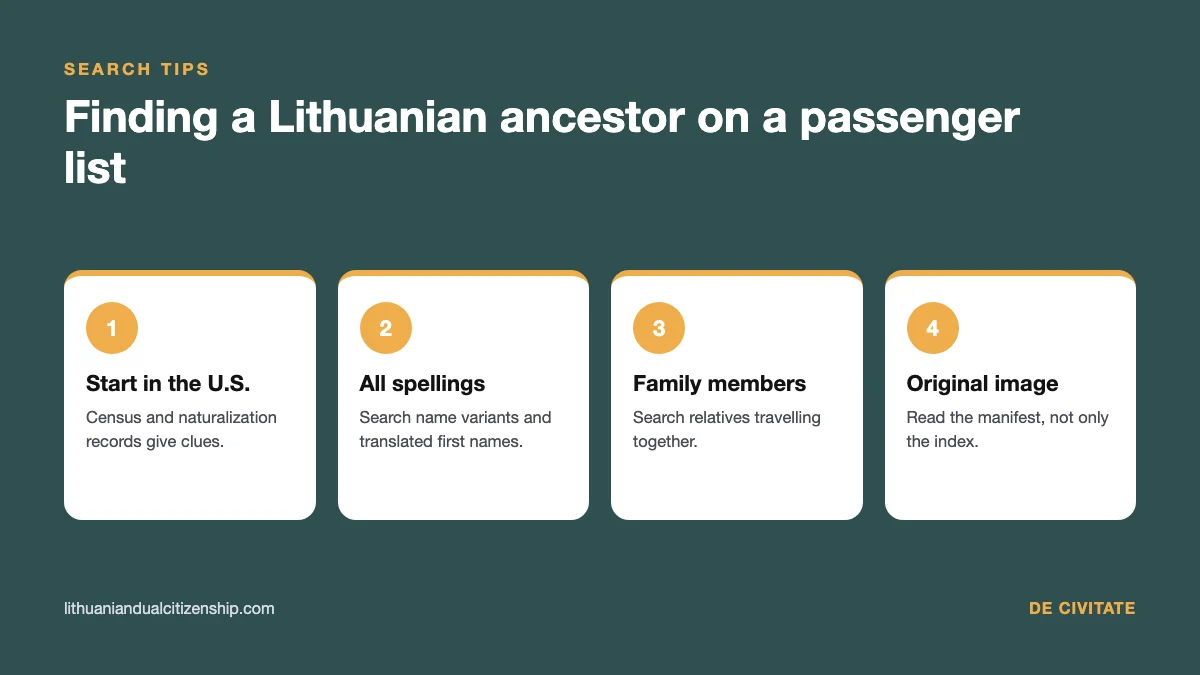
Researching Lithuanian immigration history is easier when the search begins with information already established through American family records.
A systematic process reduces the risk of identifying the wrong person, particularly when several immigrants shared common surnames.
Step 1: Establish the Ancestor’s Identity
Before searching passenger lists, collect the ancestor’s known personal information.
Useful starting details include:
-
Full name and known alternative spellings.
-
Approximate birth year.
-
Names of parents, spouses, or siblings.
-
Possible immigration year.
-
Known American places of residence.
-
Reported Lithuanian birthplace or ancestral town.
-
Information from existing family documents.
A precise immigration year is helpful but not essential.
American census records and naturalization documents may provide estimates that narrow the search period.
Step 2: Search Using Multiple Name Variations
Lithuanian surnames frequently appear in different forms across immigration documents.
Names could be adapted to Polish, Russian, German, English, or other linguistic conventions. Clerks sometimes wrote names phonetically, while later database transcriptions introduced additional variations.
For example, a Lithuanian surname ending in -as may appear in American records without that ending. Given names may also appear in translated or adapted forms.
When conducting an Ellis Island passenger lists search by name, begin with the most reliable spelling and expand the search gradually.
Search strategies may include surname-only queries, alternative given names, approximate birth years, and searches involving accompanying family members.
Avoid assuming that every spelling difference indicates a different individual.
Step 3: Examine the Original Ship Manifest
Once a potential match appears, inspect the original scanned document rather than relying entirely on its index entry.
When learning how to find ship manifests for immigrants, it is important to understand that a historical manifest may extend across multiple pages.
Later immigration forms often divided passenger information into separate sections. Birthplace, nationality, relatives, and intended destination may therefore appear on different pages of the same record.
Check the full entry and compare it with independent biographical information.
A matching name alone is rarely sufficient to establish identity.
Step 4: Verify the Passenger Against American Records
After identifying a likely manifest, compare its details with other documents.
U.S. census records can help confirm immigration periods, household composition, and places of residence.
Naturalization records may provide additional evidence about a person’s nationality, immigration history, or reported birthplace.
When asking how to find an ancestor’s immigration records, it is often more effective to reconstruct the person’s American life first and then connect those findings to a specific arrival document.
Step 5: Identify the Lithuanian Hometown
The ancestor’s town or village may be the most valuable information discovered in a passenger manifest.
A precise location can help direct research toward Lithuanian civil, church, archival, or historical citizenship records.
Record the place exactly as written before attempting to identify its modern equivalent.
Historical place names may have changed because of language, administrative boundaries, or political developments.
If the manifest identifies only a broad region, additional evidence may be necessary to establish the specific locality.
How to Find Birthplace on Ship Manifests
Finding the ancestor’s birthplace can be more challenging than identifying the passenger. Different immigration forms recorded geographic information differently, and some earlier records did not contain a dedicated birthplace field.
For arrivals in the early twentieth century, researchers should examine all available columns, including those identifying nationality, last residence, and place of birth.
These entries should be interpreted separately.
Historical Names for Lithuanian Towns
Lithuanian localities may appear under several historical names.
For example, Kaunas may appear as Kovno, Vilnius as Vilna, and Klaipėda as Memel. Other settlements may appear in Polish, Russian, German, or Yiddish forms.
A manifest may also identify Russia as an immigrant’s country of origin because Lithuania was part of the Russian Empire before its independence in 1918.
This does not necessarily mean the immigrant was ethnically Russian or born outside present-day Lithuania.
Conversely, a record stating that someone was born in Lithuania does not establish that they later became a citizen of the independent Lithuanian state.
When researching how to find birthplace on ship manifests, the most reliable approach is to compare historical place names with the relevant geographic boundaries and administrative records.
What if the Birthplace Is Missing or Incorrect?
Some passenger lists contain incomplete, inconsistent, or inaccurate birthplace information.
An immigrant may have reported their last residence instead of their birthplace. A clerk may have misunderstood a town name, or a later transcription may have introduced errors.
Researchers should preserve the original recorded information and investigate discrepancies through independent documents.
Potential corroborating sources include naturalization petitions, birth certificates, marriage records, death certificates, and Lithuanian archival records.
A discrepancy does not automatically invalidate the manifest, but it can reduce the document’s evidentiary value until the inconsistency is explained.
Can Passenger Lists Help Prove Lithuanian Citizenship by Descent?
Passenger lists can contribute to a citizenship ancestry research file, but their legal significance should not be overstated.
Lithuanian citizenship restoration generally requires evidence that the relevant ancestor held citizenship of the Republic of Lithuania before June 15, 1940, together with documentation establishing the applicant’s relationship to that ancestor.
Additional requirements depend on the applicable legal pathway, including circumstances relevant to retaining another nationality.
A ship manifest does not ordinarily constitute direct proof of historical Lithuanian citizenship.
Nevertheless, it may provide supporting information that helps researchers locate more decisive records.
Evidence of Lithuanian Origin Versus Citizenship
Lithuanian ancestry and historical Lithuanian citizenship are related but distinct concepts.
Someone may have been ethnically Lithuanian or born in a territory now belonging to Lithuania without having held citizenship of the Republic of Lithuania during the legally relevant period.
This distinction is particularly important for families whose ancestors emigrated before 1918.
Lithuania declared independence on February 16, 1918. An individual who had already emigrated may never have acquired citizenship of the independent Lithuanian state.
Passenger lists can help establish a departure or arrival timeline, but they must be assessed alongside other evidence of historical citizenship.
Why Immigration Dates Matter
An ancestor’s migration date may help establish whether the family left Lithuania before or after a legally relevant historical event.
For example, a passenger list showing arrival in the United States in 1926 may be useful when reconstructing an ancestor’s departure from Lithuania during the interwar period.
However, the American arrival date does not necessarily establish the date on which the ancestor actually left Lithuania. The person might have lived in another country before traveling to America.
The record must also be considered alongside evidence of the ancestor’s citizenship.
An arrival date alone cannot establish eligibility for Lithuanian citizenship restoration or determine whether an applicant qualifies for an exception allowing dual citizenship.
Combining Ship Manifests With Other Historical Records
A strong ancestry research file generally relies on several independent sources rather than a single immigration document.
The objective is to reconstruct an identifiable person, their family relationships, migration history, and any historical citizenship evidence relevant to the research.
U.S. Census Records
U.S. census records can help confirm where an immigrant lived after arriving in America.
Depending on the census year, they may include the person’s reported birthplace, immigration year, citizenship or naturalization status, occupation, and family composition.
Comparing a census entry with a passenger manifest may strengthen identification of the immigrant and reveal inconsistencies requiring further investigation.
However, census information was generally self-reported or provided by household members and may contain errors.
U.S. Naturalization Records
Naturalization records can be particularly helpful when examining an ancestor’s immigration history.
Depending on the document and period, a declaration of intention, petition for naturalization, or related immigration file may contain an arrival date, ship name, birthplace, former nationality, or information about family members.
These details can help locate a missing manifest or confirm an existing match.
The timing of U.S. naturalization may also be relevant when examining the ancestor’s citizenship history, although its legal implications depend on the applicable Lithuanian law and individual circumstances.
American naturalization does not, by itself, conclusively establish that the person previously held Lithuanian citizenship.
Lithuanian Archives and Civil Records
After establishing a likely Lithuanian hometown, researchers can investigate records preserved in Lithuania.
Historical sources may include internal passports, civil registration documents, military records, residence records, and other archival materials.
Depending on the record, these documents may establish identity, family relationships, residence, or citizenship.
Lithuanian state archives distinguish between records documenting historical citizenship and genealogical evidence such as birth and marriage records.
A passenger manifest identifying an ancestor’s hometown may therefore become a useful starting point for locating stronger documentary evidence.
Common Problems When Researching Lithuanian Immigration Records
Passenger manifest research is rarely straightforward for every family. Historical migrations, changing political borders, and inconsistent documentation can complicate identification.
Several problems are particularly common in Lithuanian ancestry research.
Different Spellings Across Historical Documents
An immigrant may appear under several names during their lifetime.
A Lithuanian birth record, ship manifest, American census entry, and naturalization certificate may use different spellings.
Differences may result from language conventions, transliteration, marriage, deliberate name changes, or clerical errors.
The goal is not to make every document contain identical spelling. Instead, researchers should establish a coherent identity through consistent dates, relatives, locations, and supporting records.
Where a citizenship-related submission relies on documents with different names, additional evidence connecting those identities may be necessary.
Missing or Unindexed Passenger Records
Failure to locate an ancestor in an online passenger index does not prove that the person never immigrated.
Potential explanations include inaccurate indexing, damaged records, incomplete collections, unexpected arrival ports, and travel under an unfamiliar name.
An ancestor might also have entered through Canada before moving to the United States.
Researchers should reconsider the estimated arrival date and consult other immigration collections before drawing conclusions.
Multiple Immigrants With Similar Names
Common names can produce several plausible passenger matches.
Selecting an individual solely because the name and age are similar creates a risk of connecting the wrong family to Lithuanian historical records.
More reliable identification requires several matching details, such as known relatives, destination addresses, birthplace, or subsequent naturalization information.
If the available evidence cannot distinguish between individuals, the identification should remain provisional.
How to Organize Passenger Records for Citizenship Ancestry Research
Preserving the original documents and their context makes later genealogical or legal research easier.
Each passenger record should be accompanied by the information needed to identify its source and explain its connection to the family.
A practical research file should include:
-
Original manifest image: Preserve all relevant pages, including headings and column labels.
-
Passenger identification: Record the name, approximate age, ship, arrival date, and port.
-
Geographic evidence: Note the recorded birthplace, last residence, and any historical place-name variations.
-
Family connections: Identify named relatives and compare them with civil or family records.
-
Supporting American records: Preserve relevant census entries, naturalization documents, and vital records.
-
Lithuanian archival findings: Keep records that may independently establish the ancestor’s historical citizenship or family connections.
-
Unresolved discrepancies: Document conflicting spellings, dates, and geographic information without changing the original evidence.
An organized file helps distinguish confirmed facts from reasonable hypotheses.
This distinction is important because competent authorities may evaluate the documentation as a whole and request additional evidence where identity, family relationships, or historical citizenship remain uncertain.
When Passenger Lists Are Not Enough
Passenger manifests may be useful even when they do not contain sufficient information to establish historical citizenship.
For example, a manifest identifying an ancestor as Lithuanian may support a claim about family origins but leave unanswered whether the person held citizenship of the Republic of Lithuania before June 15, 1940.
Similarly, a passenger entry showing arrival in America may help reconstruct migration history without confirming exactly when the individual departed Lithuania.
Additional documents may be needed to establish:
-
The ancestor’s historical Lithuanian citizenship.
-
The family relationship connecting the applicant to that ancestor.
-
The ancestor’s departure from Lithuania and relevant circumstances.
-
The consistency of names, dates, and identities across generations.
The necessary documentation depends on the individual case and applicable citizenship provisions.
Ship manifests are therefore best understood as research evidence that can connect American family history to records preserved in Lithuania, rather than as standalone proof of citizenship eligibility.
Frequently Asked Questions
Where can I find Lithuanian immigrant passenger lists online?
Lithuanian immigrant passenger lists can be found through Ellis Island passenger collections, the U.S. National Archives, FamilySearch, and other genealogical databases. The appropriate collection depends on the ancestor’s arrival date and port. Researchers should inspect original manifest images whenever possible because searchable indexes may contain transcription errors.
Can Ellis Island records prove Lithuanian citizenship by descent?
Ellis Island records may help establish an ancestor’s identity, birthplace, migration history, and family connections. However, they generally do not independently prove that the ancestor held citizenship of the Republic of Lithuania before June 15, 1940. Additional historical citizenship and family relationship documents may be required.
Why does my Lithuanian ancestor’s ship manifest say Russia or Poland?
Historical immigration records may reflect the political administration, geographic terminology, or nationality classifications used when the document was created. Lithuania’s borders and political status changed over time, and Lithuanian towns may appear under Russian, Polish, German, or other historical names. The recorded designation should be compared with the ancestor’s actual birthplace and other historical evidence.
How can I find a Lithuanian ancestor if their name was changed?
Begin with known American records and identify alternative spellings, translated given names, and possible surname modifications. Search passenger indexes using these variations, approximate birth dates, and family members’ names. Compare original manifests with census, naturalization, and vital records before concluding that two differently named individuals are the same person.
What if I cannot find my Lithuanian ancestor’s ship manifest?
An unsuccessful search does not establish that no immigration record exists. The ancestor may have arrived through another port, traveled under a different spelling, entered through Canada, or appeared in an incompletely indexed collection. Census records, naturalization files, and other immigration documents may help narrow the arrival period or identify an alternative research source.
Can a passenger list establish when my ancestor left Lithuania?
A passenger list can document arrival in the United States and sometimes identify the port of departure or last residence. However, the arrival date does not always establish when the ancestor originally left Lithuania, particularly if they lived or traveled elsewhere before crossing the Atlantic. Other records may be necessary to reconstruct the full migration timeline.
Find out if you qualify — free
Send us your family details and a Lithuanian citizenship specialist will review your case and explain your options.
Start free eligibility check