References to a 2026 “digital oath” pilot have created uncertainty among people completing Lithuanian citizenship procedures from overseas. For applicants in the United States, the idea of taking the Lithuanian citizenship oath online by video call may appear to remove the need to travel to a Lithuanian embassy, consulate, or Lithuania itself.
However, two separate questions must be considered. The first is whether Lithuania has officially authorized remote oath ceremonies. The second is whether a particular applicant is legally required to take an oath at all.
As of July 2026, some non-governmental websites refer to a digital oath pilot, but publicly available official Lithuanian rules and guidance do not describe a general video-call procedure, its eligibility criteria, or its implementation. The published procedure continues to describe an oath taken before an authorized official at the Ministry of the Interior or at a Lithuanian diplomatic mission or consular post. Applicants should therefore treat claims about taking the Lithuanian citizenship oath online as unconfirmed unless the option is expressly offered in an official MIGRIS message or written notice from a Lithuanian authority.
In short
- As of July 2026, official Lithuanian guidance does not describe a general option to take the citizenship oath by video call.
- The published procedure is an oath at the Ministry of the Interior or a Lithuanian diplomatic mission or consular post.
- Restoration of citizenship by descent is a separate legal route and may not require an oath at all.
- An oath generally applies to simplified acquisition, naturalization, exceptional grants and the return of citizenship.
- Your decision and MIGRIS notice confirm whether an oath is needed, where, and by when.
Is the Lithuanian Citizenship Oath Available Online in 2026?
The currently published legal framework does not establish a standard right to take the Lithuanian citizenship oath by video call. It specifies that the oath is administered at the Lithuanian Ministry of the Interior or at a Lithuanian diplomatic mission or consular office.
The prescribed procedure also involves appearing before the person administering the oath, reading the official text while placing a hand on the Constitution of the Republic of Lithuania, and signing an individual oath sheet. These requirements are structured around a supervised ceremony rather than an ordinary remote meeting. Special arrangements may apply when a disability prevents a person from following the standard procedure.
This does not prevent Lithuania from introducing a pilot program or adopting a new remote procedure in the future. It means that an applicant should not assume that a Lithuanian citizenship oath by video call is available solely because the application and much of the correspondence are handled electronically.
A genuine remote option would normally be accompanied by official eligibility rules, identity-verification procedures, technical instructions, appointment conditions, and an explanation of how the signed oath record is created and registered. Until such instructions are issued directly by the Migration Department, the Ministry of the Interior, or a Lithuanian diplomatic mission, the established in-person procedure remains the safer expectation.
An Electronic MIGRIS Application Is Not an Online Oath
Lithuanian citizenship applications and related communications are increasingly handled through the Lithuanian Migration Information System, commonly known as MIGRIS. Applicants restoring citizenship from abroad normally submit their initial application and uploaded document copies electronically.
In many cases, the Migration Department completes a preliminary review and then instructs the applicant to present original documents at a Lithuanian diplomatic mission or consular post. The use of MIGRIS makes the administrative process more digital, but it does not automatically make every subsequent legal step remote.
Submitting an oath-related application electronically is also different from taking the oath electronically. A request, document copy, or appointment application may be transmitted through an online system while the actual Lithuanian citizenship ceremony abroad still requires the applicant’s physical presence.
Applicants should read each MIGRIS notification carefully. A message allowing electronic submission of documents should not be interpreted as permission to take the oath of allegiance to Lithuania through Zoom, Teams, WhatsApp, or another video-call platform.
Who Must Take the Lithuanian Citizenship Oath?
Not every person who receives a favorable Lithuanian citizenship decision must take an oath. The obligation depends on the legal basis under which citizenship is being acquired or returned.
Under the published Citizenship Law, the oath generally applies when citizenship is granted through the simplified procedure, naturalization, an exceptional procedure, the return of citizenship, or a ground established by an international treaty. Children under 18 and certain people whom a court has recognized as legally incapable in the relevant area are generally exempt.
This distinction is particularly important for Americans applying because of Lithuanian ancestry. The terms “citizenship by descent,” “reinstatement,” “restoration,” “return,” and “simplified citizenship” are sometimes used interchangeably in English-language content, although they can refer to different legal procedures.
Restoration by Descent Is Different from the Return of Citizenship
A standard restoration case generally concerns a person who held Lithuanian citizenship before June 15, 1940, or that person’s child, grandchild, or great-grandchild. Depending on the ancestor’s history and the applicant’s circumstances, the applicant may also qualify to retain another citizenship.
The Lithuanian Citizenship Law treats restoration as a separate legal route. Decisions on restoration are made through a different administrative mechanism from decisions granting or returning citizenship. The oath provision lists the return of citizenship but does not list standard restoration under the provision governing restoration by descent.
Therefore, an applicant whose Lithuanian citizenship is restored by descent may not be required to take an oath. The citizenship decision itself, the applicable legal provision, and the instructions in MIGRIS should confirm whether any further ceremony is necessary.
This distinction prevents a common mistake: assuming that every successful descendant must complete a Lithuanian citizenship oath after restoration. Some applicants may proceed from the restoration decision to updating Lithuanian civil records or applying for a Lithuanian passport without an oath ceremony.
Simplified Acquisition and Other Routes May Require an Oath
A person of Lithuanian origin who has never held Lithuanian citizenship may apply through a simplified acquisition procedure rather than restoration. That route may require an oath even though it is also based on Lithuanian ancestry.
The oath may also apply to applicants acquiring citizenship through naturalization, receiving citizenship by exception, or having previously lost citizenship returned under the relevant statutory provisions. In those cases, citizenship rights generally arise only after the required oath has been completed.
The applicant should therefore identify the exact legal route stated in the decision rather than relying on the general label “Lithuanian citizenship by descent.”
| Citizenship route | Oath |
|---|---|
| Restoration by descent | Not listed among oath routes — follow your decision |
| Simplified acquisition (Lithuanian origin) | May be required |
| Naturalization | Generally required |
| Citizenship by exception | Generally required |
| Return of citizenship | Generally required |
Where Can Applicants Take the Lithuanian Citizenship Oath Abroad?
When an oath is required, a person living overseas does not normally have to travel to Lithuania solely for the ceremony. The published procedure allows the oath to be taken at a Lithuanian diplomatic mission or consular post.
For a person taking the Lithuanian citizenship oath from the United States, this generally means coordinating with the Lithuanian Embassy in Washington, D.C., or the appropriate consulate serving the applicant’s jurisdiction. Lithuania maintains consular offices in the United States, including locations in Chicago, New York, and Los Angeles. The responsible authority determines whether it can administer the oath and how the appointment must be arranged.
An applicant should not schedule travel or select a consular location before receiving instructions. The oath may need to be coordinated with the authority that processed the citizenship matter, and not every diplomatic or honorary consular office necessarily performs every citizenship procedure.
The official notification should identify the permitted location, appointment process, deadline, and documents that must be presented.
What Happens During the Lithuanian Citizenship Ceremony?
The Lithuanian citizenship oath is a formal legal act rather than a citizenship test or interview. The applicant is expected to use the prescribed oath text without adding qualifications, reservations, or changes.
Under the published procedure, the applicant stands before the authorized official, places a hand on the Constitution of the Republic of Lithuania, reads the oath, and signs the personal oath sheet. The signed record is then retained and reported through the relevant Lithuanian authorities.
The oath expresses allegiance to Lithuania and a commitment to observe its Constitution and laws, defend its independence, territorial integrity, and constitutional order, and respect the Lithuanian language, culture, customs, democracy, and rule of law.
The applicant may use the version that ends with a religious phrase or the version without that final phrase. The remainder of the prescribed text should not be altered.
Lithuanian Citizenship Oath Requirements
The exact Lithuanian citizenship oath requirements depend on the applicant’s citizenship route and existing nationality. The appointment notice should be treated as the controlling checklist.
An applicant will usually need a valid identity document and the relevant citizenship decision or invitation. Where Lithuanian citizenship is being acquired on the condition that another citizenship is lost or renounced, evidence relating to the other nationality may be required before the oath can be administered.
Lithuanian law contains exceptions for people who are permitted to hold Lithuanian citizenship together with another citizenship. For example, certain former Lithuanian citizens and their descendants may qualify for dual citizenship based on departure from or deportation from occupied Lithuania before March 11, 1990. An applicant who falls within an exception may not need to provide evidence of losing US citizenship.
Applicants should not renounce US citizenship merely because they have received a Lithuanian citizenship decision. Whether renunciation is required depends on the precise Lithuanian legal basis and the applicant’s eligibility for a dual-citizenship exception.
Deadlines for Taking the Oath
When an oath is required, it must be completed within the period applicable to the applicant’s legal category. The published law provides different periods for applicants who are stateless, applicants who automatically lose another citizenship, people receiving citizenship by exception, and people who have formally stated that they will renounce another citizenship.
Some categories are subject to a six-month period, while applicants who have declared an intention to renounce another citizenship may have up to two years from the relevant decree. The exact deadline stated in the citizenship decision or official notification should be followed.
Missing the deadline can affect the citizenship process and may prevent a repeated application from being considered unless there were particularly important reasons for the delay. An applicant who cannot attend within the stated period should contact the responsible Lithuanian authority before the deadline rather than assuming that an online appearance will be accepted.
How the Process Usually Works for a US-Based Applicant
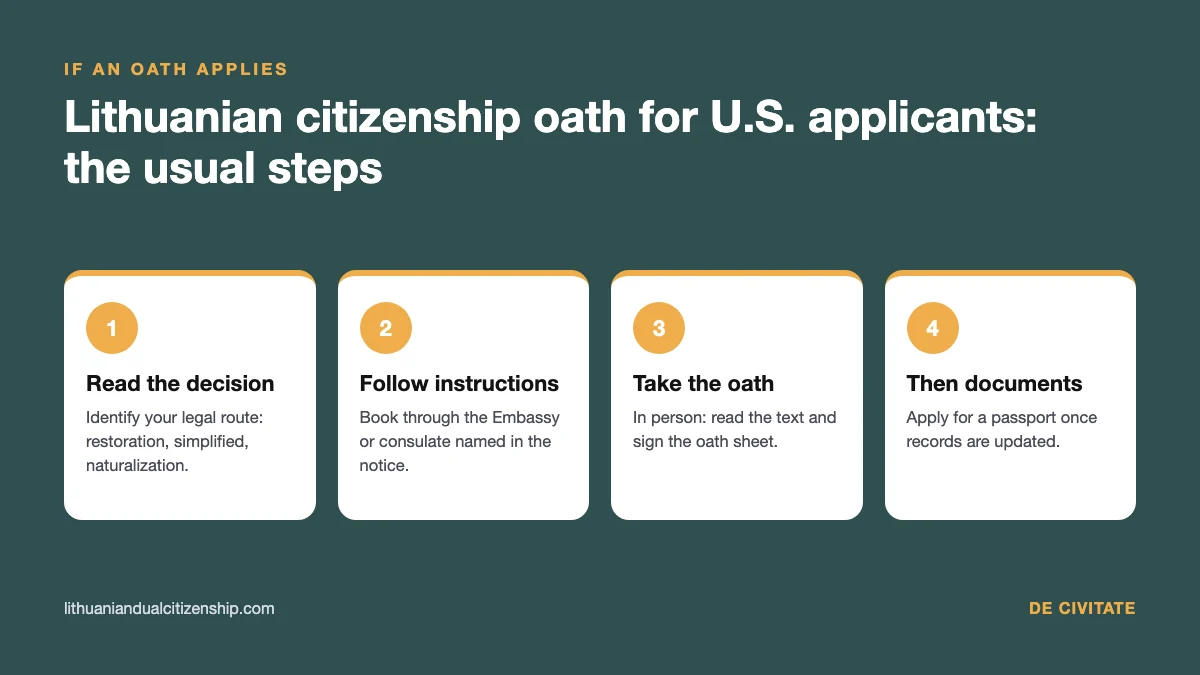
A US-based applicant should begin by reviewing the final citizenship decision and identifying whether it concerns restoration, simplified acquisition, naturalization, return, or another legal basis. This determines whether an oath is likely to be required.
If the decision or MIGRIS message instructs the applicant to take an oath, the next step is to follow the appointment instructions from the Migration Department, Ministry of the Interior, embassy, or consulate. The applicant may need to select an appropriate Lithuanian diplomatic mission based on residence and consular jurisdiction.
Before the appointment, the applicant should confirm which identity documents, citizenship records, foreign-nationality documents, translations, or evidence of renunciation must be presented. Requirements can differ depending on whether the applicant is permitted to retain US citizenship.
At the ceremony, the applicant completes the prescribed oath procedure and signs the oath sheet. Where the oath is legally required, the person generally acquires the associated rights and duties of Lithuanian citizenship only after this step has been completed.
Afterward, the applicant may need to wait until the oath and citizenship information have been entered into Lithuanian records before applying for a first Lithuanian passport or identity card. The oath ceremony itself does not automatically issue a passport.
What Would an Official Video-Call Pilot Need to Confirm?
If Lithuania formally introduces an option to take the Lithuanian citizenship oath online, the official announcement should explain which applicants can participate. Eligibility might be limited by citizenship route, country of residence, document status, security checks, technical capacity, or the authority responsible for the case.
The instructions would also need to explain how identity is verified, how the applicant handles the Constitution and prescribed oath text, how the personal oath sheet is signed, whether electronic signatures are accepted, and how the ceremony is recorded in Lithuanian state systems.
Until those details are published, an invitation to join an informal video call should not be treated as a valid Lithuanian citizenship ceremony. Applicants should verify any remote-oath communication through MIGRIS or directly with the Lithuanian diplomatic mission named in their case.
How to Avoid Misinformation About the Digital Oath
The existence of an online article mentioning a 2026 pilot does not by itself establish a legal procedure. Citizenship rules may be described inaccurately when commercial websites combine proposed reforms, anticipated changes, and existing administrative practice.
Reliable confirmation should come from a Lithuanian government authority, the Migration Department, the Ministry of the Interior, MIGRIS, or an official embassy or consular notice. The communication should relate to the applicant’s individual case and clearly state that a remote ceremony is authorized.
Applicants should be particularly cautious when a third party claims that every overseas descendant can take the Lithuanian citizenship oath online. That statement overlooks both the absence of a publicly confirmed general video procedure and the fact that many standard restoration-by-descent cases may not require an oath in the first place.
FAQ
Can I take the Lithuanian citizenship oath online in 2026?
As of July 2026, publicly available official Lithuanian guidance does not confirm a general option to take the oath by video call. Unless your MIGRIS notice or a Lithuanian authority explicitly authorizes a remote procedure, expect to attend the Ministry of the Interior or a Lithuanian diplomatic mission or consular post in person.
Do all Lithuanian citizenship restoration applicants have to take an oath?
No. A standard restoration-by-descent case is legally different from simplified acquisition, naturalization, an exceptional grant, or the return of citizenship. The oath generally applies to those other routes, while a restoration decision may become effective without an oath. The applicant’s decision and MIGRIS notice should control.
Where can I take the Lithuanian citizenship oath from the United States?
If an oath is required, the current procedure permits it at a Lithuanian diplomatic mission or consular post abroad. A US resident would normally coordinate with the Lithuanian Embassy or the appropriate consulate, which will determine the appointment, required documents, and location.
What happens during the Lithuanian citizenship oath ceremony?
Under the published procedure, the applicant appears before an authorized official, reads the prescribed oath while placing a hand on the Lithuanian Constitution, and signs a personal oath sheet. Exact arrangements may differ for a person whose disability prevents the standard procedure.
Is submitting a citizenship application through MIGRIS the same as taking the oath online?
No. MIGRIS allows applicants to submit citizenship-related applications, documents, and communications electronically, but an electronic filing does not by itself convert the oath ceremony into a video-call procedure.
Find out if you qualify — free
Send us your family details and a Lithuanian citizenship specialist will review your case and explain your options.
Start free eligibility check