
Lithuanian citizenship restoration and the simplified procedure are two separate legal pathways that are often confused because both may involve Lithuanian ancestry. For Americans with Lithuanian family roots, the distinction is especially important. One route is usually connected with a former Lithuanian citizen and the right to restore citizenship. The other is connected with Lithuanian descent, but not necessarily with a previous citizenship status in the family line.
Understanding the difference helps avoid a common mistake: assuming that any Lithuanian ancestry automatically creates the same citizenship rights. In practice, Lithuanian citizenship by descent eligibility depends on the ancestor’s historical status, the date and circumstances of emigration, the applicant’s family line, and the documents available to prove each link.
In short
- Restoration and the simplified procedure are two separate legal routes, both connected to Lithuanian ancestry.
- Restoration is for people who were Lithuanian citizens before 15 June 1940 and their descendants.
- The simplified procedure is for people of Lithuanian origin who never held Lithuanian citizenship.
- Dual citizenship may be possible in restoration cases with recognised historical circumstances — never assume it.
- Choosing the right route matters: it changes the documents you need and what happens to your other citizenship.
What Lithuanian Citizenship Restoration Means
Lithuanian citizenship restoration generally applies to people who were citizens of Lithuania before June 15, 1940, and to their descendants. This date is important because it relates to the historical period before Lithuania lost its independence during Soviet occupation. Many Lithuanian families left the country before, during, or after major political disruptions, and their descendants may still be able to rely on the former citizenship status of an ancestor.
For a US-based applicant, Lithuanian citizenship restoration usually requires showing that a parent, grandparent, great-grandparent, or another direct ancestor was a Lithuanian citizen during the relevant period. The applicant must also prove the direct family connection through civil records such as birth, marriage, name change, and sometimes naturalization documents.
This route is often discussed together with Lithuanian dual citizenship by descent because, in certain historical circumstances, applicants may be allowed to keep their existing citizenship while restoring Lithuanian citizenship. However, this depends on the facts of the case and should not be assumed without reviewing the family history and supporting records.
What the Simplified Procedure Means
Lithuanian citizenship simplified procedure is a different pathway. It is generally intended for people of Lithuanian descent who have never held Lithuanian citizenship and whose case does not fall under the restoration route. The focus is not only on proving ancestry, but on showing Lithuanian origin under the rules that apply to this specific procedure.
This path may be relevant when a person has Lithuanian ethnic roots but cannot prove that the ancestor was a citizen of Lithuania before June 15, 1940, or when the family history does not match the legal conditions for restoration. In such cases, Lithuanian ancestry may still matter, but it does not automatically create the same result as restoration.
The simplified procedure can be useful conceptually, but it is not always the best option for Americans who want to preserve their current citizenship. One of the main practical differences is that this pathway may involve stricter limitations regarding dual citizenship. That is why the distinction between Lithuanian citizenship restoration vs simplified procedure is not just technical. It can affect whether a person may keep another nationality after becoming a Lithuanian citizen.
Restoration vs Simplified Procedure: The Core Difference
The core difference is the legal basis of the claim. Lithuanian citizenship restoration is based on a previous Lithuanian citizenship status in the family line. The simplified procedure is based on Lithuanian descent or origin, but without necessarily proving that the applicant or ancestor held Lithuanian citizenship in the required historical sense.
In restoration cases, the strongest evidence usually shows that the ancestor was a citizen of the Republic of Lithuania before June 15, 1940. This may include old Lithuanian passports, internal documents, military records, archival certificates, residence records, or other official documents that confirm citizenship or strongly support it.
In simplified procedure cases, the evidence may focus more on Lithuanian ethnic origin, family records, and documents that establish descent from a person of Lithuanian origin. The burden is still documentary, but the legal question is different. The applicant is not simply proving that they have Lithuanian roots; they are proving that their facts fit a specific citizenship pathway.
| Restoration | Simplified procedure | |
|---|---|---|
| Based on | Citizenship held before 15 June 1940 (yours or an ancestor’s) | Lithuanian origin, without prior citizenship |
| Key evidence | Proof of the ancestor’s citizenship and the family line | Proof of Lithuanian origin and the family line |
| Dual citizenship | Possible in recognised historical circumstances | Its own conditions — not to be assumed |
| Typical applicant | Descendant of a citizen who left during the occupation | Descendant of Lithuanian origin with no citizen ancestor |
Lithuanian Citizenship by Descent Eligibility
Lithuanian citizenship by descent eligibility should be assessed in stages. The first question is whether the ancestor was a Lithuanian citizen during the relevant historical period. The second question is whether the applicant can prove an unbroken direct line from that ancestor. The third question is whether any events in the family history affect the right to restoration or the possibility of dual citizenship.
For many Americans, the key ancestor is a grandparent or great-grandparent. Lithuanian citizenship through grandparents can be possible when the grandparent had Lithuanian citizenship and the family line can be documented clearly. In other cases, the claim may go further back, but the older the records are, the more important it becomes to verify names, dates, places of birth, emigration records, and changes caused by translation or naturalization.
Lithuanian citizenship by ancestry should not be treated as a single universal category. Some people may qualify for restoration. Others may only qualify under the simplified procedure. Some may have Lithuanian family roots but lack the documents needed to prove eligibility. The exact result depends on the legal ground and the evidence.
Lithuanian Citizenship by Descent Requirements
Lithuanian citizenship by descent requirements usually include proof of identity, proof of the ancestor’s Lithuanian citizenship or Lithuanian origin, and proof of the direct family connection between the applicant and the ancestor. Each generation in the chain must normally be supported by official records.
For example, an applicant may need their own birth certificate, a parent’s birth certificate, a grandparent’s birth certificate, marriage certificates showing surname changes, and records confirming the ancestor’s Lithuanian citizenship or Lithuanian origin. If documents were issued in the United States or another foreign country, they may also need proper legalization, apostille, certified translation, or other formal preparation.
Name variations are common in Lithuanian descent cases. A surname may appear differently in Lithuanian, English, Polish, Russian, Yiddish, or another language depending on the time and place where the document was issued. These differences do not always make a case impossible, but they must be explained through consistent documentation.
Why the Route Matters for Americans
Lithuanian citizenship for Americans often raises two practical questions: whether the applicant is eligible through ancestry and whether they can keep US citizenship. These questions are related, but they are not identical. A person may have Lithuanian descent and still need a careful review to determine which citizenship pathway applies.
Restoration is often the more relevant route for descendants of Lithuanian citizens who left Lithuania because of occupation, political upheaval, exile, or related historical circumstances. In many such cases, the analysis focuses on whether the ancestor’s citizenship can be proven and whether the applicant falls within the permitted categories for dual citizenship.
The simplified procedure may be available to some people of Lithuanian origin, but it may not provide the same dual citizenship outcome. For US citizens, this difference is central. Before choosing a route, applicants should understand whether they are relying on former Lithuanian citizenship in the family line or only on Lithuanian descent.
Common Documentation Issues
The most common problem is not the absence of Lithuanian ancestry, but the absence of clear documentary proof. Family stories may be accurate, but citizenship authorities usually require official records. A statement that a grandparent was “from Lithuania” is not the same as proof that the person was a Lithuanian citizen.
Another issue is timing. Some ancestors left the territory associated with Lithuania before the modern Lithuanian state existed or before the relevant citizenship rules applied. Others were born in areas where borders changed, records were kept in different languages, or administrative authority shifted over time. These facts can influence whether the case supports restoration, simplified procedure, or neither.
Naturalization records in the United States can also matter. They may help establish when an ancestor became a US citizen, how the name was recorded, and whether the timeline supports the claimed Lithuanian citizenship history. In some cases, passenger lists, census records, military documents, or archival extracts may support the broader evidentiary picture, but primary citizenship-related records are usually more important.
How to Understand Which Pathway Fits
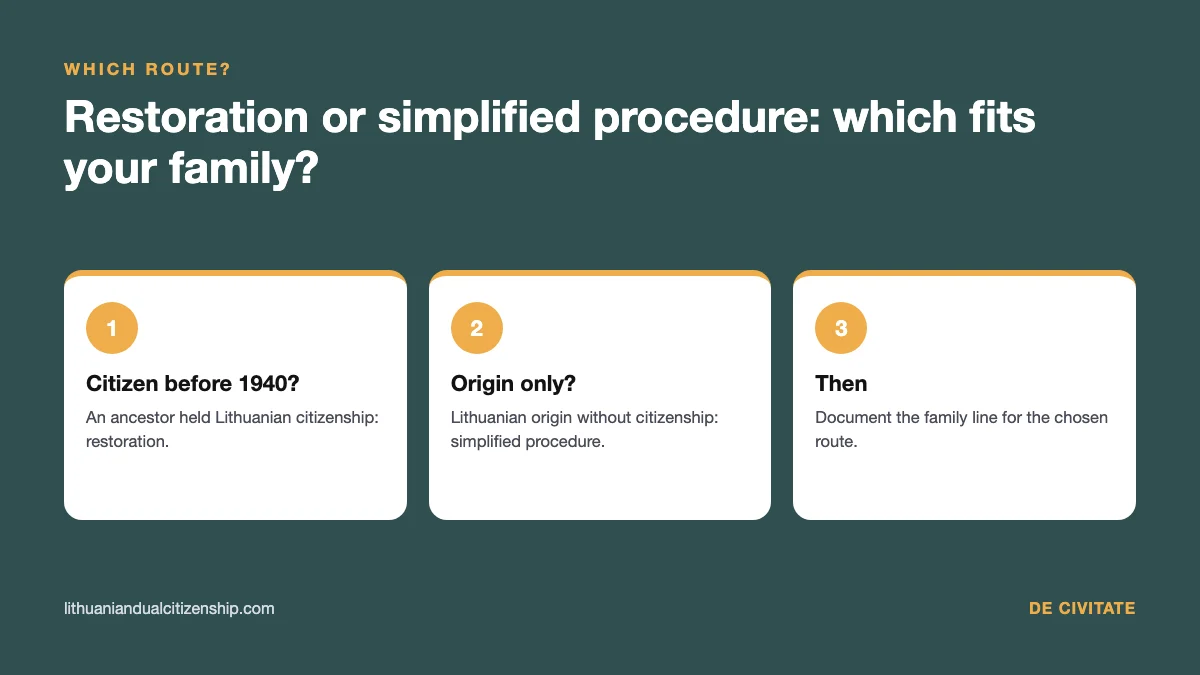
A practical way to separate the two routes is to begin with the ancestor, not with the applicant. If the ancestor can be shown to have been a Lithuanian citizen before June 15, 1940, Lithuanian citizenship restoration may be the relevant pathway. If the family can show Lithuanian origin but not the required citizenship status, the simplified procedure may need to be considered instead.
The next step is to review the family chain. Lithuanian descent citizenship requirements depend on proving each generational link. Missing birth certificates, inconsistent surnames, unclear places of birth, or gaps in marriage records can delay or weaken the case. These issues should be identified before submitting an application.
Finally, the applicant should consider the citizenship outcome. If keeping US citizenship is a priority, the distinction between restoration and simplified procedure becomes especially important. A pathway that confirms Lithuanian origin may not automatically lead to the same dual citizenship result as a restoration case based on a former Lithuanian citizen ancestor.
FAQ
Is Lithuanian citizenship restoration the same as citizenship by descent?
Not exactly. Lithuanian citizenship restoration is one possible route within ancestry-based cases, but it usually depends on proving that an ancestor was a Lithuanian citizen before the relevant historical cutoff. Citizenship by descent is a broader way to describe family-based eligibility, but the exact legal pathway must still be identified.
What is the simplified procedure for Lithuanian citizenship?
The simplified procedure is a pathway for people of Lithuanian descent who have not previously held Lithuanian citizenship and whose case is based on Lithuanian origin rather than restoration of a prior citizenship right. It has its own conditions and may have different implications for dual citizenship.
Can Americans apply for Lithuanian citizenship through grandparents?
Yes, Lithuanian citizenship through grandparents may be possible if the grandparent’s Lithuanian citizenship or Lithuanian origin can be proven and the applicant can document the direct family line. Whether the correct route is restoration or simplified procedure depends on the details of the case.
Does Lithuanian citizenship restoration allow dual citizenship?
In some ancestry-based restoration cases, dual citizenship may be possible, especially where the family history fits legally recognized historical circumstances. However, this should not be assumed automatically. The applicant’s eligibility depends on the ancestor’s status, emigration history, and supporting documents.
What documents are needed for Lithuanian citizenship by ancestry?
Applicants usually need identity documents, civil records proving each family link, and documents proving the ancestor’s Lithuanian citizenship or Lithuanian origin. These may include birth certificates, marriage certificates, archival records, old passports, military records, naturalization records, and properly prepared translations or apostilles where required.
Which pathway is better: restoration or simplified procedure?
There is no universal answer. Restoration may be more relevant when the applicant descends from a former Lithuanian citizen and wants to preserve dual citizenship where legally allowed. The simplified procedure may apply when Lithuanian origin can be proven but restoration requirements are not met. The correct pathway depends on the evidence and family history.
Find out if you qualify — free
Send us your family details and a Lithuanian citizenship specialist will review your case and explain your options.
Start free eligibility check