Reports about new civic and language examinations in parts of Europe may concern Americans considering citizenship through their Lithuanian ancestry. These developments can create the impression that every person applying for citizenship in an EU country will soon need to pass a common European test.
That is not how citizenship law operates. There is no single EU-wide citizenship examination that applies to every nationality application in 2026. Individual EU Member States establish their own rules for acquiring national citizenship, and EU citizenship generally follows automatically when a person becomes a national of a Member State. A new civic examination introduced by one country does not automatically become a requirement in Lithuania or elsewhere in the European Union.
For Lithuanian applicants, the decisive question is not whether civic tests are becoming more common in Europe. It is which legal route applies to the individual case. Lithuanian citizenship by descent, particularly reinstatement based on an ancestor’s former Lithuanian citizenship, is fundamentally different from citizenship acquired through ordinary naturalization.
In short
- There is no single EU-wide citizenship test in 2026; each country sets its own rules.
- Reinstatement of Lithuanian citizenship by descent usually requires no Lithuanian language or Constitution exam.
- Language and Constitution exams belong to naturalization — a different legal route.
- You may still need Lithuanian translations of documents and to complete the application in Lithuanian.
- Civic tests introduced elsewhere, such as France’s from 1 January 2026, do not apply to Lithuanian applications.
Is There an EU-Wide Citizenship Test in 2026?
There is no standardized EU citizenship test administered to everyone applying for nationality in an EU Member State. The European Union does not grant a separate national citizenship that replaces the citizenship of France, Lithuania, Germany, Italy, or another Member State.
Instead, each country determines who may acquire its nationality and under what conditions. Once a person becomes a citizen of Lithuania, that person also becomes an EU citizen and may receive the rights connected with that status. The underlying Lithuanian citizenship decision, however, remains governed primarily by Lithuanian law.
Some European countries have introduced or strengthened national language and civic-integration requirements. France, for example, introduced a new civic examination from January 1, 2026, for certain residence and naturalization procedures. That is a French national requirement rather than an EU-wide examination.
Applicants should therefore be cautious when reading headlines about “European citizenship tests.” Such reports may describe a change in one country, a proposal that has not been adopted, or requirements that apply only to naturalization after residence. They do not necessarily affect citizenship based on ancestry.
Does Lithuanian Citizenship by Descent Require a Language Test?
In most reinstatement cases based on descent from a former Lithuanian citizen, applicants are not required to pass a Lithuanian language examination. They are also generally not required to pass an examination on the fundamentals of the Constitution of the Republic of Lithuania.
Official European Migration Network material describing the Lithuanian system distinguishes reinstatement from naturalization and confirms that descendants applying for reinstatement are not subject to several ordinary naturalization conditions, including the Lithuanian language and Constitution examinations.
This means the answer to the question “does Lithuanian citizenship by descent require a language test?” is usually no when the applicant is pursuing reinstatement through a qualifying ancestral connection.
However, “citizenship by descent” is a broad, commonly used expression rather than a complete legal classification. A person’s application may involve reinstatement, confirmation of citizenship, a simplified procedure based on Lithuanian descent, or another legal basis. The exact requirements should therefore be evaluated according to the route that applies to the person’s documents and family history.
Why Citizenship by Descent Is Treated Differently from Naturalization
Naturalization and citizenship by descent are based on different legal concepts.
Naturalization usually concerns a person who has established a substantial connection with Lithuania through residence and integration. Language knowledge and understanding of the constitutional system can therefore form part of the naturalization conditions.
Reinstatement based on ancestry generally concerns a historical citizenship connection. The applicant is not asking the state to recognize integration achieved through years of residence. Instead, the applicant is seeking to reinstate citizenship connected to a person who previously held citizenship of the Republic of Lithuania.
For that reason, the main issue is usually evidence rather than integration. The authorities may examine whether the relevant ancestor was a Lithuanian citizen, whether the applicant is a direct descendant, and whether the legal conditions for the requested citizenship status have been established.
A person may therefore be unable to speak Lithuanian but still have a potentially valid reinstatement case. Conversely, speaking fluent Lithuanian does not compensate for missing proof of ancestry or an ancestor’s citizenship.
Lithuanian Citizenship by Descent vs Naturalization
The difference between Lithuanian citizenship by descent and naturalization determines whether language and civic examinations are likely to apply.
Reinstatement Based on an Ancestor’s Citizenship
Reinstatement may be available to a person who previously held Lithuanian citizenship before June 15, 1940, or to a qualifying descendant of such a person. Depending on the legal circumstances, descendants may include children, grandchildren, and great-grandchildren.
The analysis normally focuses on the ancestor’s citizenship status and the documented family line connecting that ancestor to the applicant. Residence in Lithuania, employment in Lithuania, and Lithuanian language proficiency are not generally the central eligibility tests for this route.
Not every person with Lithuanian heritage automatically qualifies. The result may depend on whether the ancestor was legally a Lithuanian citizen rather than merely born in territory associated with Lithuania. It may also depend on historical events, migration history, the applicant’s generation, and the particular citizenship provision being relied upon.
Citizenship Through Naturalization
Ordinary naturalization generally applies to a person who has lived in Lithuania under the required legal conditions and seeks citizenship based on residence and integration rather than inherited status.
This route may involve an examination in the Lithuanian state language and an examination covering the fundamentals of the Lithuanian Constitution. Other conditions may also apply, including requirements related to residence status, legal means of subsistence, eligibility restrictions, and citizenship of another country.
The Lithuanian citizenship naturalization test requirements should not be applied automatically to a reinstatement application. They belong to a different legal pathway.
| Reinstatement by descent | Naturalization | |
|---|---|---|
| Based on | An ancestor’s citizenship before 15 June 1940 | Residence and integration in Lithuania |
| Lithuanian language exam | Generally not required | Required unless exempt |
| Constitution exam | Generally not required | Required unless exempt |
| Main challenge | Documents proving citizenship and descent | Residence, exams and other conditions |
| Lithuanian translations | Required for foreign documents | Required for foreign documents |
What Is the Lithuanian Citizenship Constitution Exam?
The Lithuanian citizenship Constitution exam is intended to assess knowledge of the fundamentals of the Constitution of the Republic of Lithuania. It is commonly discussed together with the state-language examination because both can form part of ordinary naturalization requirements.
The Constitution examination should not be confused with document verification, an immigration interview, an oath, or a request for additional information. Those procedural steps serve different purposes.
A reinstatement applicant may still communicate with authorities, submit explanations, correct inconsistencies, or provide additional records. None of those actions necessarily means that the person must pass a formal civic examination.
There may also be circumstances in which a person is exempt from an examination that would otherwise apply to a naturalization route. Because exemptions and procedural requirements can depend on age, capacity, health, education, and the applicable legal provision, they should not be assumed without reviewing the person’s situation.
What Applicants Must Prove Instead of Passing an Exam
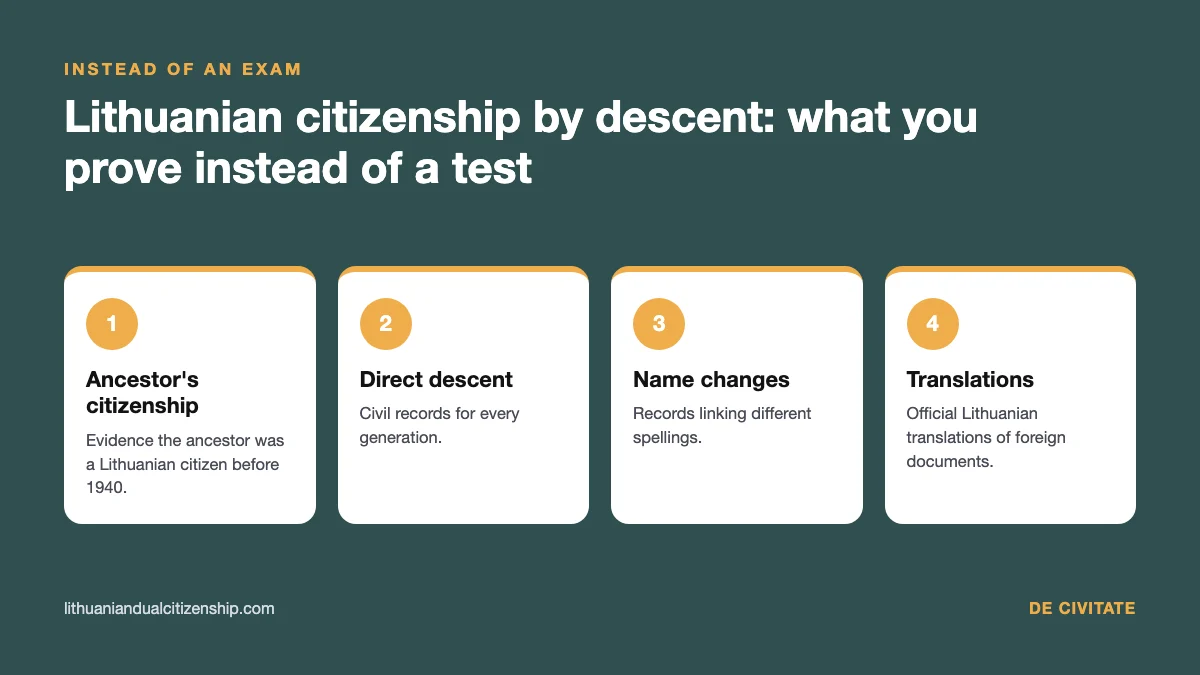
The absence of a language or Constitution examination does not make a Lithuanian citizenship restoration case automatic. The applicant must still establish the legal and factual basis of the application.
The first issue is normally the ancestor’s status. Birth in Lithuania alone may not prove that the ancestor held Lithuanian citizenship. Depending on the historical period, useful evidence may include passports, internal identity records, military records, residence documents, public-service records, archive certificates, or other official material.
The applicant must also document the direct line of descent. Birth certificates, marriage certificates, adoption records, and other civil-status documents may be needed for every generation between the Lithuanian ancestor and the applicant.
Name differences frequently require additional attention. Lithuanian names may have been translated, shortened, transliterated, or changed after immigration to the United States. Marriage, naturalization in another country, and inconsistent spelling across records can create further discrepancies.
The application may therefore need to demonstrate that documents containing different versions of a name relate to the same person. A language test does not resolve these issues; consistent documentary evidence does.
Where the applicant also wishes to retain another citizenship, additional historical facts may become relevant. Lithuanian dual-citizenship rules are limited to specified circumstances, so eligibility to reinstate Lithuanian citizenship and eligibility to hold two citizenships should not always be treated as identical questions.
Does the Application Still Involve the Lithuanian Language?
An applicant who is not required to speak Lithuanian may still encounter Lithuanian throughout the application process.
Applications may need to be completed in Lithuanian, and foreign civil or historical documents may require an official Lithuanian translation. Documents issued in the United States may also require appropriate certification or authentication, depending on the document and the submission procedure. Lithuanian consular guidance states that foreign supporting documents generally need an official Lithuanian translation.
This is an administrative language requirement, not a language-proficiency test. The applicant is not necessarily being assessed on the ability to speak, read, or write Lithuanian. The purpose is to provide the authorities with documents they can formally review.
Applicants should therefore distinguish between three separate issues: whether personal language knowledge is an eligibility condition, whether the application must be prepared in Lithuanian, and whether supporting documents require translation. Only the first concerns a language examination.
Is an Oath the Same as a Citizenship Test?
An oath of allegiance and a citizenship examination are not the same procedure.
An examination tests knowledge or language ability. An oath is a formal declaration connected with acquiring or finalizing citizenship status in cases where the law requires it. The Lithuanian Migration Department is responsible for citizenship-related document evaluation and also organizes oath procedures in applicable cases.
A person should not assume that an oath requirement means a language or Constitution examination has been introduced. The wording, timing, and method of taking an oath may depend on the applicable citizenship route and current administrative procedure.
What Do 2026 Civic-Test Changes Elsewhere in Europe Mean for Lithuanian Applicants?
For most U.S.-based descendants applying for Lithuanian citizenship reinstatement, changes to naturalization tests in another EU country have no direct effect.
A French civic test applies under French law. A German naturalization test applies under German law. Lithuanian citizenship applications are assessed under Lithuanian law. Although national citizenship provides EU citizenship rights, the EU does not replace national eligibility rules with a single ancestry, language, or civic-testing system.
The more relevant question is whether Lithuania itself changes the legal requirements for the applicant’s particular route. General political discussion about integration standards or stricter naturalization rules should not be interpreted as proof that a new exam applies to descendants.
Applicants should also distinguish between enacted rules and proposed reforms. Citizenship policies can be politically sensitive, and media coverage may discuss measures before they enter into force. A proposal, parliamentary discussion, or change affecting residence permits does not necessarily change citizenship restoration requirements.
Could Lithuania Introduce a Test for Citizenship by Descent in the Future?
Citizenship legislation can change, so no current rule should be treated as permanently guaranteed. Lithuania could amend its citizenship law or its administrative procedures in the future.
However, a test introduced elsewhere in the European Union would not automatically create a Lithuanian requirement. A change affecting Lithuanian reinstatement applicants would normally require action within Lithuania’s own legal system.
Applicants should therefore verify the rules applicable when their application is prepared and submitted. This is particularly important where a case involves unusual historical circumstances, more distant ancestry, prior loss of citizenship, adoption, an ancestor who moved within the former Soviet Union, or a request to retain another nationality.
What Should a U.S.-Based Applicant Review Before Applying?
A U.S.-based applicant should begin by identifying the precise Lithuanian citizenship pathway rather than concentrating only on exam requirements.
The person should determine which ancestor provides the claimed connection, whether that ancestor can be shown to have held Lithuanian citizenship, and how each generation in the family line can be documented. It is also important to review surname changes, inconsistent dates, missing civil records, and the ancestor’s migration history.
The applicant’s current citizenship and intention to retain it should be examined separately. Lithuanian citizenship restoration may be possible in circumstances where dual citizenship is not, or additional evidence may be required to establish an exception allowing both nationalities.
The practical difficulty of a descent-based case is therefore usually not studying for a Lithuanian citizenship exam. It is assembling a coherent evidentiary record that supports the correct legal basis.
FAQ
Does Lithuanian citizenship by descent require a language test?
Usually, no. Applicants pursuing reinstatement based on a qualifying Lithuanian ancestor generally do not need to pass a Lithuanian language examination. The precise requirements depend on the legal route and the applicant’s circumstances.
Is there a citizenship test for Lithuanian citizenship by descent?
There is generally no language or Constitution test for Lithuanian citizenship reinstatement based on descent. The application is usually evaluated through evidence of the ancestor’s citizenship, direct descent, and compliance with the relevant legal conditions.
Do the 2026 EU civic tests apply to Lithuanian citizenship by descent?
There is no single EU-wide civic test applying to every citizenship application. Tests introduced by individual EU countries are national requirements and do not automatically apply to Lithuanian citizenship by descent.
What is the difference between Lithuanian citizenship by descent and naturalization?
Citizenship by descent or reinstatement is based primarily on a historical family connection to a Lithuanian citizen. Naturalization is generally based on residence and integration and may require Lithuanian language and Constitution examinations.
Do I need to speak Lithuanian to submit a citizenship restoration application?
Personal Lithuanian language proficiency is generally not required for a qualifying reinstatement application. However, the application and supporting documents may need to be submitted or officially translated into Lithuanian.
Is the Lithuanian citizenship oath a language or civic test?
No. An oath is a formal declaration and is not an examination of language ability or constitutional knowledge. Whether and how an oath applies may depend on the applicant’s citizenship route and procedure.
Find out if you qualify — free
Send us your family details and a Lithuanian citizenship specialist will review your case and explain your options.
Start free eligibility check