Families affected by Soviet occupation, forced deportation, political repression, imprisonment, and exile often have a complicated documentary history. For their descendants, that history may also be relevant to Lithuanian citizenship restoration.
Lithuanian citizenship for descendants of deportees is not based simply on the fact that an ancestor suffered repression or had Lithuanian roots. In a typical restoration case, the applicant must establish that a qualifying ancestor held citizenship of the Republic of Lithuania before June 15, 1940 and that the applicant is a child, grandchild, or great-grandchild of that person. Lithuanian law also recognizes circumstances connected with exile from occupied Lithuania and departure before March 11, 1990 when determining whether another citizenship may be retained.
For descendants of political prisoners, the analysis can require additional care. Political imprisonment may form an important part of the historical evidence, but the citizenship case still depends on the applicable legal ground, the ancestor’s citizenship status, the circumstances of repression or displacement, and the documents available to prove those facts.
In short
- Descendants of deportees and political prisoners can restore Lithuanian citizenship if the ancestor was a citizen before 15 June 1940.
- Descendants means children, grandchildren and great-grandchildren; each generation must be documented.
- Deportation records prove what happened — they do not by themselves prove citizenship before 1940.
- Lithuanian law allows people exiled from occupied Lithuania before 11 March 1990 and their descendants to keep another citizenship.
- Relatives of the same deportee can still receive different decisions.
Why Deportation and Political Repression Matter for Citizenship Restoration
Lithuania’s modern citizenship framework reflects the consequences of occupation and forced displacement during the twentieth century. One legally important category is a person exiled from the occupied Republic of Lithuania before March 11, 1990.
The Law on Citizenship defines such a person by reference to forced removal from Lithuania during the occupation period, following decisions of occupation authorities or courts, for reasons connected with resistance to occupation regimes, political or social reasons, or origin. This definition makes the circumstances of an ancestor’s displacement potentially significant rather than merely historical background.
This is why Lithuanian citizenship restoration for descendants of deportees usually involves more than proving Lithuanian ancestry. The applicant may need to establish several different facts: that the ancestor was a Lithuanian citizen during the relevant period, that the historical circumstances satisfy the applicable legal category, and that the applicant descends directly from that person.
The same distinction matters when researching Lithuanian citizenship for descendants of Soviet deportees or Lithuanian exiles. A family account of deportation to Siberia, imprisonment, forced resettlement, or political persecution may provide a valuable starting point, but an application normally depends on documentary evidence rather than family history alone.
Who May Qualify as a Descendant?
Current Lithuanian consular guidance states that persons who held citizenship of the Republic of Lithuania before June 15, 1940 and their descendants have an indefinite right to seek reinstatement of Lithuanian citizenship. For this purpose, descendants include children, grandchildren, and great-grandchildren.
This means an applicant does not necessarily need a Lithuanian parent. A Lithuanian grandparent or great-grandparent may also provide the relevant ancestral connection, depending on the facts and documentary record.
However, each generation must still be connected. If an applicant relies on a great-grandparent, the evidentiary chain may need to establish the relationship from the great-grandparent to the grandparent, from the grandparent to the parent, and from the parent to the applicant.
This is one reason Lithuanian citizenship by descent is primarily a document-based process. A parent does not necessarily need to restore citizenship before a child applies, but the parent’s civil records may still be essential to proving the family line.
Pre-1940 Lithuanian Citizenship Must Be Distinguished from Lithuanian Ancestry
One of the most important points for descendants of deportees and political prisoners is the distinction between Lithuanian heritage and citizenship of the Republic of Lithuania.
An ancestor may have been born in Lithuania, spoken Lithuanian, belonged to a Lithuanian family, or lived in territory that is now part of Lithuania. Those facts can help with genealogical research, but they do not necessarily establish citizenship.
For restoration cases involving descendants, the central issue is generally whether the qualifying ancestor actually held citizenship of the Republic of Lithuania before June 15, 1940. The U.S. Embassy of Lithuania specifically explains that birth or residence in Lithuania is not by itself equivalent to proof of Lithuanian citizenship.
Applicants therefore often need separate proof of Lithuanian citizenship before 1940. An old Lithuanian passport may provide particularly direct evidence, but the absence of a surviving passport does not necessarily end the inquiry. Archival documents, passport files, military or public-service records, civil records containing citizenship information, and other historical materials may help establish the ancestor’s legal status.
Deportation Records and Citizenship Evidence Prove Different Facts
A deportation file can be highly relevant without proving every element of a citizenship claim.
For example, Soviet records may identify the person who was deported, the family members removed with them, their former residence, the date of deportation, the destination, or the authority responsible for the decision. Political repression files may contain arrest records, court decisions, imprisonment information, rehabilitation documents, or records explaining the grounds for persecution.
These materials may help prove the historical circumstances of exile or repression. They do not necessarily prove that the ancestor held citizenship of the Republic of Lithuania before June 15, 1940.
The two questions should therefore be investigated separately: what establishes the ancestor’s Lithuanian citizenship, and what establishes deportation, exile, political imprisonment, or another relevant historical circumstance?
In some cases, one archive file may contain evidence relevant to both questions. In others, applicants need records from several institutions or countries.
| What you must show | Typical evidence |
|---|---|
| Ancestor’s citizenship before 15 June 1940 | Lithuanian passport, internal passport files, archive certificates |
| Deportation, exile or imprisonment | Deportation decisions, prisoner and court records, rehabilitation documents |
| Direct descent | Birth, marriage, adoption and name-change records for each generation |
| Your identity | Passport and civil records of the applicant |
Descendants of Political Prisoners May Require a More Individual Analysis
The phrase Lithuanian citizenship for descendants of political prisoners can describe several different family histories.
One ancestor may have been arrested and imprisoned in Lithuania. Another may have been convicted and then deported. A third may have been sent to a prison, labor camp, or other location elsewhere in the Soviet Union. Family members may also have been deported separately.
These factual differences matter because political prisoner status should not automatically be treated as interchangeable with every citizenship-law category. The applicant should identify exactly what happened to the ancestor and determine which documents establish those circumstances.
Historical Lithuanian consular guidance has specifically referred to documents showing that an ancestor was a deportee or political prisoner, while the citizenship legislation defines the broader legal category of a person exiled from occupied Lithuania through the circumstances of forced removal.
As a result, Lithuanian citizenship restoration for descendants of political prisoners should be assessed through the underlying facts rather than the family label alone.
Can Descendants of Deportees Keep Their Existing Citizenship?
This is particularly important for U.S.-based applicants.
Lithuanian law generally restricts multiple citizenship, but it contains specific exceptions. Current Lithuanian consular guidance states that the requirement to renounce another citizenship does not apply to persons who were exiled from the occupied Republic of Lithuania before March 11, 1990 and their descendants, or to persons who left Lithuania before that date and their descendants, when the applicable requirements are satisfied.
Accordingly, Lithuanian dual citizenship for descendants of deportees may be possible when the applicant can establish the required ancestral citizenship, descent, and qualifying historical circumstances.
The existence of a deported or politically persecuted Lithuanian ancestor should not, however, be treated as an automatic guarantee of dual citizenship. The Migration Department evaluates the documentary evidence and applicable legal basis in the individual application.
What Documents May Be Important?
The exact set of citizenship documents depends on the family history, but most cases require evidence addressing several separate parts of the claim.
First, the applicant needs documents identifying the qualifying ancestor and establishing Lithuanian citizenship during the relevant historical period.
Second, the applicant normally needs civil-status records creating a continuous family connection between that ancestor and the applicant. Birth certificates are central, while marriage certificates, divorce records, adoption documents, and official name-change records may be necessary when identities or surnames changed between generations.
Third, a case relying on deportation, exile, or political repression may require historical evidence documenting what occurred. Depending on the family history, relevant archive records can include deportation decisions, prisoner records, rehabilitation documents, residence records, lists of deported family members, displaced-person records, court materials, or archival certificates.
Finally, the applicant must provide the documents required for their own identity and application.
Name and Date Differences in Historical Records
Document inconsistencies are common in families affected by war, occupation, deportation, and migration.
A Lithuanian name may have been written differently in Lithuanian, Russian, Polish, German, or English records. A person named Jonas in Lithuania may later appear under another spelling in Soviet or U.S. documentation. Surnames may also change through marriage, transliteration, or Americanization.
Places can create similar problems. A record may describe a birthplace using an older Russian, Polish, Soviet, or regional designation rather than the modern Lithuanian place name.
Dates can vary as well. Historical records may contain transcription errors, different calendar conventions, estimated birth years, or inconsistencies created during later immigration procedures.
Such discrepancies do not necessarily make restoration impossible. They can, however, create uncertainty about whether several documents refer to the same individual. A strong documentary file should make those connections understandable rather than leaving unexplained contradictions.
Why U.S. Documents May Be Part of the Evidence Chain
American applicants often need records from both Lithuania and the United States.
Lithuanian archives may establish the ancestor’s citizenship and historical circumstances, while U.S. civil records can connect subsequent generations. Birth certificates, marriage records, naturalization files, immigration documents, death certificates, and name-change records may help reconstruct the family line.
The purpose is not to collect as many records as possible. Each document should answer a specific evidentiary question.
For example, one record may establish the identity of the Lithuanian ancestor. Another may show that the same person became the parent of the applicant’s grandparent. A marriage certificate may explain a surname change, while a later birth certificate establishes the next generation.
When the records form a coherent chain, the historical narrative becomes easier to verify.
Can Members of the Same Family Receive Different Decisions?
Yes, different descendants of the same Lithuanian deportee or political prisoner can have different outcomes.
One relative’s successful citizenship restoration does not automatically create citizenship rights or guarantee approval for another applicant. Each application has its own documentary record and must satisfy the applicable legal requirements.
For example, siblings may submit different versions of civil documents. One applicant may have a complete record explaining a surname change while another submits an incomplete certificate. Cousins may descend through different children of the same ancestor and therefore rely on different documentary chains.
Applicants may also have different citizenship circumstances or rely on different legal grounds.
A relative’s previous case can still be useful. It may identify the archive where citizenship evidence was found or reveal which historical records exist. But another applicant should still verify whether the evidence proves their own direct descent and supports their own application.
Applying for Citizenship Restoration from the United States
Current guidance from the Embassy of Lithuania in the United States states that applications for reinstatement of Lithuanian citizenship are submitted electronically through the Lithuanian Migration Information System, MIGRIS. The applicant uploads the relevant documents and follows the subsequent instructions issued through the system.
Where originals must be presented at a Lithuanian consular post, the Migration Department can first conduct a preliminary assessment through MIGRIS. The applicant then receives instructions concerning the presentation of original documents.
This makes document preparation particularly important. Before filing, applicants should understand what each document proves and whether major gaps or contradictions remain in the evidence.
What to Check Before Starting a Deportee or Political Prisoner Case
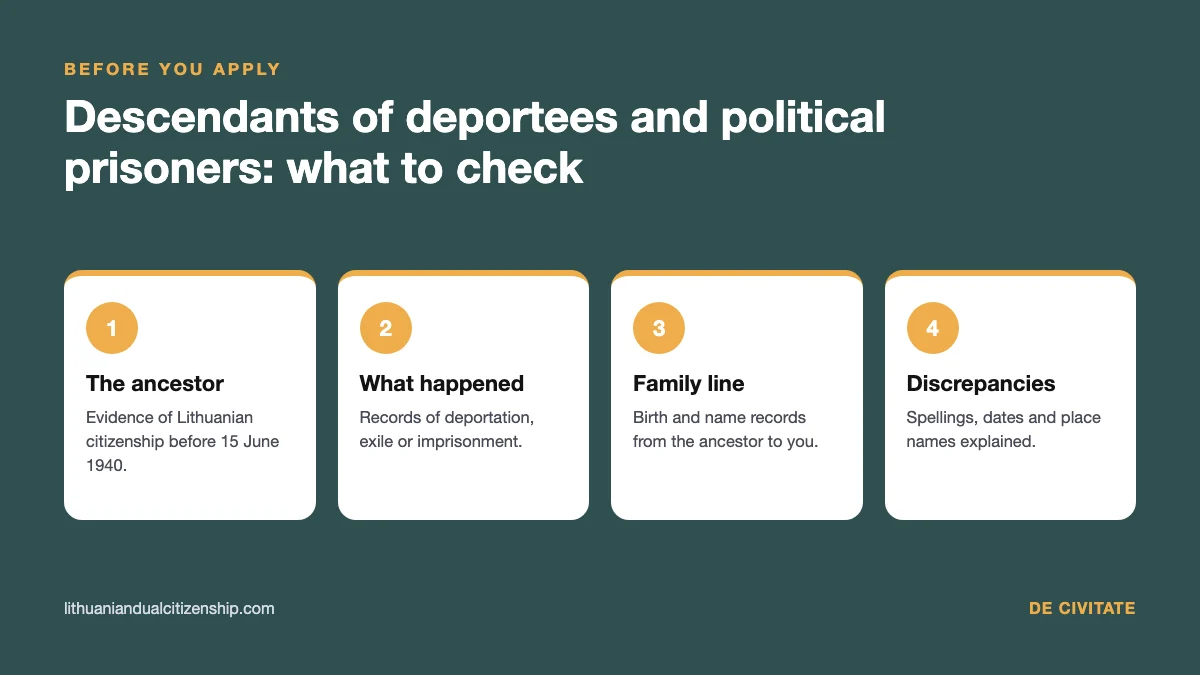
Before relying on Lithuanian citizenship for descendants of Lithuanian exiles, deportees, or political prisoners, it is useful to reconstruct the family history chronologically.
Start with the qualifying ancestor. Determine when and where the person lived, whether there is evidence of citizenship of the Republic of Lithuania before June 15, 1940, and what happened during the occupation period.
Then separate the evidence relating to citizenship from the evidence relating to repression or displacement. A document showing deportation may be crucial but should not automatically be treated as proof of citizenship.
Next, build the family line from the ancestor to the modern applicant and identify any missing birth, marriage, adoption, or name-change records.
Finally, review spelling differences, inconsistent dates, different place names, and other discrepancies before submission. The goal is to present a documentary chain in which the ancestor’s legal status, historical circumstances, and relationship to the applicant can each be understood independently.
For descendants of families affected by deportation and political imprisonment, the historical record can be fragmented. That does not necessarily prevent citizenship restoration, but eligibility should be based on the documents that can actually be established rather than on assumptions about ancestry or family history.
Frequently Asked Questions
Can descendants of Lithuanian deportees restore citizenship?
They may be able to. A typical restoration claim requires evidence that a qualifying parent, grandparent, or great-grandparent held citizenship of the Republic of Lithuania before June 15, 1940, together with proof of direct descent. If the ancestor was exiled from occupied Lithuania before March 11, 1990, that history may also be relevant to the rules allowing the applicant to retain another citizenship.
Can descendants of political prisoners qualify for Lithuanian citizenship?
They may qualify, but political prisoner status alone should not be treated as an automatic basis for citizenship. The case normally requires proof of the ancestor’s Lithuanian citizenship, the applicant’s direct descent, and the historical circumstances relevant to the applicable citizenship-law category.
Can I keep my U.S. citizenship if I restore Lithuanian citizenship?
In qualifying cases, Lithuanian law permits an exception to the requirement to renounce another citizenship for persons exiled from occupied Lithuania before March 11, 1990 and their descendants, as well as certain persons who left Lithuania before that date and their descendants. Whether the exception applies depends on the individual facts and evidence.
What documents can prove deportation or political imprisonment?
Relevant evidence may include deportation decisions, prisoner or court records, rehabilitation documents, archival certificates, lists of deported family members, residence records, or other official records documenting repression or forced displacement. The documents required depend on what must be established in the particular case.
Can two relatives from the same family receive different citizenship decisions?
Yes. Each applicant must establish their own eligibility and documentary chain. Even relatives relying on the same Lithuanian ancestor may submit different records, have different name or date discrepancies, follow different branches of the family line, or have different individual circumstances.
Find out if you qualify — free
Send us your family details and a Lithuanian citizenship specialist will review your case and explain your options.
Start free eligibility check