Finding Lithuanian archive records is often one of the most important steps for Americans researching Lithuanian citizenship by descent. Many families know that a parent, grandparent, or great-grandparent came from Lithuania, but they may not have the original documents needed to prove the family line, the ancestor’s identity, or the ancestor’s connection to the Republic of Lithuania before 1940.
Archive research can help fill that gap. Lithuanian birth records, marriage records, death records, internal passport files, residence documents, military records, and other archival materials may help create a clearer evidentiary picture. In citizenship restoration cases, the goal is not only to build a family tree. The goal is to locate records that may support a legal and historical claim.
For U.S.-based applicants, the process usually starts with American documents and then moves toward Lithuanian archival sources. U.S. records may provide names, dates, towns, spelling variants, immigration routes, and family relationships. Lithuanian archive records may then help confirm whether the same person can be connected to Lithuania in a way that is relevant for citizenship by descent.
In short
- A citizenship by descent file usually has to prove two things: your direct line to the Lithuanian ancestor and that ancestor’s connection to Lithuanian citizenship, usually before 15 June 1940.
- Start with U.S. records — naturalization papers, passenger lists, census and marriage records give the names, dates, towns and spelling variants a Lithuanian archive search needs.
- Birth, marriage and death entries are mostly held by the Lithuanian State Historical Archives; interwar records such as 1919–1940 internal passport files are relevant at the Lithuanian Central State Archives.
- “Russia”, “Poland” or “Kovno” as a birthplace in U.S. records is common — the key is to identify the exact locality.
- A missing record is not a dead end: substitute evidence can still support a coherent file.
Why Lithuanian Archive Records Matter for Citizenship by Descent
Lithuanian citizenship by descent documents usually need to prove two separate things. First, they need to show a direct family connection between the applicant and the Lithuanian ancestor. Second, they may need to show that the ancestor had a relevant connection to Lithuanian citizenship, usually before June 15, 1940, depending on the applicant’s situation and the legal basis of the claim.
This is why Lithuanian archive records for citizenship by descent can be so important. A family story, an old surname, or a U.S. census record showing “Lithuania” as a birthplace may be useful for research, but it may not be enough by itself. Citizenship restoration often depends on official documents, archive certificates, civil records, and a consistent chain of evidence.
Archive records can also help resolve problems that commonly appear in U.S. documents. A Lithuanian town may be listed under a Russian, Polish, German, Yiddish, or Anglicized name. A surname may appear in several spellings. A person born in what was historically Lithuanian territory may be recorded in U.S. records as having been born in Russia, Poland, Kovno, Vilna, Suwalki, or another historical region. Lithuanian archival research may help connect those records to a specific person and place.
Start With U.S. Records Before Searching in Lithuanian Archives
A strong Lithuanian archive search usually begins outside Lithuania. Before requesting records from Lithuanian archives, it is useful to collect as much information as possible from U.S. documents. These records may not prove Lithuanian citizenship on their own, but they often provide the clues needed to make the Lithuanian search realistic.
U.S. naturalization records, passenger lists, census records, draft registration cards, Social Security records, marriage certificates, death certificates, obituaries, cemetery records, church records, and family documents may all help identify the ancestor. The most useful details are the person’s full name, maiden name, approximate birth date, spouse’s name, parents’ names, religion, place of birth, last residence in Europe, year of immigration, and possible name changes after arrival in the United States.
This step matters because Lithuanian archives usually need specific information to search effectively. A request based only on “my grandfather was born somewhere in Lithuania” may be too broad. A request that includes a village name, parish, district, approximate birth year, parents’ names, and known spelling variants is much more likely to produce useful results.
What Lithuanian Archive Records May Help a Citizenship Case
Different types of Lithuanian ancestry records for citizenship may serve different purposes. Some records help prove the family line. Others may help prove the ancestor’s identity, residence, or citizenship-related status. In many cases, several records need to be reviewed together because no single document tells the complete story.
Lithuanian vital records birth, marriage, and death archives are often the starting point. Birth records may confirm the ancestor’s date and place of birth, parents, religion, and family name. Marriage records may connect generations, explain surname changes, and identify spouses. Death records may help confirm identity when other records are incomplete.
Lithuanian birth records for citizenship by descent are especially useful when the applicant needs to prove the link between generations. However, a birth record does not always prove citizenship by itself. It may show that a person was born in Lithuania or in a historically relevant area, but the record still needs to be assessed in the context of the person’s date of birth, residence, later migration, and other available documents.
For proof of Lithuanian citizenship before 1940, other records may be more directly relevant. These can include interwar Lithuanian passports, internal passport files, military service records, civil service records, identity documents, residence records, school or employment records, and archive certificates referring to citizenship or official status. When direct proof is unavailable, indirect records may still help support the overall file, depending on the case.
| Record | Where it is usually held | What it can help prove | Limitations |
|---|---|---|---|
| Birth records | Lithuanian State Historical Archives (church and civil registers) | Date and place of birth, parents, religion, family name | Does not prove citizenship by itself |
| Marriage records | Lithuanian State Historical Archives | Links generations, explains surname changes, identifies spouses | Names may appear in several spellings and languages |
| Death records | Lithuanian State Historical Archives | Confirms identity when other records are incomplete | Usually supporting evidence |
| Internal passport files (1919–1940) | Lithuanian Central State Archives | Identity and residence recorded by interwar Lithuanian authorities | Not available for every person or locality |
| Military and civil service records | Lithuanian Central State Archives | Official status in interwar Lithuania | Exist only if the ancestor served or worked for the state |
| U.S. records (naturalization, passenger lists, census) | U.S. archives and local registries | Names, towns, spelling variants, migration route, family links | Clues and support; rarely proof of Lithuanian citizenship |
Lithuanian State Historical Archives Genealogy Records
The Lithuanian State Historical Archives are one of the main repositories for genealogical research connected to Lithuania. For many citizenship by descent cases, this archive is important because it holds historical vital records, including birth, marriage, and death records from church and civil sources.
Lithuanian State Historical Archives genealogy records may include records created by Catholic, Jewish, Orthodox, Lutheran, Reformed, and other religious communities, depending on the place and period. The language of the record may vary. Older records may appear in Russian, Polish, Latin, Hebrew, Yiddish, German, or Lithuanian, depending on the time, location, religion, and administrative authority.
For U.S.-based descendants, this can be confusing. A family may know the modern Lithuanian name of a town, while the archive record may use an older form. In other cases, a U.S. document may list “Kovno” or “Vilna,” while the relevant Lithuanian archival search may require identifying the exact town, parish, district, or historical administrative unit. This is why place-name research is often as important as surname research.
Lithuanian Central State Archives and Interwar Records
The Lithuanian Central State Archives may be relevant when the research concerns records from the interwar Republic of Lithuania. This period is especially important because many citizenship restoration cases focus on whether an ancestor held Lithuanian citizenship before June 15, 1940.
Records from the interwar period may include internal passport files, state institution records, military service records, school records, employment records, residence-related documents, and other administrative materials. These records can be valuable because they may show that a person was officially recorded by Lithuanian authorities during the period when the Republic of Lithuania existed as an independent state.
Not every ancestor will have a surviving record in the same archive. The relevant source depends on where the person lived, when they left Lithuania, whether they served in the military, whether they worked for a state institution, whether they applied for identification documents, and whether records from that locality survived.
Lithuanian Internal Passport Records From 1919 to 1940
Lithuanian internal passport records from 1919 to 1940 can be especially important for citizenship-related research. During the interwar period, internal passports functioned as identity documents inside Lithuania. They were not the same as international travel passports, but they can be highly relevant because they may identify the person as part of the interwar Lithuanian administrative system.
For citizenship by descent research, an internal passport file may contain valuable details such as name, date of birth, place of birth, residence, family status, occupation, religion, photograph, signatures, and supporting documents. In some cases, internal passport records may help connect a person’s identity across different spellings and languages.
These records are not available for every person, and their survival depends on location and archive holdings. Still, when they exist, they can be among the strongest Lithuanian citizenship restoration archive records, especially where the family no longer has an old Lithuanian passport or other obvious proof of citizenship.
How to Search for Lithuanian Birth, Marriage, and Death Records
Searching for Lithuanian birth, marriage, and death records requires more than entering a name into a database. Many Lithuanian records were created at the parish, community, district, or civil registration level. The correct search path often depends on the ancestor’s religion, town, approximate date, and historical jurisdiction.
For a birth record, the most useful information is the ancestor’s full name, approximate year of birth, place of birth, parents’ names, and religious community. For a marriage record, the spouse’s name, approximate marriage year, location, and parents’ names can be important. For a death record, the place of death, age, family members, and burial information may help confirm identity.
Spelling variation should be expected. Lithuanian names may have been recorded in different grammatical forms. Jewish surnames may appear in Yiddish, Hebrew, Russian, Polish, German, or Anglicized forms. Women’s surnames may change after marriage. U.S. records may simplify or alter names after immigration. A successful archive search often depends on comparing several versions rather than insisting on one spelling.
Building the Family Chain From the Applicant to the Lithuanian Ancestor
Lithuanian citizenship by descent documents normally need to connect each generation clearly. If the claim is based on a grandparent, the applicant usually needs documents linking the applicant to the parent and the parent to the grandparent. If the claim is based on a great-grandparent, one more generation must be documented.
This family chain is usually built with birth certificates, marriage certificates, name-change documents, and sometimes death certificates or court records. The purpose is to show that the applicant is the direct descendant of the person whose Lithuanian citizenship or Lithuanian origin is being researched.
Archive records can support this chain, but they must fit together with civil records from the United States or other countries. If a Lithuanian record uses one surname spelling and a U.S. record uses another, additional documents may be needed to show that both records refer to the same person. If a woman’s surname changed through marriage, marriage records become especially important.
What to Do When the Birthplace Is Listed as Russia, Poland, or Kovno
Many U.S. descendants become concerned when an ancestor’s American records do not list Lithuania as the birthplace. This is common and does not automatically mean the ancestor was not Lithuanian or that archive research is impossible.
Historical borders and administrative names changed over time. Before Lithuanian independence, many places associated with modern Lithuania were part of the Russian Empire. Some records may refer to Kovno, which is the historical name connected with Kaunas Governorate. Other records may list Poland, Vilna, Suwalki, Russia, or a regional term rather than Lithuania.
The key is to identify the actual locality behind the record. A U.S. naturalization document may say “Russia,” while a passenger list may name a town, and a marriage record may preserve a more specific regional clue. Once the locality is identified, Lithuanian archival research can determine whether records exist for that place and period.
When Archive Records Are Missing or Incomplete
Not every Lithuanian archive search produces a complete record. Some books were damaged, lost, transferred, or never created in the form the applicant expects. Some records survive only for certain years or communities. Others may be difficult to access because of privacy rules, incomplete indexing, or uncertain spelling.
A missing record does not always end the research. In many cases, the next step is to look for substitute evidence. A missing birth record may be supported by a marriage record, internal passport file, residence record, school record, military record, or church record involving relatives. A missing citizenship document may be supported by other records showing residence, official status, service, or direct references to Lithuanian citizenship.
The strength of substitute evidence depends on the facts of the case. Some records are strong because they directly refer to citizenship. Others are useful because they connect names, places, dates, and family relationships. The main goal is to create a coherent document file rather than rely on one isolated record.
How Archive Records Fit Into the Citizenship Restoration Process
Lithuanian citizenship restoration archive records are usually part of a broader evidence file. Archive documents may help prove the ancestor’s identity, Lithuanian origin, citizenship-related status, family relationships, or residence history. However, archive records do not automatically guarantee a positive citizenship decision.
The final assessment may depend on the ancestor’s citizenship status, date of departure, family line, later naturalization history, continuity of documents, legal basis of the application, and the position of the competent Lithuanian authorities. For this reason, archive research should be treated as the evidence-gathering stage, not as a guarantee of eligibility.
It is also important to distinguish between genealogy research and citizenship research. Genealogy research may be satisfied with a plausible family connection. Citizenship research usually requires a higher level of documentary consistency. Names, dates, places, and family relationships should be aligned as carefully as possible.
Practical Steps Before Requesting Lithuanian Archive Records
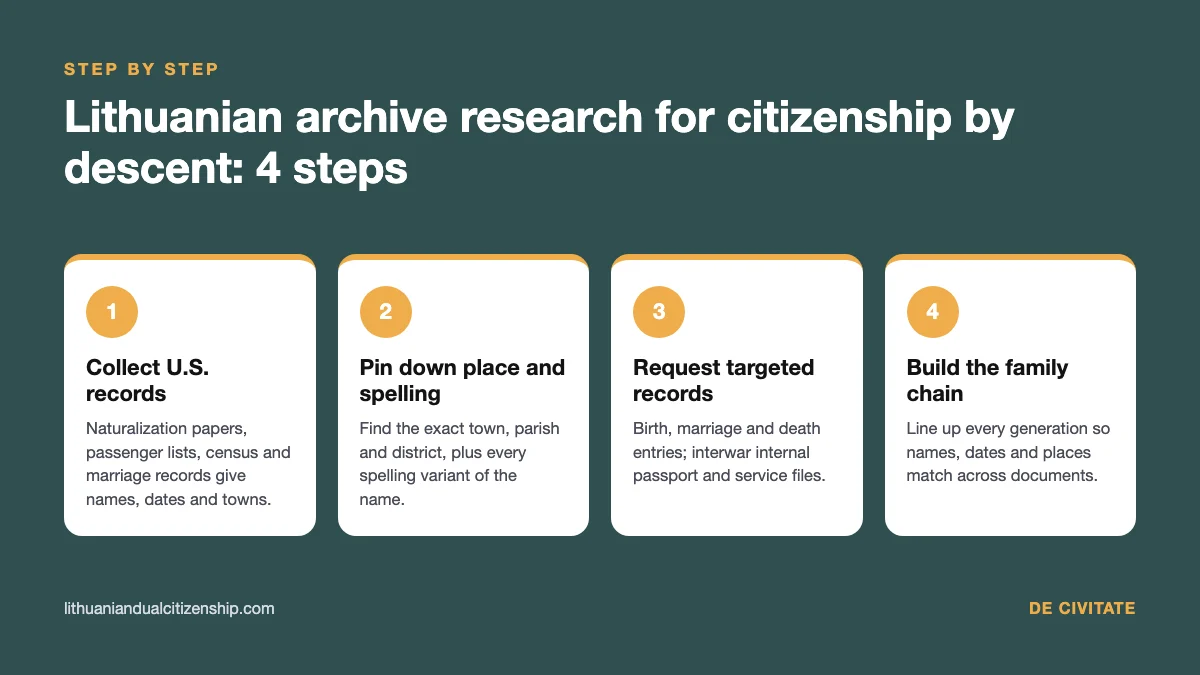
Before contacting a Lithuanian archive, it is useful to organize the available information into a clear research summary. This summary should identify the ancestor, known spelling variants, approximate dates, family members, religion, place names, migration details, and the specific document being requested.
A focused request is usually better than a broad one. Instead of asking for “all records about my Lithuanian family,” it is more effective to ask for a birth record for a named person in a specific town around a specific year, or an internal passport file for a person who lived in a known district during the interwar period.
It is also useful to separate research goals. One goal may be to prove the ancestor’s birth and parents. Another may be to find proof of Lithuanian citizenship before 1940. Another may be to document the family chain from the ancestor to the applicant. Each goal may require different records and sometimes different archives.
Common Mistakes in Lithuanian Archive Research
One common mistake is assuming that a U.S. record showing Lithuanian ancestry is the same as proof of Lithuanian citizenship. It may be a useful clue, but citizenship restoration usually requires more precise documentation.
Another mistake is searching only under the modern English spelling of a name. Lithuanian, Polish, Russian, Jewish, and American records may all record the same person differently. A search strategy should account for phonetic variations, transliteration, maiden names, patronymics, and shortened names.
A third mistake is ignoring historical geography. Many families search for a modern town name without checking older administrative names. In Lithuanian research, the same place may appear under different names depending on the period, language, and government that created the record.
A fourth mistake is treating archive records as isolated documents. A birth record, internal passport file, U.S. naturalization record, and marriage certificate may each provide only part of the story. The strongest citizenship by descent file usually depends on how well the documents work together.
FAQ
Where can I find Lithuanian archive records for citizenship by descent?
Lithuanian archive records for citizenship by descent are usually found in Lithuanian state archives, especially archives holding vital records, interwar administrative records, internal passport files, military records, residence records, and other historical documents. The correct archive depends on the type of record, the ancestor’s location, the relevant period, and the purpose of the search.
Are Lithuanian birth records enough for citizenship by descent?
Lithuanian birth records may be important, but they are not always enough by themselves. A birth record can help prove identity, family connection, and place of birth. However, proof of Lithuanian citizenship before 1940 may require additional documents, such as internal passport records, citizenship-related documents, military or civil service records, residence records, or other archive evidence.
What are Lithuanian internal passport records from 1919 to 1940?
Lithuanian internal passport records from 1919 to 1940 were connected to identity documentation inside interwar Lithuania. They may contain personal details such as name, birth information, residence, family status, occupation, and sometimes photographs or supporting documents. In citizenship restoration research, they can be valuable because they may help show that a person was officially recorded by Lithuanian authorities during the relevant period.
What information do I need before requesting a Lithuanian archive search?
The most useful information includes the ancestor’s full name, maiden name if applicable, approximate birth date, place of birth or residence, parents’ names, spouse’s name, religion, emigration period, and known spelling variants. Even approximate details can help, but a more specific request usually gives archivists a better chance of locating the correct record.
Can U.S. records replace Lithuanian archive records?
U.S. records can be very useful, but they usually work best as supporting evidence. Naturalization records, passenger lists, census records, and marriage or death certificates may provide clues about identity, birthplace, migration, and family relationships. For citizenship restoration, Lithuanian archive records or official documents from Lithuania may still be needed to establish facts more directly.
What if my ancestor’s U.S. records say Russia or Poland instead of Lithuania?
This is common in Lithuanian ancestry research. Historical borders and place names changed, and many U.S. records used broader political terms such as Russia, Poland, Kovno, Vilna, or Suwalki. The important step is to identify the specific locality and determine whether it corresponds to a place relevant to Lithuanian archival records and citizenship research.
Can archive records prove Lithuanian citizenship before 1940 without an old passport?
They may help. An old Lithuanian passport can be strong evidence, but it is not always available. Other records, including internal passport files, military or civil service documents, identity records, residence records, and archive certificates, may support proof of Lithuanian citizenship before 1940, depending on the content of the records and the applicant’s overall evidence file.
Is Lithuanian archive research the same as genealogy research?
Not exactly. Genealogy research focuses on reconstructing family history. Lithuanian citizenship restoration research must also consider whether the documents support a legal claim. The records need to connect the applicant to the ancestor and may need to show facts relevant to Lithuanian citizenship, residence, departure, identity, and name continuity.
Find out if you qualify — free
Send us your family details and a Lithuanian citizenship specialist will review your case and explain your options.
Start free eligibility check