For many families in the United States, the main challenge in Lithuanian citizenship restoration is not proving Lithuanian ancestry in a general sense. The harder question is often more specific: how to prove Lithuanian citizenship before 1940 when the family no longer has an old Lithuanian passport.
This issue is common. Many Lithuanian emigrants left Europe during war, occupation, displacement, poverty, or political instability. Original passports, identity papers, and civil documents may have been lost, destroyed, renamed, mistranslated, or left behind. In some families, descendants only have U.S. records showing that an ancestor was born in “Russia,” “Poland,” “Kovno,” “Vilna,” “Lithuania,” or another historical place name.
The absence of an original passport does not automatically mean that a citizenship restoration case is impossible. In many cases, proof of Lithuanian citizenship before 1940 may be built through a combination of Lithuanian archive records, military records, civil status documents, internal passport files, residence records, foreign immigration documents, and family-line evidence. The strength of the case usually depends on whether the documents can show both the ancestor’s legal connection to the Republic of Lithuania before June 15, 1940 and the applicant’s descent from that person.
In short
- An old Lithuanian passport is strong evidence, but it is not the only way to prove citizenship before 1940.
- Internal passport files, Lithuanian military records, civil service and identity records can serve as direct evidence.
- Birth, marriage and death records mainly prove the family line, not citizenship itself.
- U.S. naturalization papers, passenger lists and census records support the case but rarely replace Lithuanian proof.
- Records listing Russia, Poland, Kovno or Vilna are common and can be explained with consistent supporting documents.
Why the Date Before 1940 Matters
When people refer to Lithuanian citizenship before 1940, they are usually referring to citizenship of the Republic of Lithuania before the Soviet occupation period. For citizenship restoration by descent, the relevant historical question is often whether the applicant, parent, grandparent, or great-grandparent held Lithuanian citizenship before June 15, 1940.
This distinction matters because Lithuanian ethnicity, Lithuanian language, Lithuanian birthplace, and Lithuanian citizenship are not always the same thing. A person may have been ethnically Lithuanian but not documented clearly as a citizen of the Republic of Lithuania. Another person may have lived in a border region where records used Polish, Russian, Yiddish, German, or Lithuanian forms of names and places. In citizenship restoration research, the goal is usually not only to show heritage but to document the legal status of the ancestor.
A well-prepared case usually separates three questions. First, who was the ancestor? Second, what evidence shows that this ancestor held Lithuanian citizenship before 1940? Third, how is the modern applicant legally connected to that ancestor through birth, marriage, name-change, and other family records?
Is an Old Lithuanian Passport Always Required?
An old Lithuanian passport is strong evidence, but it is not always the only possible form of evidence. Many families do not have an original passport because the document was lost during emigration, war, displacement, or later family moves. Others may only know that a passport once existed but cannot locate it.
In practice, documents proving Lithuanian citizenship before 1940 can include several types of official or supporting records. An internal or foreign passport issued by the Republic of Lithuania before June 15, 1940 is one of the clearest examples. However, other documents may also help if they directly or indirectly show Lithuanian citizenship, residence, military service, public service, identity, or legal status.
The key point is that a missing passport usually shifts the work from simple document collection to historical reconstruction. Instead of relying on one document, the applicant may need to assemble a consistent evidentiary chain from multiple sources. That chain should connect the same person across different records, explain name and place variations, and support the conclusion that the ancestor was a Lithuanian citizen before 1940.
Direct Evidence of Lithuanian Citizenship Before 1940
Direct evidence is the strongest category of proof. It usually includes documents that explicitly show that the person was a citizen of the Republic of Lithuania or held a Lithuanian state-issued identity document before the relevant date.
An internal passport or foreign passport of the Republic of Lithuania issued before June 15, 1940 is often the clearest form of direct evidence. Some families may also find identity documents, certificates, or official references that identify the person as a Lithuanian citizen. Documents related to service in the Lithuanian armed forces or employment in the Lithuanian civil service may also be important, especially when they identify the person clearly and correspond with the correct period.
When direct evidence exists, the case can be more straightforward. Still, the document must usually match the correct person, date range, and family line. If the name appears in a different spelling or language, the applicant may need additional records to show that the person in the archive document is the same ancestor in the family tree.
| Evidence | What it shows | Strength |
|---|---|---|
| Lithuanian internal or foreign passport issued before 15 June 1940 | Citizenship of the Republic of Lithuania | Direct — the clearest proof |
| Internal passport archive files | Identity, residence and administrative records of the interwar state | Direct or strong, when the file survived |
| Lithuanian military records | Service in the Lithuanian armed forces | Strong, for men of service age |
| Civil service and identity records | Official status in interwar Lithuania | Strong when the person is clearly identified |
| Birth, marriage and death records | Family line, birthplace, parents | Supporting — usually not proof of citizenship |
| U.S. records (naturalization, passenger lists, census) | Identity, timeline, former nationality | Supporting evidence |
Lithuanian Internal Passport Records
Lithuanian internal passport records are often one of the most important sources for citizenship by descent evidence. These records may contain details about a person’s identity, residence, age, family status, occupation, photograph, place of origin, or other identifying information. Depending on the surviving archive file, they may help establish that a person lived under the legal framework of the Republic of Lithuania during the interwar period.
For descendants in the United States, internal passport files can be especially useful when the family does not have the original passport. The archive record may preserve traces of the passport application or related administrative documentation even if the physical document itself disappeared.
These records are also useful for resolving spelling problems. A Lithuanian surname may appear with Lithuanian endings in one file, a Russian or Polish spelling in another, and an Americanized version in U.S. records. If the same birth date, parents, spouse, residence, or place of origin appears across records, the internal passport file may become part of a broader proof package.
Lithuanian Military Records as Citizenship Evidence
Lithuanian military records may also help prove Lithuanian citizenship before 1940. Service in the Lithuanian armed forces can be significant because it may show the person’s relationship with the Lithuanian state during the interwar period.
Military-related documents may include service records, conscription files, certificates, personnel documents, or archive references. Their value depends on the details they contain. A record that clearly identifies the person, date, place, and service connection is usually more useful than a vague reference with limited identifying information.
Military records can be especially helpful for male ancestors who were of service age during the interwar period. However, not every Lithuanian citizen served in the army, and the absence of military records should not be treated as proof that the person was not a citizen. It simply means that other evidence may need to be used.
Civil Status Records and Family Documents
Civil status records are usually essential for proving the family line. Birth, marriage, divorce, death, and name-change documents may not always prove citizenship by themselves, but they help connect the applicant to the Lithuanian ancestor.
For example, a Lithuanian birth record may show where the ancestor was born and who the parents were. A marriage record may connect the ancestor to a spouse whose name later appears in U.S. immigration records. A death certificate may preserve a birthplace, parent names, or alternate surname spelling. U.S. birth certificates can connect each generation from the applicant back to the Lithuanian-born ancestor.
These records become more important when the old passport is missing. If the applicant relies on archive records found in Lithuania, civil documents must usually show that the person in those Lithuanian records is the same person from whom the applicant descends. Without a clear family chain, even a promising Lithuanian archive record may not be enough.
Lithuanian Archive Records for Citizenship by Descent
Lithuanian archive records for citizenship by descent may include internal passport files, residence records, municipal documents, court records, property records, school records, civil service documents, tax-related materials, and other administrative records from the relevant period. The availability of these records depends on the location, time period, survival of files, and historical circumstances.
Archive research often requires flexibility because not every ancestor will appear in the same type of file. Some people left a clear paper trail through passports or military service. Others may appear mainly in local records, church books, civil registry documents, residence lists, or indirect references.
For families in the United States, the archive search often begins with what is already known from American records. Passenger lists, naturalization papers, census entries, draft registrations, marriage certificates, and death records may provide clues about original names, birthplaces, dates, relatives, and migration routes. Those clues can then help narrow the search in Lithuanian archives.
Foreign Records That Can Support the Case
Foreign records do not usually replace Lithuanian proof of citizenship by themselves, but they can support the reconstruction of identity and timeline. U.S. naturalization records, alien registration files, passenger lists, census records, draft cards, Social Security records, and immigration documents may all help identify the ancestor and connect them to Lithuania.
For example, a U.S. naturalization petition may list the ancestor’s place of birth, date of arrival, spouse, children, and former nationality. A passenger list may show the last residence or nearest relative in Lithuania. A census record may show language, immigration year, or citizenship status in the United States. These records can help confirm that the person found in Lithuanian archives is the same person who later appeared in the United States.
Foreign records must be used carefully. Historical U.S. documents may list Lithuania as Russia, Poland, Kovno, Kovna, Vilna, Wilno, or another historical term. This does not necessarily defeat a case, but it may require explanation. The goal is to show consistency across the full document set rather than rely on a single foreign document in isolation.
When Records Say Russia, Poland, Kovno, or Vilna
Many American families are confused when their ancestor’s records do not say “Lithuania.” This is common in Lithuanian citizenship research because borders, empires, administrative regions, and place names changed over time. An ancestor may have been born in a place that later became part of Lithuania, or a U.S. document may have used the political term familiar at the time of immigration.
“Kovno” or “Kovna” may refer to Kaunas or the Kaunas region. “Vilna” or “Wilno” may refer to Vilnius or the Vilnius region. Some records may say Russia because the ancestor was born before Lithuanian independence, when much of the territory was under the Russian Empire. Other records may say Poland because of interwar border changes or the way foreign clerks understood the region.
These variations should not be ignored, but they should not be treated automatically as contradictions either. A strong application usually explains historical geography, connects place names to modern or interwar locations, and supports the explanation with consistent identity records.
How to Build Evidence Without an Old Passport
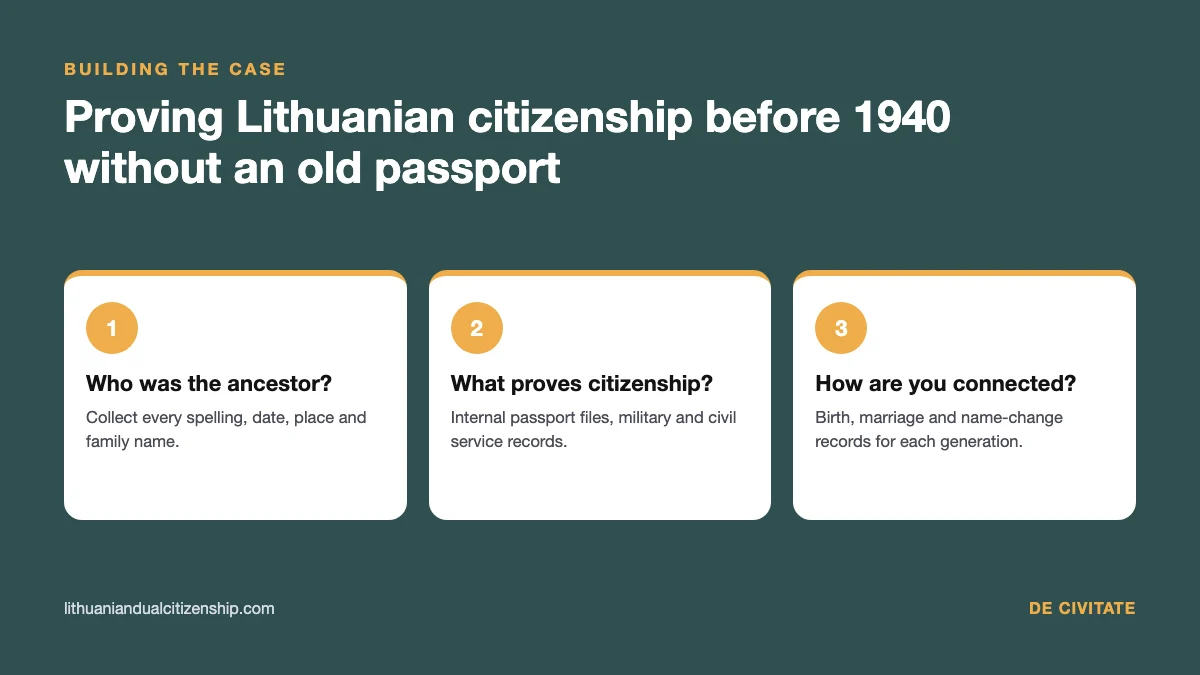
When an old passport is missing, the strongest approach is usually to build a layered evidence file. The file should first identify the ancestor as precisely as possible. This means collecting names in all known spellings, birth dates, birthplaces, spouse names, parent names, children’s names, religion where relevant, migration dates, and known residences.
The next step is to search for Lithuanian-side evidence. Internal passport records, military records, civil status documents, residence records, and other archive materials may help show the ancestor’s status before 1940. If direct evidence is not available, indirect evidence may still be useful, especially when multiple records point to the same legal and historical conclusion.
The final step is to connect the ancestor to the applicant. Each generation should be supported by civil documents such as birth and marriage records. If names changed through marriage, immigration, translation, or Americanization, the file should include records that explain those changes.
Common Problems in Pre-1940 Citizenship Proof
One common problem is inconsistent spelling. Lithuanian names may appear differently in Lithuanian, Polish, Russian, Yiddish, German, and English records. Surnames may also change after immigration to the United States. A difference in spelling does not necessarily make the record unusable, but the applicant may need enough surrounding details to show that the records refer to the same person.
Another problem is missing birth or marriage records. Some records were lost, damaged, or never centralized. In such cases, church records, archive extracts, foreign civil records, or secondary documents may help fill the gap. The value of these records depends on their reliability, detail, and consistency with the rest of the file.
A third problem is confusing ancestry with citizenship. Lithuanian origin may help explain the family history, but citizenship restoration usually requires more than a general statement that the ancestor was Lithuanian. The evidence should support the ancestor’s legal status before 1940 and the applicant’s descent from that person.
How Strong Should the Evidence Be?
There is no universal document set that works for every family. The strength of proof depends on the ancestor’s history, the records that survived, the clarity of the family line, and how the authorities evaluate the evidence. A case with a pre-1940 Lithuanian passport may look different from a case based on internal passport files, military documents, and foreign immigration records.
In many cases, the best evidence package is not the largest one but the most coherent one. Documents should support each other. Dates should be explainable. Name variations should be documented. Places should make historical sense. The family line should be clear from the ancestor to the applicant.
Because citizenship restoration documents are reviewed in a legal and administrative context, applicants should avoid assuming that any single record will be sufficient. A U.S. census record, family story, DNA result, or old photograph may be helpful background, but it usually needs to be supported by official documents that address citizenship, identity, and descent more directly.
FAQ
Can I prove Lithuanian citizenship before 1940 without an old passport?
Yes, in many cases it may be possible to prove Lithuanian citizenship before 1940 without an old passport. Alternative evidence may include Lithuanian internal passport records, military records, civil service records, civil status documents, archive records, residence records, and foreign immigration documents that help establish the ancestor’s identity and legal connection to Lithuania.
What documents can prove Lithuanian citizenship before 1940?
Documents proving Lithuanian citizenship before 1940 may include internal or foreign passports of the Republic of Lithuania, records related to service in the Lithuanian armed forces, civil service documents, identity records, birth or civil status documents that directly refer to Lithuanian citizenship, and other archive records that support the person’s status before June 15, 1940.
Are Lithuanian archive records useful for citizenship by descent?
Yes, Lithuanian archive records can be very useful for citizenship by descent, especially when the family does not have an original passport. Archive files may help confirm identity, residence, family connections, military service, civil status, or other facts relevant to proving Lithuanian citizenship before 1940.
Can U.S. records help prove Lithuanian citizenship ancestor proof?
U.S. records can help support Lithuanian citizenship ancestor proof, but they usually work best as supporting evidence rather than the only evidence. Naturalization records, passenger lists, census records, alien registration files, and death certificates may help identify the ancestor, confirm family links, and provide clues for Lithuanian archive research.
What if my ancestor’s records say Russia, Poland, Kovno, or Vilna instead of Lithuania?
This is common in Lithuanian citizenship research. Historical borders and place names changed, and foreign records often used older political or regional terms. These records may still be useful if they can be connected to the correct person, location, time period, and family line through consistent supporting documentation.
Find out if you qualify — free
Send us your family details and a Lithuanian citizenship specialist will review your case and explain your options.
Start free eligibility check