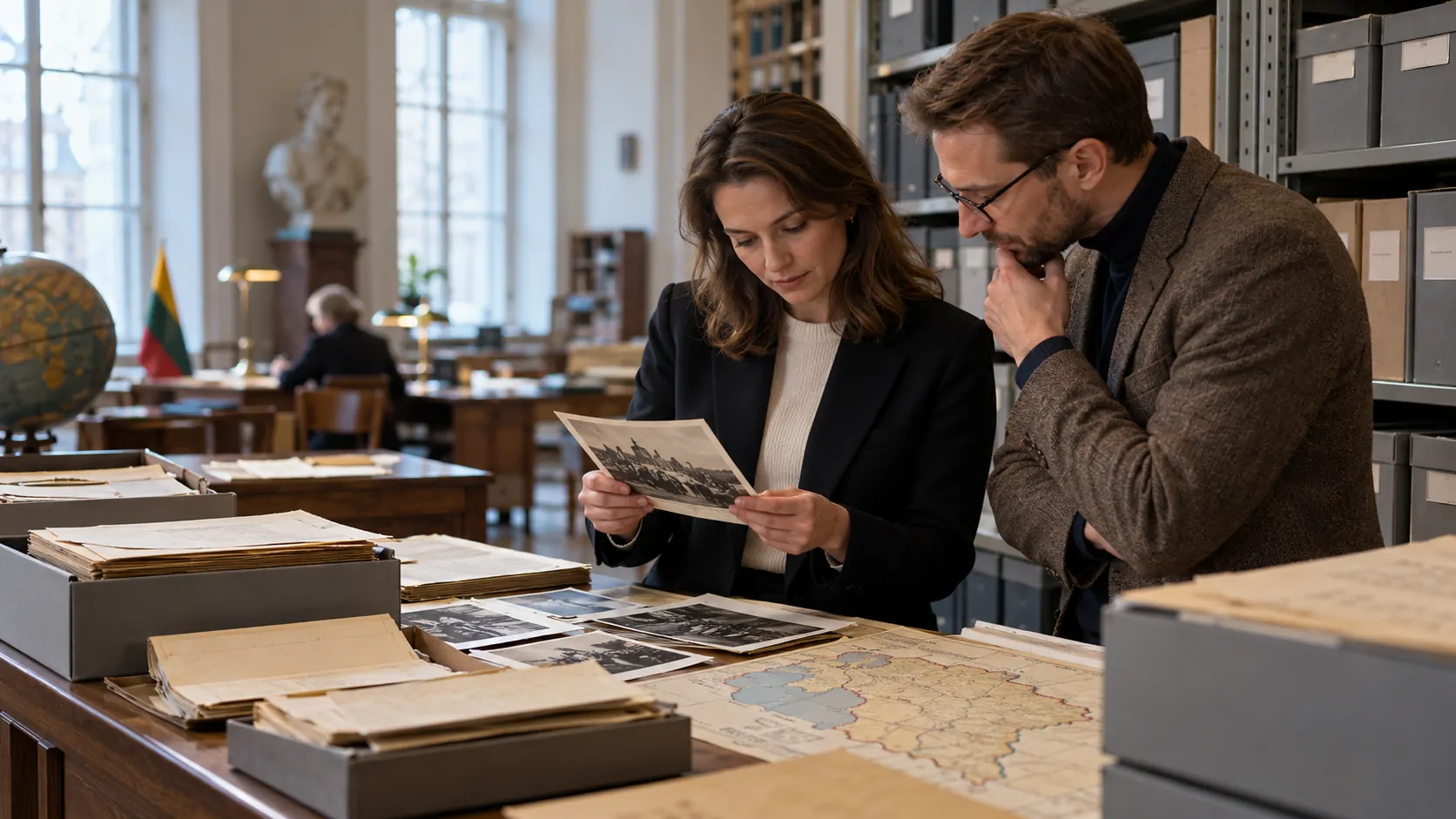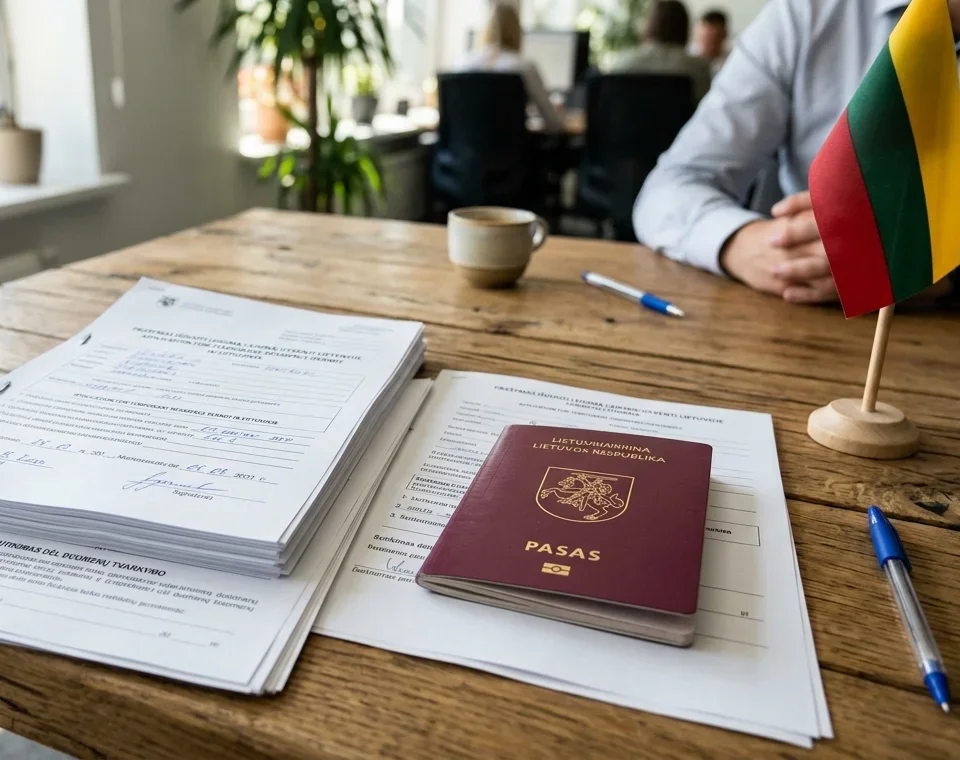
We sit across the table from hopeful families almost every single day. A prospective client will come into our office, open up a carefully preserved folder, and proudly slide a stack of vintage, sepia-toned photographs across the desk. They smile, pointing out their grandfather who emigrated from Kaunas decades ago, bringing nothing but a worn suitcase to start a new life. Because they read a few optimistic articles online, they naturally assume that claiming lithuanian citizenship by descent is just a matter of mailing these nostalgic old papers overseas and waiting for a brand-new passport to arrive in the mail.
As legal professionals, our team has the difficult job of shattering that illusion.
Here is the reality of the situation in 2026. The European migration bureaucracy functions like a highly calibrated, completely unforgiving machine. The officials reviewing files in Vilnius do not operate on family nostalgia. They certainly do not make decisions based on good intentions or educated guesses. They operate on ruthless, uncompromising legal frameworks. If your application is missing a single required stamp, your case gets suspended. If you submit the wrong translation formatting, you are looking at an outright rejection.
In short
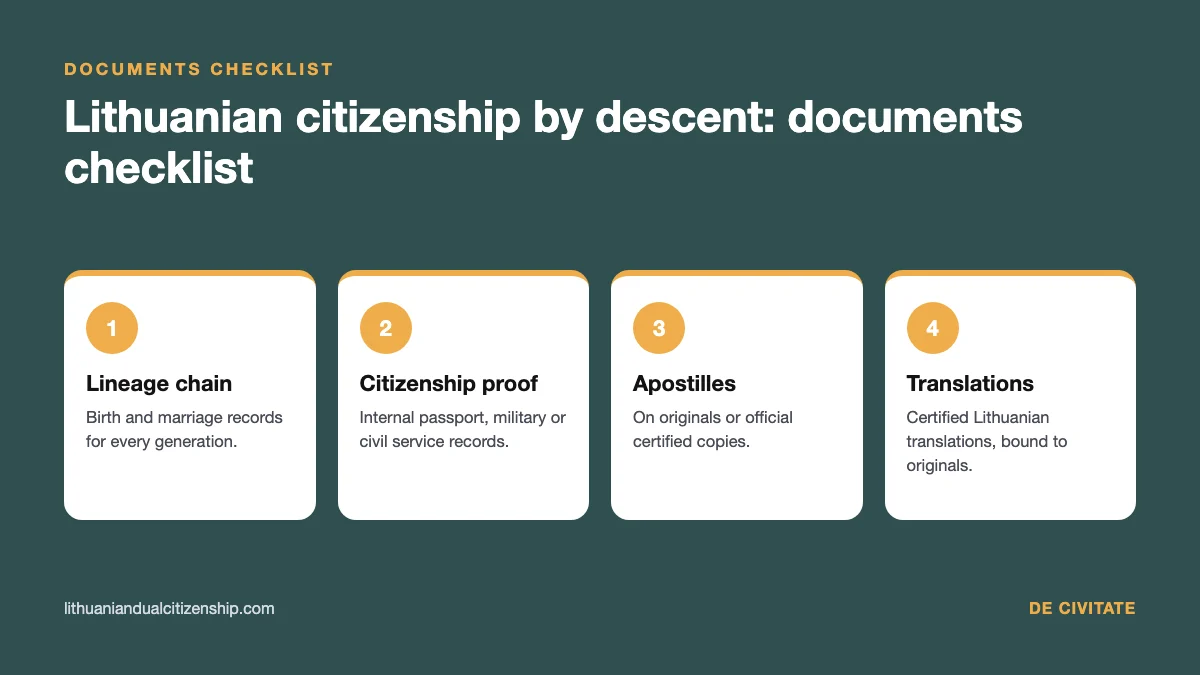
- Your file needs two things: an unbroken lineage chain and proof of the ancestor’s Lithuanian citizenship.
- The lineage chain starts with your own birth certificate and passport and goes up generation by generation.
- Strong citizenship proof includes interwar internal passports, military service books and civil service records.
- Every civil document issued outside Lithuania needs an apostille on the original or an official certified copy.
- Translations into Lithuanian must be certified and bound to the authenticated originals.
Who Usually Qualifies (Quick Criteria)
Establishing the absolute baseline of your eligibility must always come first. Our attorneys constantly remind our clients that historical timelines dictate absolutely everything in modern immigration law. To qualify under the current statutes, your ancestor must have held actual, official citizenship of the Republic of Lithuania prior to June 15, 1940. Furthermore, they had to depart that territory before March 11, 1990.
Did they flee the advancing Soviet tanks? Did they survive the horrors of Siberian exile? That specific history of traumatic displacement is actually the key that unlocks your legal rights today. If your family history aligns perfectly with those dates, you most likely qualify for lithuanian dual citizenship. This remarkable legal provision allows applicants to retain their American, British, Australian, or Canadian passports while holding a European Union passport simultaneously. However, a theoretical qualification remains completely useless unless you can back it up. It requires undeniable physical proof.
The Core Lineage Chain (Your Mandatory Set)
Our consultants describe successful applications as unbreakable physical chains. You stand at the bottom of this chain, and your ancestor stands at the very top. We must connect every single generation in between using flawless vital records. If even one single marriage record goes missing, that chain breaks entirely. The Migration Department will stop reviewing your file immediately. Gathering the correct lithuanian citizenship by descent documents requires immense patience, money, and professional precision.
Your Documents
We always start with your own identity. The migration officials need your original, long-form birth certificate and a certified copy of your current valid passport. Are you married? You must include your marriage certificate. Did you change your name legally for any other reason, like an adoption? We need those specific court orders. You should never provide blurry smartphone scans or uncertified printouts. Our firm strictly submits pristine, certified copies issued directly by civil registries. Anything less guarantees a failure.
Parent Documents
Next, we move upward one generation. We need your parents’ birth certificates alongside their marriage records. If they eventually divorced, we must add the divorce decrees to the file. The officials track every single name change bridging these generations to prevent identity fraud. If your mother’s maiden name shows strange spelling variations across different records, our lawyers must clarify them immediately. We build solid chronological bridges so the foreign bureaucrats never have to guess who is who.
Grandparent / Great-Grandparent Documents
Keep digging deeper into the archives. You must locate the vital records for your grandparents. If you are tracing your roots back to your great-grandparents, that means finding their paperwork too. Locating a 1928 marriage certificate from some tiny farming village frustrates families constantly, but you absolutely must find it. Without the marriage records, legally proving that your grandfather actually fathered your parent becomes legally impossible. Our firm frequently assists clients in hunting down these highly elusive regional records.
| Generation | Documents |
|---|---|
| You | Long-form birth certificate, valid passport, marriage certificate and name-change records if any |
| Your parents | Birth certificates, marriage records, divorce decrees if any |
| Grandparents / great-grandparents | Birth and marriage records for each generation up to the ancestor |
| The Lithuanian ancestor | Proof of citizenship: interwar internal passport, military service book, civil service records, archive extracts |
| All foreign documents | Apostille plus certified Lithuanian translation |
Strong Proof of Lithuanian Citizenship/Origin
This specific hurdle destroys the vast majority of DIY applications. Proving ethnic origin means absolutely nothing to any government. Your DNA test does not matter here. Our firm must provide concrete proof of lithuanian ancestry demonstrating their actual legal citizenship at the time. Acquiring your lithuanian ancestry citizenship represents a highly specific legal status that requires a rock-solid paper trail.
Passports, ID, and Citizenship Records
What do the migration officials actually respect? Internal passports issued between 1918 and 1940 act as absolute gold. Old military service books work beautifully. Civil service employment records serve as excellent proof as well. Interestingly, foreign naturalization papers—like US citizenship documents—that explicitly list a previous nationality as “Lithuanian” carry massive weight today. We use whatever official interwar documents we can find to build the case.
Lithuanian Archive Extracts and Registry Evidence
Ancestors who fled the war usually left everything behind. When the family attics turn up completely empty, our archival researchers step in to help. Requesting lithuanian archives citizenship records usually becomes our primary and most successful strategy. We dig through interwar census data, regional tax registries, and passport issuance logs hidden deep inside the vaults in Vilnius. Finding an old passport application that still contains the original fingerprints and photographs serves as an undeniable trump card. Official archival extracts hold supreme legal authority.
Missing Documents: What to Do
World War II destroyed massive European archives. Missing crucial papers happens to nearly every single client our firm represents. Do not panic if you hit a dead end. Our legal team builds solid cases around these historical gaps every single day. We know the legal workarounds.
Alternative Evidence Options
If you cannot find the civil birth certificates, church baptismal registries serve as excellent secondary options. We hunt for old property deeds, school enrollment logs, or historical ship passenger manifests showing the departure ports. Our legal strategy involves combining multiple weaker alternative documents to build one undeniable argument that satisfies the strict migration officers. We essentially overwhelm them with secondary data to prove our point.
Correcting and Reissuing Records
Sometimes the documents you find contain glaring errors. Local clerks misspelled hometowns or recorded the wrong birth years. Submitting documents with uncorrected errors can lead to requests for additional evidence, delays or a refusal. Our attorneys often must navigate local court systems to legally amend the incorrect vital records before sending anything overseas. Correcting these historical mistakes takes months and requires navigating local county bureaucracy, but it remains completely necessary for a successful European application.
Apostille/Legalization Checklist
Vintage 1950 birth certificates look beautiful, but European bureaucrats require international authentication stamps. Securing an apostille for lithuanian citizenship remains entirely non-negotiable for our firm. It proves to the foreign governments that your local state documents are genuinely authentic and not forged.
Which Documents Typically Need Apostille
Any civil registry document issued outside of Lithuania needs an apostille. This typically covers birth, marriage and death certificates and name-change or naturalization records. Documents from countries outside the Hague Apostille Convention need consular legalization instead. Requirements can vary by document type, so check the current Migration Department guidance before you order stamps; documents without the required authentication are usually not accepted.
Common Apostille Errors to Avoid
Our consultants see easily preventable mistakes constantly. First, never get photocopies apostilled; you must authenticate the original documents or official certified copies only. Second, once the state secretaries staple the apostille certificates to your documents, you must never remove those staples. Taking the staples out invalidates the apostilles completely, and your document loses all of its legal power instantly. Leave those staples alone.
Lithuanian Translations Checklist
The officials reviewing the files in Vilnius conduct their business in Lithuanian exclusively. Understanding the strict lithuanian translation requirements for citizenship ensures that the files process smoothly without unnecessary bureaucratic delays.
What Counts as an Official Translation
Your bilingual family members cannot translate these legal documents. The Migration Department demands certified, professional translations exclusively. The translators must attach sworn affidavits confirming the exact text accuracy. You must treat this step with extreme professionalism. Your legal translations demand an uncompromising, detail-oriented quality. You cannot cut corners here. Substandard translations will force the officials to question the validity of your entire file.
How to Package Originals + Translations
Bureaucrats appreciate highly organized submissions. The certified translations must be securely bound directly to the authenticated original documents using special ribbons and official seals. Messing with these bindings renders the documents completely void. Our firm ensures these packages remain intact and legally binding from the moment they leave our office to the moment they hit the official’s desk in Europe.
Name Mismatches and Inconsistencies
When immigrants arrived overseas, local port clerks frequently butchered their Eastern European names. Jonas became John. Karolis became Charles. Unexplained name differences between records are a common reason for follow-up questions and delays. Resolving any name mismatch lithuanian citizenship application requires an aggressive legal strategy from day one. We never wait for the government to ask questions.
Common Mismatch Types
Immigrants dropped difficult letters from their surnames constantly to assimilate. Dates of birth got mixed up because European exit papers and American entry logs utilized entirely different calendar formats. You cannot simply hope the officers will ignore these discrepancies. Our firm addresses them head-on, ensuring that no questions remain unanswered.
How to Prove “Same Person” Across Records
Fixing these inconsistencies requires building strict chronological timelines. Did they legally change their names during the naturalization process? We will retrieve that specific court document. If not, our attorneys will obtain an official “One and Same Person” court order locally. We show clear, undeniable evidence proving that John and Jonas are exactly one human being, making the official’s decision effortless.
Submission Strategy (DIY vs Assisted)
Navigating complex dual citizenship laws requires immense focus. Managing foreign bureaucracies across multiple time zones takes hundreds of hours. Unrepresented applicants often spend two full years tracking down their documents, only to receive delay notices over minor technicalities. They forget one stamp. They use the wrong translators. They misinterpret complex heritage laws.
Why navigate this highly complex legal maze completely alone?
Our firm handles these exact procedures every single day. We know exactly what the migration officials expect to see inside every submitted folder. We anticipate the problems long before they occur. Reclaiming your lithuanian dual citizenship by descent is a monumental event for your family tree, and it deserves professional attention.
FAQ
What documents do I need for Lithuanian citizenship by descent?
Your own birth certificate and passport, birth and marriage records connecting every generation to the Lithuanian ancestor, and proof that the ancestor was a Lithuanian citizen — for example an interwar internal passport, military service book or civil service records.
Do all documents need an apostille?
Civil registry documents issued outside Lithuania need an apostille. It must be placed on the original document or an official certified copy, not a photocopy.
Can family members translate my documents?
No. The Migration Department requires certified professional translations into Lithuanian, bound to the authenticated originals.
What if I cannot find a birth certificate?
Church baptismal registers, property deeds, school records or passenger manifests may serve as alternative evidence, and archive research often fills the gap.
What if names differ across documents?
Name differences must be explained with records — for example naturalization or court name-change documents — showing that the records refer to the same person.
Find out if you qualify — free
Send us your family details and a Lithuanian citizenship specialist will review your case and explain your options.
Start free eligibility check