
or a U.S. citizen considering Lithuanian citizenship restoration, the potential effect on a security clearance can be an important practical issue. This is particularly relevant for federal employees, military personnel, intelligence professionals, defense contractors, and others who hold or may later need access to classified information.
Lithuanian dual citizenship does not automatically prevent a U.S. citizen from obtaining or retaining a security clearance. However, applying for foreign citizenship, obtaining a foreign passport, using rights associated with another nationality, maintaining significant foreign interests, or failing to make required disclosures can receive additional scrutiny.
For people researching Lithuanian dual citizenship for Americans, the key question is therefore not simply whether two citizenships can coexist. The more important issue is how the foreign citizenship was obtained, why it was pursued, how it is used, what foreign connections exist, and whether applicable reporting requirements have been followed.
In short
- Lithuanian dual citizenship does not automatically disqualify you from a U.S. security clearance.
- Reviews focus on Foreign Preference (Guideline C) and Foreign Influence (Guideline B) — conduct, ties and disclosure.
- For covered individuals, applying for and receiving foreign citizenship are reportable under SEAD 3 — the application itself, not only approval.
- Applying for, holding or using a Lithuanian passport can be separately reportable; use a U.S. passport to enter and leave the U.S.
- There is no government-wide rule requiring renunciation, but agency-specific requirements may apply.
Dual Citizenship Is Not an Automatic Security Clearance Disqualifier
Under the National Security Adjudicative Guidelines, being a citizen of the United States and another country is not, by itself, disqualifying. The government evaluates whether the foreign involvement creates an actual conflict with U.S. national security interests or whether relevant information has been concealed. The assessment is based on the individual’s overall circumstances rather than citizenship status alone.
This means that security clearance for dual citizens is possible. Two applicants who both hold U.S. and Lithuanian citizenship may nevertheless be evaluated differently because their reasons for obtaining Lithuanian citizenship, foreign relationships, finances, travel patterns, passport use, and conduct may be different.
A person’s eligibility for classified access therefore cannot usually be determined from the existence of Lithuanian citizenship alone.
How Foreign Citizenship Is Evaluated in a Security Clearance Review
Foreign citizenship issues most commonly intersect with Guideline B, Foreign Influence, and Guideline C, Foreign Preference.
These guidelines address different but sometimes overlapping concerns. Foreign Influence focuses primarily on relationships and interests that could create vulnerability to pressure or conflicting obligations. Foreign Preference focuses more directly on conduct that may indicate preference for another country when that conduct conflicts with U.S. national security interests.
Foreign Preference
Guideline C does not assume that exercising a right associated with another citizenship automatically demonstrates disloyalty. Instead, the surrounding circumstances matter.
Potential concerns can include applying for or acquiring another citizenship, failing to report a foreign passport or identity document when reporting is required, failing to use a U.S. passport when entering or leaving the United States, certain forms of foreign government or military involvement, and other conduct that may demonstrate conflicting foreign obligations. SEAD 4 also identifies circumstances that may mitigate concerns, including cases where the foreign citizenship does not conflict with U.S. national security interests.
This distinction matters for someone actively pursuing Lithuanian citizenship restoration. The clearance review may focus less on the label “dual citizen” and more on what the applicant has actually done in connection with the second nationality.
Foreign Influence
Guideline B considers whether foreign contacts or interests could create divided allegiance, vulnerability to coercion, or a conflict between personal interests and the obligation to protect classified information.
Relevant circumstances may include close relationships abroad, significant foreign financial or property interests, professional connections, business activities, or connections to foreign governments. The country involved and the nature and significance of those connections can also be considered.
Having relatives in Lithuania or maintaining an ordinary connection with Lithuanian heritage is therefore not automatically disqualifying. The significance of a particular foreign connection depends on its nature, frequency, financial importance, and potential to create pressure or conflicting obligations.
Why Restoring Lithuanian Citizenship May Receive Additional Attention
There can be an important distinction between automatically possessing foreign citizenship from birth and deliberately taking steps to obtain or formally restore citizenship later in life.
SEAD 4 specifically recognizes that citizenship arising solely from a parent’s citizenship or from birth in another country can be relevant when evaluating possible concerns. An affirmative application for another nationality presents a different factual situation because the applicant has intentionally taken action concerning foreign citizenship.
For many Americans pursuing Lithuanian dual citizenship by descent, the motivation may be family heritage, preserving a legal connection to ancestors, mobility within Europe, or passing citizenship rights to descendants. None of those reasons establishes a security problem on its own.
However, an investigator or adjudicator may reasonably examine why the citizenship was pursued and what the applicant intends to do with it. Obtaining citizenship primarily to document ancestry may present a different factual profile from obtaining it as part of plans for foreign government employment, permanent relocation, significant overseas business activity, or other substantial foreign commitments.
The purpose should be explained accurately rather than framed around what the applicant believes an investigator would prefer to hear.
Does Applying for Lithuanian Citizenship Have to Be Reported?
For individuals already subject to national security reporting requirements, this is particularly important.
SEAD 3 identifies application for and receipt of foreign citizenship as reportable foreign activities for covered individuals. Application for, possession of, or use of a foreign passport or identity card for travel is also identified as reportable.
Accordingly, an active clearance holder should not assume that reporting is required only after Lithuanian citizenship has been approved. The application itself may be reportable.
The precise reporting process can vary according to the employing agency, clearance environment, contractual requirements, and position. DCSA advises federal civilians to work with their agency security office and DoD contractors to work with their Facility Security Officer when determining how to self-report relevant security changes or concerns.
Someone considering submission through MIGRIS while holding a clearance should therefore review the applicable security rules before filing rather than waiting until the Lithuanian process is complete.
What Happens If You Obtain a Lithuanian Passport?
A Lithuanian passport can receive separate attention from the citizenship itself.
Under current adjudicative guidance, the relevant considerations include disclosure and how the passport is used. SEAD 4 identifies failure to disclose a foreign passport or identity card when required, as well as failure to use a U.S. passport when entering or leaving the United States, among conduct that may raise foreign-preference concerns.
SEAD 3 separately treats application for, possession of, or use of a foreign passport for travel as reportable for covered individuals.
A person should therefore avoid assuming that obtaining Lithuanian citizenship and obtaining or using a Lithuanian passport are identical security events. Each may create a separate reporting obligation or question.
Agency-specific requirements should also be checked before using a Lithuanian passport. A general security clearance determination does not necessarily override restrictions associated with a particular employer, assignment, intelligence program, or sensitive position.
Foreign Citizenship Rights Can Matter More Than Citizenship Status Alone
Lithuanian citizenship can provide meaningful rights beyond simply possessing evidence of ancestry. Depending on the person’s situation, it may affect European residence, employment, travel, political participation, and other activities.
From a clearance perspective, what matters is how those rights interact with the individual’s overall foreign connections and obligations.
For example, obtaining citizenship but maintaining limited foreign involvement can present a different factual situation from combining Lithuanian citizenship with substantial property, financial interests, political activity, foreign government employment, or extensive overseas commitments.
The same principle applies when evaluating the broader pros and cons of dual citizenship. A benefit that is legally available to a Lithuanian citizen is not automatically a security concern, but actually exercising particular rights may become relevant depending on the circumstances.
| Event | Security relevance |
|---|---|
| Applying for Lithuanian citizenship | Reportable for covered individuals (SEAD 3) |
| Receiving Lithuanian citizenship | Reportable; disclosed in later vetting |
| Applying for or holding a Lithuanian passport | Reportable; separate from citizenship |
| Using a foreign passport to enter or leave the U.S. | Potential concern — use a U.S. passport |
| Property, finances or close ties in Lithuania | Assessed under Foreign Influence (Guideline B) |
| Citizenship restored for family heritage | Not disqualifying by itself; conduct afterwards matters |
Can You Keep Lithuanian Citizenship With a Security Clearance?
There is no government-wide rule stating that every U.S. dual citizen must renounce another citizenship solely in order to hold a security clearance.
SEAD 4 identifies willingness to renounce foreign citizenship that conflicts with U.S. national security interests as one potential mitigating circumstance, but it does not establish universal renunciation as an automatic requirement for every dual citizen.
The practical result is that a U.S. citizen may be able to maintain both Lithuanian citizenship and security clearance eligibility.
That does not mean every agency, position, overseas assignment, special-access program, or employment suitability determination will be treated identically. A person can potentially satisfy the general standards for clearance eligibility while facing additional requirements associated with a particular position.
Applicants should therefore distinguish between national security eligibility, employment suitability, access to a particular classified program, and assignment eligibility.
Foreign Family, Property, and Financial Connections
Restoring Lithuanian citizenship sometimes accompanies other changes in a person’s relationship with Lithuania. Someone may begin spending more time there, acquire property, maintain financial accounts, develop business relationships, or strengthen connections with relatives.
None of these circumstances should automatically be interpreted as disqualifying.
However, Guideline B specifically recognizes that foreign business, financial, property, and personal relationships can become relevant if they create a potential conflict of interest or make an individual vulnerable to foreign pressure.
An applicant should therefore expect the overall foreign profile to matter more than the citizenship certificate considered in isolation.
Applying for a Security Clearance After Restoring Lithuanian Citizenship
A person who restores Lithuanian citizenship before ever applying for a U.S. security clearance should still expect to disclose the relevant information during the personnel vetting process.
Current DCSA eApp guidance requires applicants to provide information about dual or multiple citizenship, including the foreign country, dates of citizenship, how citizenship was acquired, and relevant renunciation actions if applicable. It also requires information concerning current and previous foreign passports.
Accuracy is particularly important. A foreign citizenship issue that might otherwise be explainable can become more significant if an applicant provides incomplete, inconsistent, or misleading information.
Applicants should therefore preserve records showing when Lithuanian citizenship was applied for, when it was recognized or restored, and when any Lithuanian passport was issued or used. Maintaining an organized Lithuanian citizenship documents checklist can also make it easier to explain the chronology later if questions arise during the clearance investigation.
Does the Reason for Restoring Citizenship Matter?
It can.
Security adjudication involves context, so the reason for intentionally pursuing another citizenship may help explain the individual’s conduct.
An applicant who restored Lithuanian citizenship because of documented family heritage may have a different overall profile from someone whose restoration coincided with extensive plans to relocate, enter foreign government service, develop substantial foreign financial interests, or exercise obligations that could conflict with U.S. responsibilities.
The motivation itself is not evaluated in isolation. Investigators and adjudicators can consider what the person says alongside what the person actually does.
Consistency therefore matters. If an applicant describes restoration as primarily related to ancestry but subsequently uses Lithuanian citizenship extensively for financial, political, professional, or governmental purposes, those later activities may become relevant to the overall assessment.
What Should a Clearance Holder Review Before Starting the Lithuanian Process?
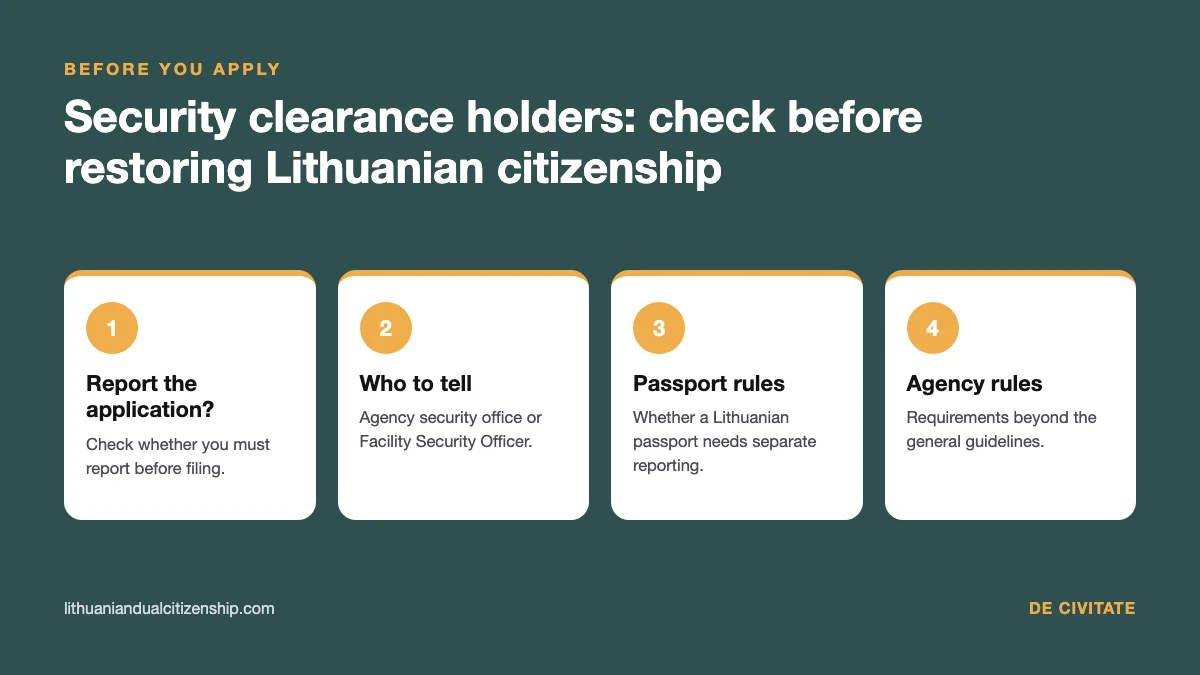
Before beginning a Lithuanian citizenship restoration case, a person with an existing clearance or sensitive position should verify:
- whether applying for foreign citizenship must be reported before submission;
- who within the agency or company should receive the report;
- whether obtaining a Lithuanian passport requires a separate report or approval;
- whether planned travel, residence, financial activity, or military service obligations create additional reporting issues;
- whether the person’s specific agency, assignment, or access program imposes requirements beyond the general adjudicative guidelines.
This review should take place before major steps are taken when possible. Reporting a potentially relevant event through the correct security channel is materially different from allowing the government to discover an undisclosed event later.
Lithuanian Citizenship and a Clearance Must Be Evaluated Separately
Eligibility for Lithuanian citizenship and eligibility for access to U.S. classified information are governed by different legal and administrative systems.
Successfully completing Lithuanian citizenship restoration does not determine whether a U.S. security clearance will be granted. Likewise, holding a U.S. security clearance does not determine whether a person qualifies for Lithuanian citizenship.
A person considering restoration should therefore evaluate both processes independently. The Lithuanian side concerns citizenship eligibility, ancestry, documentation, and the applicable restoration pathway. The U.S. security side concerns disclosure, foreign influence, foreign preference, reliability, and compliance with applicable personnel-security rules.
This is particularly important for applicants researching citizenship by descent primarily because of ancestry. The fact that the citizenship is based on family history can be relevant context, but the applicant’s subsequent decisions concerning that citizenship may still matter.
Key Takeaway
Lithuanian dual citizenship and a U.S. security clearance can coexist. Foreign citizenship alone does not automatically establish divided loyalty or require denial of national security eligibility.
The risk analysis becomes more fact-specific when a U.S. citizen actively applies to restore Lithuanian citizenship, obtains or uses a Lithuanian passport, develops substantial foreign interests, exercises particular foreign citizenship rights, or fails to comply with reporting requirements.
For an existing clearance holder, the most important practical issue is usually disclosure. Application for foreign citizenship and foreign passport activity can be reportable events, so the applicable security office or Facility Security Officer should be consulted according to the rules governing the individual’s position.
Frequently Asked Questions
Can you have Lithuanian dual citizenship with a U.S. security clearance?
Yes, it may be possible. Dual citizenship alone is not an automatic disqualifier for a U.S. security clearance. The determination depends on the individual’s overall circumstances, including foreign ties, conduct, passport use, financial interests, and compliance with disclosure requirements.
Does applying for Lithuanian citizenship affect an existing security clearance?
It can trigger reporting and additional review, but applying for Lithuanian citizenship does not automatically result in clearance suspension or revocation. A current clearance holder should follow the reporting requirements applicable to the person’s agency, employer, position, and clearance environment.
Do I have to report an application for Lithuanian citizenship?
If you are a covered individual subject to SEAD 3 reporting requirements, application for and receipt of foreign citizenship are reportable activities. The exact reporting procedure should be confirmed with the appropriate agency security office or Facility Security Officer.
Can I hold a Lithuanian passport while I have a security clearance?
Possessing a Lithuanian passport does not by itself determine whether a clearance will be granted or retained, but foreign passport application, possession, or use can be reportable. Agency-specific restrictions may also apply, so passport use should be addressed with the appropriate security office.
Do I have to renounce Lithuanian citizenship to obtain a security clearance?
There is no universal rule requiring every dual U.S. citizen to renounce another citizenship solely because a security clearance is required. The outcome depends on the individual circumstances, although willingness to renounce citizenship that creates a national security conflict may be considered as a mitigating factor.
Is citizenship inherited by descent viewed differently from citizenship I actively apply for?
It can be. Citizenship acquired automatically through birth or a parent can present different facts from an affirmative decision to apply for or restore foreign citizenship. However, neither situation determines the clearance result by itself, and the individual’s subsequent conduct and foreign connections remain relevant.
Find out if you qualify — free
Send us your family details and a Lithuanian citizenship specialist will review your case and explain your options.
Start free eligibility check