
U.S. naturalization records can play an important role in Lithuanian citizenship by descent cases, especially for American families whose Lithuanian ancestors emigrated to the United States during the late nineteenth or twentieth century. These records may help explain when an ancestor arrived in America, what citizenship or nationality they claimed, how their name was recorded, and whether they became a U.S. citizen before or after key historical dates.
At the same time, U.S. naturalization records usually do not answer every question in a Lithuanian citizenship restoration case. A naturalization certificate, petition, declaration of intention, or related immigration file may support the evidence, but it may not by itself prove that the ancestor held citizenship of the Republic of Lithuania before June 15, 1940. In many cases, the naturalization record must be read together with Lithuanian archive records, vital records, family documents, and evidence of direct descent.
Understanding how naturalization records affect Lithuanian citizenship by descent helps applicants avoid two common mistakes. The first is assuming that any U.S. document saying “Lithuanian” automatically proves eligibility. The second is assuming that an ancestor’s U.S. naturalization automatically prevents citizenship restoration. The actual impact depends on the dates, documents, legal category, and the applicant’s family history.
In short
- U.S. naturalization records do not automatically prevent Lithuanian citizenship by descent.
- They help identify the ancestor: original name, birthplace, arrival date, spouse, children and former nationality.
- A declaration of intention shows a plan; the oath or certificate shows naturalization was completed.
- The petition often says more than the certificate about who the ancestor was.
- They are bridge documents — usually supporting evidence, not proof of Lithuanian citizenship before 1940.
Why U.S. Naturalization Records Matter in Lithuanian Citizenship Cases
For many Americans with Lithuanian ancestry, the paper trail in the United States is easier to find than the paper trail in Lithuania. Families may have U.S. census records, passenger lists, draft cards, naturalization petitions, death certificates, or old certificates of naturalization, while Lithuanian passports or interwar documents may be missing.
This is why U.S. naturalization records Lithuanian citizenship by descent research often begins with American documents. These records can help identify the ancestor more precisely. They may show the ancestor’s original name, place of birth, date of birth, arrival date, port of entry, spouse, children, address, former nationality, or country of former allegiance. Even when the record does not prove Lithuanian citizenship directly, it may help connect the ancestor to the correct person in Lithuanian archives.
Naturalization records can also help establish a migration timeline. In Lithuanian citizenship restoration cases, timing often matters. The date when the ancestor left Lithuania, the date when they became a U.S. citizen, and whether they were a Lithuanian citizen before June 15, 1940 may all be relevant. A naturalization record can provide evidence that helps organize those facts into a coherent file.
What U.S. Naturalization Records Can Show
A U.S. naturalization file may include several different records, and each type can be useful in a different way. A declaration of intention usually shows that an immigrant planned to become a U.S. citizen, but it does not necessarily prove that naturalization was completed. A petition for naturalization usually provides more detailed biographical information and may include the applicant’s date and place of birth, current address, spouse, children, arrival details, and prior nationality. A certificate of naturalization confirms that the person became a U.S. citizen.
For Lithuanian citizenship by descent naturalization records are especially useful when they clarify identity. Lithuanian names were often changed, shortened, translated, misspelled, or adapted after immigration. A person known in the United States as John, Joseph, William, Anna, or Mary may have had a different Lithuanian birth name. Surnames may also appear in different forms depending on language, gender, spelling, and the clerk who created the record.
Naturalization records may also mention a birthplace that does not look Lithuanian to a modern reader. Some U.S. documents list an ancestor’s birthplace as Russia, Poland, Kovno, Kovna, Vilna, Suwalki, or another historical administrative area. This does not automatically mean the person was not Lithuanian. It often reflects the political geography of the time, especially because many Lithuanian emigrants were born before the modern Republic of Lithuania existed or while Lithuanian lands were controlled by larger empires.
The Difference Between Birthplace, Nationality, and Citizenship
One of the most important issues in these cases is the difference between birthplace, ethnicity, nationality, and citizenship. U.S. records may use these terms inconsistently. A record may call someone Lithuanian by ethnicity, Russian by former empire, Polish by administrative area, or a citizen of a country that controlled the territory at the time of departure. These labels can be useful clues, but they should not be treated as the final legal answer.
Lithuanian citizenship restoration usually focuses on whether the ancestor held citizenship of the Republic of Lithuania during the relevant historical period. For many cases, the key question is not simply whether the ancestor was ethnically Lithuanian or born in a place that is now Lithuania. The stronger question is whether documents can show citizenship of the Republic of Lithuania before June 15, 1940, or whether other legally relevant facts support the restoration route.
This is why Lithuanian citizenship by descent proof of citizenship before 1940 often requires more than one document. A U.S. naturalization record may identify the ancestor and show that the person came from Lithuania or a Lithuanian region. A Lithuanian archive record may show residence, passport data, military service, civil status, or another fact connected to citizenship. Together, these records may form a stronger evidentiary picture than either source alone.
Does Naturalization Affect Lithuanian Dual Citizenship?
A common question is: does naturalization affect Lithuanian dual citizenship? The answer depends on the specific facts of the case. U.S. naturalization can matter because it shows when the ancestor acquired another citizenship. However, the legal effect of that naturalization should not be assumed without looking at the full family timeline and the applicable Lithuanian citizenship category.
For some families, an ancestor became a U.S. citizen long after leaving Lithuania. For others, the ancestor naturalized before 1940, during the interwar period, or before the Republic of Lithuania was established in 1918. These differences may affect how the case is assessed. The date of naturalization may also matter when comparing the ancestor’s status with documents showing Lithuanian citizenship, residence in Lithuania, departure from Lithuania, or later displacement.
In many Lithuanian citizenship restoration ancestor naturalized in America cases, the naturalization record is not a simple “yes” or “no” factor. It is one piece of evidence. It may support the case by showing identity, date of emigration, and former nationality. It may also raise questions if the timeline suggests that the ancestor acquired another citizenship before a legally relevant date. The safest approach is to treat naturalization records as part of a document analysis, not as a standalone conclusion.
Ancestor Naturalized in the U.S.: Why the Date Matters
When reviewing Lithuanian citizenship by descent if ancestor naturalized in U.S. records, the date of naturalization is usually one of the first details to check. A declaration of intention date, petition filing date, oath date, and certificate date are not the same thing. The most legally significant date is usually the date when naturalization was completed, not the date when the ancestor first expressed an intention to naturalize.
This distinction is important because many immigrants filed a declaration years before becoming citizens. Some never completed the process. Others filed more than once because they moved, records expired, or earlier paperwork was not accepted. If a family only has a declaration of intention, it should not automatically be treated as proof that the ancestor became a U.S. citizen on that date.
The naturalization date should also be compared with the ancestor’s date of birth, departure from Lithuania, marriage, children’s births, and any Lithuanian records showing citizenship or residence. In descent-based cases, the sequence of events can be important. A record that appears problematic in isolation may be less concerning when the full timeline is reconstructed. Conversely, a record that seems helpful may still need stronger supporting documentation from Lithuanian or other official sources.
Naturalization Certificate vs. Full Naturalization File
Many families focus on the U.S. naturalization certificate because it is the most recognizable document. A U.S. naturalization certificate Lithuanian citizenship restoration file may be useful, especially if it confirms the ancestor’s name and date of naturalization. However, the certificate is often less detailed than the full naturalization file.
The petition for naturalization can sometimes be more valuable for citizenship by descent research. It may show the immigrant’s place of birth, date of birth, address, spouse, children, date of arrival, ship name, and former nationality. These details can help connect the U.S. identity to records in Lithuania. If the person’s name changed in America, the petition may also help explain the transition from the original Lithuanian name to the Americanized version.
A certificate may prove that naturalization happened, while the petition may explain who the person was. For Lithuanian citizenship restoration, both types of information can matter. The certificate may establish the naturalization date, but the broader file may provide the identity evidence needed to locate Lithuanian archive records or resolve inconsistencies in the family record.
| Record | What it can show | Limitation |
|---|---|---|
| Declaration of intention | That the immigrant planned to become a U.S. citizen | Does not prove naturalization was completed |
| Petition for naturalization | Birthplace, date of birth, arrival, ship, spouse, children, former nationality | Place names may be broad or historical |
| Oath record / certificate | That naturalization was completed and when | Often fewer identifying details |
| Full naturalization file | Links original and Americanized names | Usually supporting evidence for Lithuanian citizenship |
Name Changes and Spelling Variations in Naturalization Records
Name variation is one of the most common problems in Lithuanian citizenship by descent cases. U.S. naturalization records can help solve this problem, but they can also create confusion if they contain spelling errors or simplified versions of Lithuanian names.
Lithuanian surnames may appear in several forms depending on language, gender, and historical context. A surname may be written differently in Lithuanian, Polish, Russian, Yiddish, German, or English-language records. Given names may also be translated or replaced with American equivalents. For example, a person may use one name on a ship record, another on a naturalization petition, and another on a death certificate.
A naturalization record becomes especially helpful when it links several versions of the same identity. If the document includes the original name, Americanized name, spouse, children, date of birth, and place of birth, it may help demonstrate that apparently different records refer to the same person. This can be important when building a consistent file for Lithuanian citizenship restoration.
When U.S. Records Say Russia, Poland, Kovno, or Lithuania
Many Lithuanian ancestors arrived in the United States during periods when borders and political control in Eastern Europe were very different from today. As a result, U.S. naturalization records may describe the same person in different ways. One document may say Russia, another may say Lithuania, and another may list Kovno, Kovna, Vilna, Suwalki, or another regional term.
This does not necessarily defeat a Lithuanian citizenship by descent case. It does mean the record needs interpretation. A reference to Russia may reflect the Russian Empire rather than modern Russian ethnicity or citizenship. A reference to Poland may reflect interwar border changes or administrative control. A reference to Kovno may point toward Kaunas Governorate or the city of Kaunas, depending on the context.
For citizenship restoration, the goal is not simply to replace one historical label with another. The goal is to show, through reliable documents, how the ancestor’s identity, birthplace, residence, citizenship, and migration history fit together. U.S. records can provide clues, but Lithuanian records or other historical documents may be needed to establish the relevant citizenship-related facts.
Can U.S. Naturalization Records Prove Lithuanian Citizenship Before 1940?
U.S. records can support a claim, but they may not be enough by themselves. A naturalization petition that says the ancestor was Lithuanian or born in Lithuania can be useful evidence, especially if it is consistent with other records. However, Lithuanian authorities may still require documents showing that the ancestor held Lithuanian citizenship before June 15, 1940, or documents that otherwise satisfy the relevant legal standard.
This is where many applicants misunderstand the role of naturalization records. A U.S. document may identify the ancestor’s origin, but it was not created by Lithuanian authorities to certify Lithuanian citizenship. It may use broad or inconsistent terminology. It may also reflect what the immigrant reported to a U.S. official rather than what Lithuanian records would show.
In practice, U.S. naturalization records are often strongest when used as bridge documents. They connect the American family line to the Lithuanian person. They help resolve names, dates, and locations. They may show that the ancestor came from Lithuania or a Lithuanian region. But the core citizenship proof often requires Lithuanian documents or other records that more directly address the ancestor’s status before 1940.
How Naturalization Records Fit Into the Descent Line
Lithuanian citizenship by descent is not only about the ancestor. It is also about proving the applicant’s direct family connection to that ancestor. Naturalization records may help here if they list the ancestor’s spouse and children. In some cases, a petition for naturalization includes the names, dates of birth, and places of birth of children. This can help connect generations when other records are incomplete.
However, descent usually needs to be documented through civil records such as birth, marriage, and name-change records. If the ancestor was a great-grandparent, the applicant may need to connect each generation clearly. Naturalization records can support that chain, but they usually do not replace vital records.
The most effective document file is internally consistent. Names, dates, places, and relationships should make sense across U.S. records, Lithuanian records, and family documents. If there are discrepancies, they should be identified and addressed carefully rather than ignored. Small differences are common in historical records, but unexplained contradictions can make a file harder to assess.
Common Problems in Naturalization-Based Evidence
One common problem is relying on a single record that uses the word “Lithuanian” without proving citizenship. This can be helpful for research, but it may not be enough for a legal citizenship restoration file. Ethnic origin and legal citizenship are related in some contexts, but they are not always the same.
Another issue is confusing the declaration of intention with completed naturalization. A declaration may show that the ancestor intended to become a U.S. citizen, but the certificate or oath date usually provides stronger evidence that naturalization actually occurred. If the file contains only a declaration, more research may be needed.
A third problem is inconsistent names. If the ancestor’s Lithuanian name, U.S. name, and family surname do not match clearly, the application may need additional records to connect them. Marriage records, court name-change records, Social Security records, death records, or naturalization petitions may help explain the discrepancy.
A fourth issue is assuming that a U.S. naturalization record answers the Lithuanian legal question. It may not. The record may be important, but the citizenship restoration analysis usually depends on the full historical and documentary context.
What to Check Before Relying on a Naturalization Record
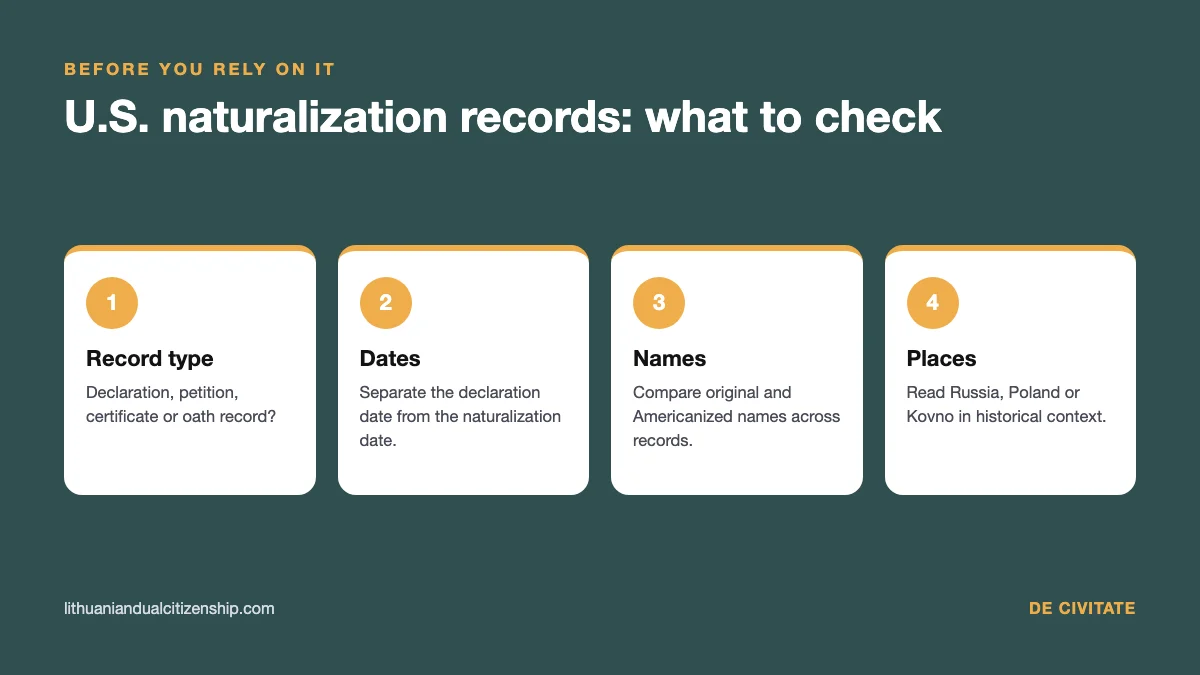
Before relying on a U.S. naturalization record in a Lithuanian citizenship by descent case, it is important to review what type of record it is, when it was created, and what facts it actually proves. A certificate, petition, declaration, index card, or court record may each have a different evidentiary value.
The naturalization date should be separated from the declaration date. The name should be compared with other records. The birthplace should be interpreted in historical context. The former nationality or allegiance should be treated as a clue, not as the only proof. If the document lists a spouse or children, those details should be compared with the civil records used to prove descent.
It is also important to check whether the ancestor’s U.S. record points to a specific town, district, or region. Lithuanian archive searches often become more effective when the location is precise. A vague reference to Lithuania may be useful, but a town name, parish, county, or historical administrative unit can be much more helpful.
How These Records Can Strengthen a Lithuanian Citizenship Restoration File
Naturalization records can strengthen a citizenship restoration file by making the family history more coherent. They can show that the person in U.S. records is the same person whose records appear in Lithuania. They can explain why the family surname changed. They can show when the ancestor arrived in the United States and when U.S. citizenship was acquired.
They can also help identify missing records. If a naturalization petition lists a specific birthplace, that location can guide archive research in Lithuania. If it lists a ship arrival date, passenger records may provide another layer of evidence. If it lists spouse and children, civil records can be organized more accurately.
For applicants in the United States, naturalization records often serve as a practical bridge between American family documents and Lithuanian historical records. They may not replace Lithuanian proof, but they can make the overall evidentiary file clearer and more persuasive.
Why Individual Review Is Often Necessary
No single rule explains every Lithuanian citizenship restoration naturalization certificate case. The legal and documentary analysis may depend on the ancestor’s birth date, place of residence, departure date, citizenship history, naturalization date, and the applicant’s line of descent. It may also depend on whether the case involves restoration of citizenship, recognition of descent, dual citizenship retention, or another related procedure.
Because historical records are often incomplete or inconsistent, the same type of U.S. naturalization record may have different significance in different families. In one case, it may help prove identity and support archive research. In another, it may raise questions about timing. In another, it may be useful mainly for explaining a name change.
For this reason, applicants should treat naturalization records as part of a broader evidence review. The strongest approach is usually to reconstruct the full timeline, identify the ancestor’s legal status at key moments, and compare U.S. documents with Lithuanian records before drawing conclusions about eligibility.
FAQ
Does U.S. naturalization automatically prevent Lithuanian citizenship by descent?
No. An ancestor’s U.S. naturalization does not automatically answer the eligibility question. It may matter, especially because the date of naturalization can affect the historical timeline, but the impact depends on the applicant’s documents, the ancestor’s status, and the relevant Lithuanian citizenship category.
Is a U.S. naturalization certificate required for Lithuanian citizenship restoration?
A U.S. naturalization certificate may be useful, but whether it is required depends on the case. It can help prove when the ancestor became a U.S. citizen and may help explain name changes or identity details. However, other records may also be needed to prove Lithuanian citizenship before June 15, 1940 and the applicant’s direct descent.
Can a U.S. naturalization record prove Lithuanian citizenship before 1940?
Usually, a U.S. naturalization record is supporting evidence rather than final proof of Lithuanian citizenship. It may show that the ancestor was born in Lithuania, came from Lithuania, or identified as Lithuanian. Stronger citizenship proof often requires Lithuanian archive records or other documents connected to the Republic of Lithuania before June 15, 1940.
What if my ancestor’s naturalization record says Russia or Poland instead of Lithuania?
This is common in historical records and does not automatically mean the ancestor was not Lithuanian. The wording may reflect old borders, empires, administrative regions, or how U.S. officials recorded the information. The record should be interpreted with other documents that show the ancestor’s birthplace, residence, citizenship, and family history.
What is the difference between a declaration of intention and a naturalization certificate?
A declaration of intention usually shows that an immigrant planned to become a U.S. citizen. A naturalization certificate confirms that the person completed naturalization and became a U.S. citizen. For Lithuanian citizenship by descent analysis, this distinction can matter because the date of completed naturalization is usually more important than the date of intention.
Why are naturalization records useful if they do not prove everything?
They are useful because they can connect the American family line to the Lithuanian ancestor. They may show names, dates, places, relatives, arrival details, former nationality, and the date of U.S. citizenship. These details can help locate Lithuanian records, explain discrepancies, and build a clearer citizenship restoration file.
Find out if you qualify — free
Send us your family details and a Lithuanian citizenship specialist will review your case and explain your options.
Start free eligibility check