Many Americans researching Lithuanian citizenship by descent discover an unexpected problem in their family documents. A U.S. naturalization record, ship manifest, census entry, birth certificate, marriage record, or death certificate may not say “Lithuania” at all. Instead, it may list an ancestor’s birthplace as Russia, Poland, Kovno, Kovno Russia, Kovna, Kovne, or another historical place name that does not match the modern map.
This can be confusing for descendants who believe their parent, grandparent, or great-grandparent came from Lithuania. It can also create concern about whether the family line can still support a Lithuanian citizenship restoration case. In many cases, a birthplace listed as Russia, Poland, or Kovno does not automatically disprove Lithuanian origin. It often reflects the political geography, administrative language, or recordkeeping habits of the period when the document was created.
For Lithuanian citizenship by descent, however, the wording in U.S. records still matters. These documents may help reconstruct identity, migration history, family relationships, and possible place of origin. At the same time, they usually need to be interpreted alongside Lithuanian, Polish, Russian Empire, civil, church, archival, and other historical records.
In short
- U.S. records often list Russia, Poland, Kovno or Vilna instead of Lithuania — this is common and not automatically a problem.
- “Kovno Russia” usually means Kaunas or the Kovno Governorate of the Russian Empire, not today’s Russian Federation.
- A birthplace listed as Poland needs careful checking of the exact town and period because of border changes.
- U.S. naturalization records help prove identity and migration, but rarely Lithuanian citizenship on their own.
- Narrow broad labels down to a specific town, then connect it to evidence of citizenship before 15 June 1940.
Why U.S. Records May Not Say Lithuania
A common issue in Lithuanian ancestry records is that the ancestor’s birthplace appears under the name of an empire, state, province, or administrative region rather than the ethnic or modern national place. This is especially common for immigrants who left Europe in the late nineteenth or early twentieth century.
Modern Lithuania did not exist as an independent republic throughout all periods covered by U.S. immigration and naturalization records. Before the restoration of Lithuanian statehood in 1918, many territories associated with Lithuanian families were part of the Russian Empire. In later periods, some areas connected to Lithuanian families were affected by shifting borders, Polish administration, Soviet occupation, German occupation, and postwar displacement.
U.S. clerks and immigration officials often recorded what they heard, what appeared in foreign documents, or what matched the political terminology of the time. As a result, a person from a Lithuanian town could be described in American documents as born in Russia, Poland, Kovno, Vilna, Suwalki, or another historical jurisdiction. This does not necessarily mean the family was ethnically Russian or Polish, and it does not automatically determine whether the person was or was not connected to Lithuania.
For citizenship restoration purposes, the key question is usually not whether every U.S. document says “Lithuania.” The more important question is whether the available evidence can establish the ancestor’s identity, family line, and relevant connection to the Republic of Lithuania under the applicable legal framework.
What “Kovno Russia” Means in Immigration Records
One of the most frequent confusing phrases is “Kovno Russia.” In U.S. immigration records, naturalization papers, and family documents, Kovno usually refers to Kaunas or to the historical Kovno Governorate of the Russian Empire. Kaunas is a major city in present-day Lithuania, while Kovno was the older Russian, Yiddish, Polish, German, or English rendering commonly used in historical records.
When a record says “Kovno Russia,” it often means that the person came from Kovno or the Kovno administrative region when that territory was under the Russian Empire. It does not usually mean that the person was born in today’s Russian Federation. For many Lithuanian, Jewish Lithuanian, Polish-speaking, Belarusian, and other families from the region, “Russia” in old U.S. records functioned as a political label rather than a precise modern nationality.
This distinction is important for descendants researching Lithuanian citizenship restoration. An ancestor born in Kovno may still have a relevant Lithuanian connection, but the record must be interpreted historically. A U.S. document saying “Kovno Russia” can be a useful clue, not the final answer. It may point researchers toward Kaunas-area archival records, church registers, civil records, internal passport files, military records, residence records, or other sources that may clarify the ancestor’s exact place of origin and later legal status.
| Record says | Usually refers to | What to do |
|---|---|---|
| Kovno Russia (Kovna, Kowno, Kauen) | Kaunas or the Kovno Governorate of the Russian Empire | Identify the exact town or locality |
| Vilna (Wilno, Vilno) | Vilnius or the Vilnius region | Check which state controlled the place in the relevant period |
| Russia | Often the Russian Empire before 1918 | Narrow it to a town, province or district |
| Poland | Possibly a border region or interwar Poland | Check the town against borders of the time |
| Lithuania | Helpful, but describes origin | Still prove citizenship before 15 June 1940 |
Birthplace Listed as Russia and Lithuanian Citizenship by Descent
A Lithuanian citizenship by descent birthplace listed as Russia can raise understandable questions. Some applicants worry that this wording makes the family ineligible. In many cases, that concern is too broad. A U.S. record listing “Russia” may simply reflect that the ancestor was born in a territory then administered by the Russian Empire.
For Lithuanian citizenship restoration, the legal analysis usually focuses on whether the ancestor was a citizen of the Republic of Lithuania during the relevant historical period, commonly before June 15, 1940, and whether the applicant can prove direct descent through civil documents. If the ancestor left Europe before the creation of the modern Lithuanian state in 1918, the case may require especially careful review, because a person who emigrated before Lithuanian statehood may not have held citizenship of the Republic of Lithuania unless other facts support that conclusion.
This is why a single U.S. document is rarely enough. A naturalization petition may say “Russia,” while another document may say “Lithuania,” “Kovno,” “Kaunas,” “Vilna,” or a specific town. A death certificate may use one country name, while a passenger list uses another. The practical task is to compare the documents, identify whether they refer to the same person, and determine whether the historical location can be connected to Lithuania and to the relevant citizenship period.
In many cases, “Russia” is not a contradiction. It is a historical label that needs to be translated into the correct geographic and legal context.
Birthplace Listed as Poland and Lithuanian Citizenship Restoration
A Lithuanian citizenship by descent birthplace listed as Poland can be more complex because border changes and regional administration varied significantly. Some families connected to Lithuania lived in areas that were at different times associated with the Russian Empire, interwar Poland, Lithuania, or other jurisdictions. In U.S. records, “Poland” may refer to nationality, language, political control, ethnic identity, a nearby administrative center, or simply what the immigrant reported to the official.
For Lithuanian citizenship restoration, a birthplace listed as Poland does not automatically exclude a Lithuanian citizenship case. It does, however, make geographic verification more important. The exact town, district, parish, county, or province may matter more than the country label in the American document.
For example, a U.S. naturalization record may list the birthplace as Poland, while another record may identify a town that was historically connected to Lithuania or to a disputed border region. In other situations, the ancestor may have lived in Lithuania, held documents issued by Lithuanian authorities, or had family events recorded in Lithuanian institutions even if one U.S. record uses “Poland.” The evidentiary value depends on the full document set.
Because of this, applicants should avoid treating “Poland” as either a complete disqualification or automatic proof of Lithuanian eligibility. It is a signal that the family history needs precise historical mapping.
Why U.S. Naturalization Records Matter
U.S. naturalization records are often important in Lithuanian citizenship ancestry research because they may contain details that do not appear in later family documents. Depending on the period and file type, naturalization documents may include a date and place of birth, last foreign residence, date of arrival in the United States, ship name, spouse and children, former nationality, name variants, and address in the United States.
For Lithuanian citizenship by descent U.S. naturalization records can help connect different parts of the family file. They may show that a person using an Americanized name is the same person who appears in an older European record under a Lithuanian, Polish, Russian, Yiddish, German, or Latinized version of the name. They may also show when the ancestor became a U.S. citizen, which can matter when reconstructing the family’s legal history.
However, U.S. naturalization records should be used carefully. They were created for American legal purposes, not for modern Lithuanian citizenship restoration. The place names may be broad, inconsistent, misspelled, translated, or based on historical political boundaries. A naturalization certificate may say less than the underlying petition or declaration. A petition may differ from a passenger list. A later census may simplify the birthplace even further.
The strongest approach is usually to treat U.S. naturalization records as part of a larger evidence chain. They can support identity and migration history, but Lithuanian archive records or other European documents may still be needed to establish the citizenship-related facts more directly.
The Difference Between Birthplace, Nationality, Ethnicity, and Citizenship
One reason these cases become confusing is that historical records often mix several different concepts. Birthplace, nationality, ethnicity, language, residence, subjecthood, and citizenship are not the same thing.
A U.S. document may say that a person was born in Russia because the place was under the Russian Empire at the time. Another document may describe the same person as Lithuanian because of ethnicity, language, cultural identity, or later state affiliation. A ship manifest may list last residence rather than birthplace. A census may record the answer given by a family member decades after immigration. A naturalization record may use “Russia,” “Poland,” or “Lithuania” depending on the year, the form, and the official’s understanding.
For Lithuanian citizenship restoration, this distinction is critical. A person’s ethnic Lithuanian origin may be relevant in some contexts, but restoration of citizenship usually requires proof connected to Lithuanian citizenship and direct descent. A record that says “Lithuanian” may be helpful, but it may not prove citizenship by itself. Likewise, a record that says “Russia” may look negative at first, but it may still refer to a Lithuanian place or person.
A careful file should separate these concepts instead of forcing all documents to use the same modern terminology.
How to Interpret Conflicting Place Names
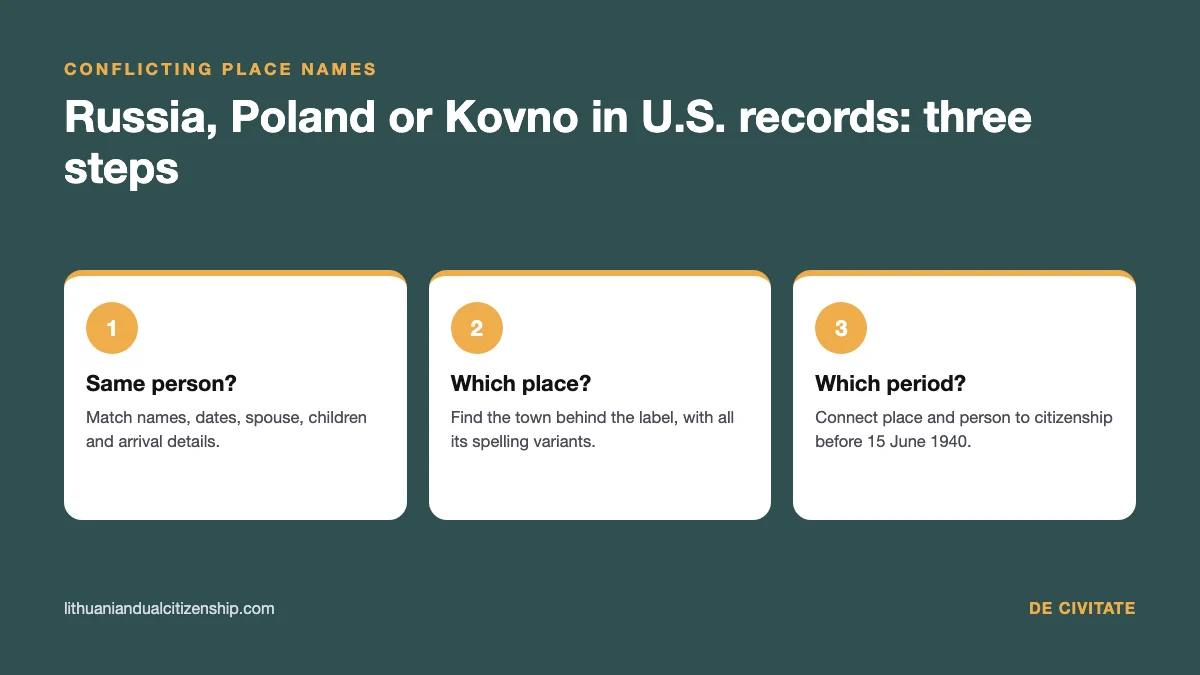
Conflicting place names are common in Lithuanian citizenship ancestry records. A single ancestor may appear as born in Russia in one record, Lithuania in another, Poland in a third, and Kovno in a fourth. This does not always mean the documents are wrong or that they belong to different people.
The first step is to determine whether the documents refer to the same individual. Names, dates, spouse names, children’s names, addresses, occupation, arrival information, and relatives can help establish continuity. Minor spelling differences are common, especially when names moved between Lithuanian, Polish, Russian, Yiddish, German, and English.
The second step is to identify the historical location. A town name may have several variants. Kovno may appear as Kaunas, Kovna, Kovne, Kowno, or Kauen. Vilnius may appear as Vilna, Wilno, Vilno, or Vilne. Smaller towns may have even more variations. In some cases, the country label is less useful than the town, parish, district, or province.
The third step is to connect the place and person to the relevant legal period. For Lithuanian citizenship restoration, the most important evidence often relates to whether the ancestor held citizenship of the Republic of Lithuania before June 15, 1940, or whether the family line otherwise fits the applicable requirements. A U.S. birthplace entry may guide the research, but it usually does not answer the legal question alone.
Documents That May Help Clarify Lithuanian Ancestry
When U.S. records list the birthplace as Russia, Poland, or Kovno, additional documentation can help clarify the family history. Useful records may include birth, marriage, and death certificates from the United States and Europe; U.S. naturalization files; passenger arrival records; census records; military records; Lithuanian internal passport records; residence records; church books; civil registry records; archival certificates; and documents showing departure, displacement, or later nationality status.
The exact documents needed depend on the family story. A person born in the Russian Empire before 1918 may require a different evidentiary path than a person born in independent Lithuania in the 1920s. A family from Kaunas may require different archives than a family from the Vilnius region or a borderland area. Jewish Lithuanian family research may involve additional name variants, religious records, community records, and Holocaust-era or postwar documents.
For an applicant, the most important point is that documents must work together. One record may identify a place. Another may prove a family relationship. A third may show citizenship, residence, or departure. The file is usually evaluated as a body of evidence rather than as a single phrase in one American document.
When a U.S. Record Helps and When It Creates Risk
A U.S. record can help a Lithuanian citizenship restoration case when it supports identity, shows a consistent family line, identifies a historical Lithuanian place, or explains why later documents use different versions of the same name. For example, a naturalization petition listing “Kovno Russia” may help connect an American family to Kaunas-area records.
At the same time, U.S. records can create risk if they are inconsistent, incomplete, or interpreted without historical context. A document that lists a different birthplace, different birth year, or different parent’s name may need explanation. A record that says only “Russia” or “Poland” without a town may be too broad to prove Lithuanian origin by itself. A naturalization record may also raise questions about when the ancestor became a U.S. citizen and how that relates to the citizenship status of the family line.
The safest way to use these records is not to ignore contradictions, but to explain them through additional documents. Historical geography, name variants, administrative borders, and recordkeeping practices can often account for differences that look problematic at first glance.
What Applicants Should Avoid Assuming
Applicants should avoid assuming that “Russia” means the ancestor has no Lithuanian connection. They should also avoid assuming that “Kovno” automatically proves eligibility. Both conclusions are too simple.
A Lithuanian citizenship restoration case usually depends on several elements: the ancestor’s identity, the applicant’s direct descent, the ancestor’s connection to Lithuanian citizenship during the relevant period, and the documentary evidence available to prove these facts. Place names are important, but they are only one part of the file.
It is also risky to rely only on family stories. Oral history can be valuable, especially when it points to a town, surname variant, religion, occupation, or migration route. But citizenship restoration usually requires documentary support. If the U.S. documents are vague or inconsistent, archival research may be needed before any reliable conclusion can be reached.
How This Affects Lithuanian Citizenship by Descent Cases
When U.S. records list the birthplace as Russia, Poland, or Kovno, the effect on Lithuanian citizenship by descent depends on what the records show when read together. In many cases, these labels are historically understandable and can be reconciled with Lithuanian ancestry. In other cases, they reveal that more research is needed, especially if the ancestor emigrated before 1918, came from a border region, or has unclear citizenship status before 1940.
For a U.S.-based applicant, the practical goal is to move from broad American labels to precise historical evidence. “Russia” should be narrowed to a town, province, or district. “Poland” should be checked against the relevant borders and time period. “Kovno” should be connected to Kaunas, the Kovno Governorate, or a specific locality. Then the family line should be documented through birth, marriage, death, naturalization, and archive records.
A birthplace listed as Russia, Poland, or Kovno does not by itself decide the outcome. It is a research issue and an evidentiary issue. With careful interpretation, these records may become useful pieces of a Lithuanian citizenship restoration file rather than obstacles.
FAQ
Does a birthplace listed as Russia prevent Lithuanian citizenship by descent?
Not necessarily. In many U.S. records, “Russia” may refer to the Russian Empire rather than the modern Russian Federation. If the ancestor came from a territory that is now in Lithuania or was historically connected to Lithuania, the record may still be relevant. The key issue is whether the evidence can establish the ancestor’s identity, direct family line, and citizenship-related connection to Lithuania.
What does Kovno Russia mean in U.S. naturalization records?
“Kovno Russia” usually refers to Kovno, the historical name for Kaunas or the Kovno Governorate under the Russian Empire. It often appears in U.S. immigration and naturalization records for people from present-day Lithuania. The phrase should be interpreted in historical context rather than treated as proof that the person was from modern Russia.
Can an ancestor born in Kovno qualify for Lithuanian citizenship restoration?
An ancestor born in Kovno may be relevant to a Lithuanian citizenship restoration case, but birth in Kovno alone does not automatically prove eligibility. The applicant usually needs documents showing direct descent and evidence connected to the ancestor’s Lithuanian citizenship status during the relevant period. Additional archival records may be needed.
What if U.S. records list the birthplace as Poland instead of Lithuania?
A birthplace listed as Poland does not automatically rule out Lithuanian citizenship restoration. Some Lithuanian families came from regions affected by changing borders and administrative control. The exact town, time period, family documents, and citizenship-related evidence should be reviewed before drawing a conclusion.
Are U.S. naturalization records enough for Lithuanian citizenship restoration?
U.S. naturalization records can be useful, but they are usually not enough by themselves. They may help prove identity, name changes, migration history, and family links. However, Lithuanian citizenship restoration often requires additional documents, especially records that establish the ancestor’s connection to Lithuania and the applicant’s direct descent.
Why do different records list different birthplaces for the same ancestor?
Different records may use different geographic labels because borders, political control, languages, and recordkeeping practices changed over time. A person from the same town may be described as born in Russia, Poland, Lithuania, Kovno, or another regional name depending on when and where the record was created.
Should old place names be translated into modern Lithuanian names?
Old place names should usually be identified and matched to their modern equivalents, but the original wording should not be ignored. Both the historical name and the modern location can matter. For example, Kovno may need to be connected to Kaunas or to a specific locality within the former Kovno Governorate.
Find out if you qualify — free
Send us your family details and a Lithuanian citizenship specialist will review your case and explain your options.
Start free eligibility check