
DNA ancestry tests have made it easier for many people to discover possible Lithuanian roots. A test may show Baltic ancestry, connect you with distant relatives, or support family stories about an ancestor who came from Lithuania. However, when it comes to Lithuanian citizenship by descent, DNA results are usually not enough to prove eligibility.
Lithuanian citizenship restoration is a legal procedure based on documents, not only biological ancestry. In most cases, applicants must show a documented family line to an ancestor who had Lithuanian citizenship during the relevant historical period. A DNA test can sometimes be useful as a research clue, but it normally cannot replace birth certificates, marriage certificates, archive records, passports, naturalization files, or other official documents.
This article explains how DNA testing fits into the citizenship-by-descent process, what kind of proof is usually required, and what applicants can do when documents are missing or incomplete.
In short
- A DNA test generally does not prove Lithuanian citizenship by descent.
- Citizenship restoration depends on documents: the ancestor’s citizenship and a documented family line.
- DNA can suggest Baltic ancestry but cannot show where an ancestor was born, whether they were a citizen or when they left.
- DNA is useful for research: it can connect you with relatives who hold documents or know the original surname.
- Even if DNA identifies an unknown parent, the relationship still needs official records.
Does a DNA Test Prove Lithuanian Citizenship by Descent?
A DNA test generally does not prove Lithuanian citizenship by descent by itself. It may suggest genetic ancestry connected to Lithuania or the Baltic region, but citizenship is not determined by ethnicity alone. Lithuanian citizenship restoration usually depends on whether a qualifying ancestor held Lithuanian citizenship and whether the applicant can prove a legal family connection to that person.
This distinction is important. A person may have Lithuanian genetic ancestry without having an ancestor who legally held citizenship of the Republic of Lithuania. Another person may have a strong legal claim through a documented parent, grandparent, or great-grandparent even if a commercial DNA test gives only a broad or unclear ethnicity estimate.
DNA results can also be imprecise. Commercial ancestry tests usually estimate regional genetic background, but they do not prove that a specific ancestor was a Lithuanian citizen. They also do not establish the official civil status events needed for a citizenship application, such as birth, marriage, name change, emigration, or naturalization history.
For this reason, a DNA test for Lithuanian citizenship should usually be treated as an additional genealogical tool, not as primary legal evidence.
Why Lithuanian Citizenship by Descent Requires Documents
Lithuanian citizenship by descent proof of ancestry normally requires a paper trail. The purpose of the documentation is to show two things: first, that the ancestor had a qualifying connection to Lithuanian citizenship, and second, that the applicant descends from that ancestor through a continuous family line.
In practice, this often means collecting civil records for each generation. Birth certificates may show parent-child relationships. Marriage certificates may explain surname changes. Death certificates, naturalization records, passenger lists, military documents, archive extracts, and old identity documents may help connect the family story to official historical facts.
The key issue is not simply whether the family was ethnically Lithuanian. The stronger issue is whether the ancestor can be linked to Lithuanian citizenship or to documents that support that legal status. Depending on the case, official records may need to show the ancestor’s citizenship, residence, place of origin, departure from Lithuania, or other historically relevant details.
This is why can ancestry DNA prove Lithuanian citizenship is usually the wrong legal question. DNA may indicate ancestry, but Lithuanian citizenship restoration required documents usually need to prove identity, family relationships, and historical citizenship status through official records.
What DNA Test Results Can and Cannot Show
DNA test results can sometimes be helpful at the research stage. For example, they may confirm that family stories about Lithuanian or Baltic ancestry are plausible. They may also connect an applicant with relatives who have documents, family trees, photographs, letters, or archive references. In some cases, DNA matches can help identify unknown branches of a family or clarify which surname variation may be relevant.
However, DNA results have clear limits. They do not prove that a specific person was born in Lithuania. They do not prove that an ancestor was a citizen of Lithuania. They do not show when the ancestor left Lithuania. They do not explain whether the ancestor naturalized in another country before or after a legally relevant date. They also do not create a civil record connecting one generation to another.
For citizenship purposes, genetic ancestry and legal descent are not the same thing. A test may say that someone has Lithuanian, Baltic, Eastern European, or broadly regional ancestry, but that result does not identify a legally qualifying ancestor. It also does not replace official documents that establish parentage, marriage, name changes, or citizenship status.
In many cases, DNA results may support personal research, but they will not be treated as a substitute for documentary evidence in a Lithuanian citizenship by descent application.
| Question | Can a DNA test answer it? |
|---|---|
| Do I have Lithuanian or Baltic genetic ancestry? | It can suggest it |
| Was a specific ancestor born in Lithuania? | No |
| Was my ancestor a Lithuanian citizen before 1940? | No |
| When did my ancestor leave Lithuania? | No |
| Which relatives might hold family documents? | Yes — a useful research lead |
| Who is an unknown biological parent? | It may help, but official records are still needed |
How to Prove Lithuanian Descent Without Relying on DNA
Applicants who want to know how to prove Lithuanian descent without documents should first understand that “without documents” usually means “without documents currently in the family,” not necessarily without any documents at all. Many families no longer possess original Lithuanian records, but relevant evidence may still exist in archives, church registers, civil registry offices, immigration files, court records, or U.S. naturalization collections.
A practical approach usually begins with the documents closest to the applicant. Your own birth certificate, your parents’ birth and marriage records, and your grandparents’ records can establish the first parts of the family chain. From there, older records may be needed to connect the line to the Lithuanian-born or Lithuanian-citizen ancestor.
For U.S.-based applicants, useful records may include naturalization petitions, declarations of intention, passenger arrival records, census records, draft registration cards, marriage records, death records, Social Security records, and family court documents. These may contain names, birthplaces, former nationalities, dates of arrival, and surname variations.
Lithuanian archive records can also be important. Depending on the ancestor’s history, records may exist in civil, church, military, school, property, passport, population, or local administrative collections. The exact availability of records can vary by region, time period, language, war damage, and the ancestor’s legal status.
The goal is to reconstruct a documented chain. A DNA test may point you in the right direction, but the application usually depends on whether the documentary chain can be established.
What Counts as Proof of Lithuanian Ancestry for Citizenship?
Proof of Lithuanian ancestry for citizenship can involve different types of records, depending on the applicant’s family history. The most useful documents are usually those that identify the ancestor and directly or indirectly support the ancestor’s Lithuanian citizenship or qualifying connection to Lithuania.
Documents from Lithuania may include old Lithuanian passports, internal passports, military service records, civil service records, birth certificates, marriage certificates, archive certificates, residence records, or other official documents from the relevant historical period. If direct citizenship documents are unavailable, other records may sometimes help support the case, depending on their content and the legal interpretation of the file.
Documents from the United States may also matter. Naturalization records can show when an ancestor became a U.S. citizen and what previous nationality or birthplace was recorded. Passenger lists may show arrival dates and origin. Marriage and death records may confirm name changes or connect generations. Census records may provide supporting context, although they are usually stronger when combined with official vital or immigration records.
The strongest applications usually avoid relying on one isolated record. Instead, they show a consistent documented pattern across multiple records. If names, dates, or places differ, additional documents may be needed to explain the discrepancy.
Can Genetic Ancestry Prove Citizenship by Descent in Any Situation?
Can genetic ancestry prove citizenship by descent? In the Lithuanian context, it should not be treated as a standalone basis for citizenship restoration. Genetic ancestry may help establish biological relationships in a broad sense, but citizenship by descent normally requires legally recognized records.
There may be exceptional family situations where DNA evidence helps resolve a private genealogical problem, such as identifying a biological parent or confirming a relationship between living relatives. Even then, the DNA result itself may not be enough for a citizenship file unless the relevant legal relationship is also reflected in official civil records or recognized through an appropriate legal process.
For example, if DNA testing helps identify a previously unknown parent, the next issue would usually be whether the birth record, court record, adoption record, or other official documentation can legally establish that relationship. Citizenship authorities generally need official documents that can be reviewed, authenticated, translated, and connected to the applicant’s legal identity.
This means DNA may sometimes help an applicant find the right records, but it usually cannot replace those records.
Common Problems When Documents Are Missing
Missing documents are common in Lithuanian citizenship by descent cases. Families may have lost records during war, migration, displacement, political occupation, or multiple moves between countries. Surnames may have changed after immigration to the United States. Lithuanian names may appear in Polish, Russian, German, Yiddish, English, or Latinized forms. Birthplaces may be recorded as Lithuania, Russia, Poland, Kovno, Vilna, Kovna, Vilnius, Kaunas, or another historical term.
These issues do not automatically make a case impossible. However, they usually require careful evidence-building. If a birth certificate is missing, a marriage record, church record, archive extract, naturalization file, or court document may help. If a surname changed, marriage records, name change orders, Social Security records, or consistent record patterns may explain the variation.
Applicants should be cautious about assuming that a DNA test will solve these gaps. A DNA result does not explain historical name changes, prove legal citizenship, or establish a complete family line. The better strategy is usually to identify the missing link and look for a document that fills that specific gap.
How DNA Testing Can Still Help Your Research
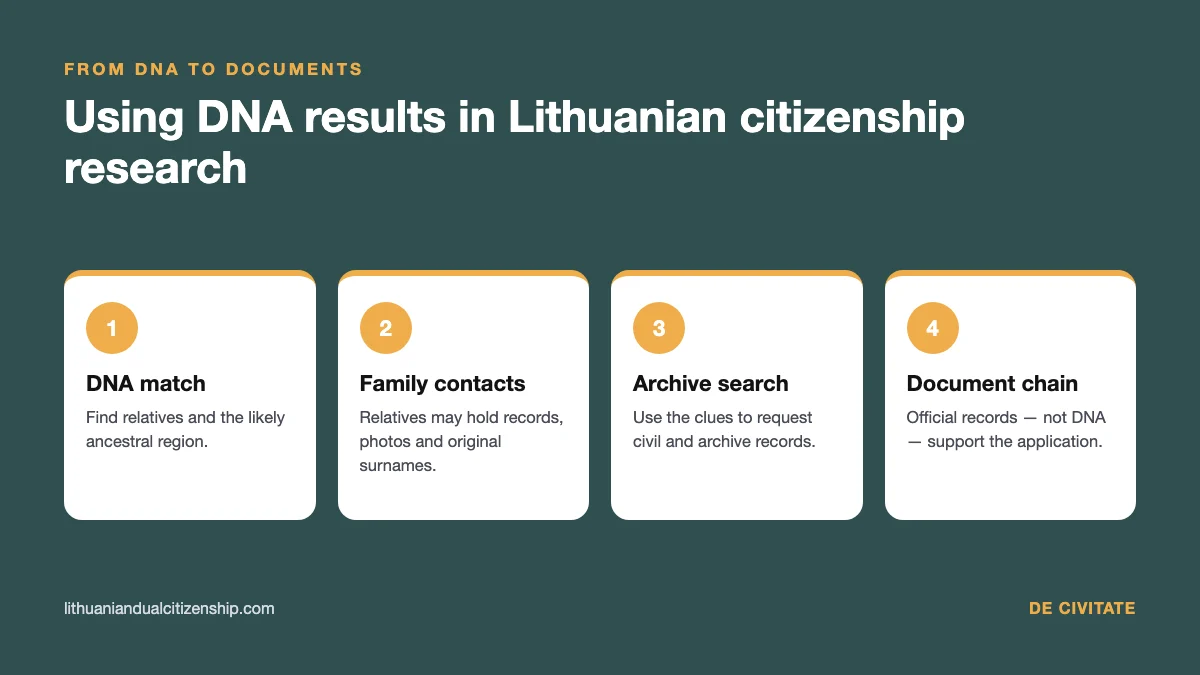
Although DNA test results usually cannot prove Lithuanian citizenship by descent, they can still be useful before the application stage. DNA matches may connect you with relatives who preserved family documents. A match may lead to a branch of the family that knows the original Lithuanian surname, the village of origin, or the ancestor’s migration route.
DNA databases can also help when family records contain conflicting stories. If several matches point to the same ancestral region or surname group, this may help guide archive searches. It can also help determine whether a family line should be researched through a maternal branch, paternal branch, or collateral relatives.
However, these findings should be converted into documentary evidence whenever possible. A family tree built from DNA matches may be useful for research, but official records are usually needed before it becomes relevant to a citizenship application. The practical value of DNA is therefore indirect: it can help you locate people, names, places, and clues that lead to documents.
What to Do Before Applying for Lithuanian Citizenship by Descent
Before applying, it is usually better to assess the document chain rather than rely on DNA results or family stories alone. Start by identifying the ancestor through whom you believe you may qualify. Then determine whether that ancestor was a parent, grandparent, or great-grandparent, and whether records can connect each generation.
Next, look for documents that show the ancestor’s Lithuanian citizenship, origin, residence, emigration, and naturalization history. For U.S.-based families, naturalization records can be especially important because they may affect how the ancestor’s citizenship history is understood. Lithuanian archive searches may also be needed if family-held documents are incomplete.
It is also important to check whether names, dates, and places are consistent across records. Small spelling differences are common, especially in older immigration and civil records. Larger discrepancies may require additional explanation. The more complete and coherent the document file is, the easier it usually becomes to evaluate eligibility.
A DNA test can be kept as a research aid, but it should not be treated as the foundation of the application. The foundation should be official, verifiable documentation.
FAQ
Can a DNA test prove Lithuanian citizenship by descent?
A DNA test usually cannot prove Lithuanian citizenship by descent by itself. It may show possible Lithuanian or Baltic ancestry, but citizenship restoration normally requires official documents proving the ancestor’s citizenship status and the applicant’s family connection to that ancestor.
Does DNA count as proof of Lithuanian ancestry?
DNA may count as a personal genealogical clue, but it is usually not enough as legal proof of Lithuanian ancestry for citizenship purposes. Authorities generally rely on civil records, archive records, identity documents, naturalization files, and other official evidence.
Can ancestry DNA prove Lithuanian citizenship?
Ancestry DNA cannot usually prove Lithuanian citizenship. It may help identify family origins or relatives, but it does not prove that a specific ancestor held Lithuanian citizenship or that the applicant has a legally documented line of descent.
What documents are usually needed for Lithuanian citizenship by descent?
Applicants usually need documents proving their identity, documents linking each generation to the next, and records showing that the qualifying ancestor had Lithuanian citizenship or a legally relevant connection to Lithuania. Depending on the case, birth, marriage, naturalization, passport, military, archive, and name change records may be important.
How can I prove Lithuanian descent if my family has no documents?
If your family has no documents at home, records may still exist in U.S. archives, Lithuanian archives, church registers, civil registry offices, immigration records, court files, or naturalization collections. The main task is to rebuild the family chain through official records rather than relying only on DNA or oral history.
Can DNA help if a parent or grandparent is unknown?
DNA testing may help identify biological relatives or clarify an unknown family line. However, for citizenship purposes, that relationship usually still needs to be supported by official civil records, court records, adoption records, or other legally recognized documentation.
Find out if you qualify — free
Send us your family details and a Lithuanian citizenship specialist will review your case and explain your options.
Start free eligibility check