Lithuanian surname changes in immigration records can create confusion for families researching citizenship by descent. A person who appears under one surname in a U.S. census record may appear under a different spelling in a passenger list, a naturalization file, a Lithuanian archive document, a Polish-language church record, a Russian Empire civil record, or a Yiddish community source.
For many applicants, these differences do not automatically mean that the family line is broken. In many cases, Lithuanian citizenship records name discrepancies reflect language changes, transliteration, clerical habits, border history, religious recordkeeping, migration, marriage, or later Americanization after arrival in the United States.
The important question is usually not whether every document uses the exact same spelling. The more practical question is whether the available records can reasonably show that different versions of the name refer to the same person and the same family line.
In short
- Lithuanian names often appear differently in Lithuanian, Polish, Russian, Yiddish and English records.
- Different spellings do not automatically break a citizenship by descent case.
- Most U.S. name changes were not made by Ellis Island officials; passenger lists were often prepared before arrival.
- Compare the full identity profile — dates, places, parents, spouse, children — not just the letters.
- Treat name discrepancies as evidence issues and explain them with records.
Why Lithuanian Names Often Changed Across Records
Lithuanian ancestor name changes in records are common because the same person could move through several administrative, linguistic, and cultural systems during one lifetime. A Lithuanian-born ancestor may have been recorded by local church authorities, Russian Empire officials, Polish-speaking clerks, Jewish community recordkeepers, immigration officers, U.S. census takers, naturalization courts, employers, schools, and family members.
Each system had its own spelling habits. Some records used Lithuanian forms, while others used Polish, Russian, Yiddish, Hebrew, German, or English equivalents. In addition, many historical documents were written by clerks who recorded names phonetically rather than according to a fixed spelling standard.
This means that Lithuanian name variations in citizenship records are often part of the normal evidentiary landscape. A surname may look different because it passed from one alphabet to another, because endings were adapted to another language, or because a family gradually adopted a simplified spelling in the United States.
Lithuanian, Polish, Russian, and Yiddish Name Variants
Lithuanian Polish Russian Yiddish name variants are especially common in families from territories that were historically multilingual. Depending on the time period and location, a record may reflect a Lithuanian-speaking environment, a Polish cultural setting, Russian imperial administration, Jewish communal documentation, or later U.S. immigration and civil registration.
Lithuanian surnames often include grammatical endings that may disappear or change in foreign records. A surname ending in a Lithuanian form may be shortened in English or adapted in Polish or Russian records. Diacritics may also be dropped because U.S. records often did not preserve Lithuanian characters.
Polish and Russian names in Lithuanian genealogy records can create additional complexity. A place or family name may have been written in Polish in one document and in Russian or Cyrillic in another. When that name was later transliterated into English, more than one spelling could result. These variations can look like contradictions, even when they refer to the same person.
Yiddish names in Lithuanian records can add another layer. Jewish families from Lithuania may appear in records with Hebrew or Yiddish given names, Russian civil forms, Polish spellings, and later English versions. A person known in the family by one name may have used a different secular, religious, or Americanized name in official documents.
Surname Spelling Variations in U.S. Immigration Records
Lithuanian surname spelling variations often became more visible after immigration to the United States. Passenger lists, census records, draft registrations, marriage certificates, death certificates, and naturalization files may all use different versions of the same surname.
Some changes were minor. A surname may have lost diacritics, gained or lost a final letter, or been written according to how it sounded to an English-speaking clerk. Other changes were more substantial. A Lithuanian or Jewish surname may have been shortened, translated, anglicized, or replaced by a more familiar American form.
These changes were not always formal legal name changes. In many families, the new spelling simply became the version used in daily life, employment, school records, and later civil documents. This is why a citizenship-related document review should usually compare the full record set rather than relying on one isolated spelling.
Were Lithuanian Names Changed at Ellis Island?
Ellis Island Lithuanian name changes are often discussed in family stories, but the issue is usually more complicated than the popular version suggests. Many surnames did change around the time of immigration, but the change was often not made by an immigration officer at Ellis Island itself.
In many cases, passenger lists were created before arrival, based on information collected at the port of departure. A name could already have been spelled in a simplified, Germanized, Polish, Russian, Yiddish, or English-influenced way before the ship reached New York. Later changes often happened after settlement, during naturalization, employment, marriage, school enrollment, or ordinary community use.
For Lithuanian citizenship by descent name discrepancies, the practical point is not whether the family story about Ellis Island is perfectly accurate. The key issue is whether the old-world records and U.S. records can be connected through consistent supporting details, such as dates, relatives, places, spouses, children, residence patterns, or migration history.
How Name Discrepancies Can Affect Lithuanian Citizenship by Descent
Lithuanian citizenship records name discrepancies may matter when they affect the ability to prove identity continuity. If one document names the ancestor as a Lithuanian citizen or resident and another document connects that ancestor to the applicant’s family line, the records need to work together.
A minor spelling difference may be manageable when the surrounding details are consistent. For example, if the surname differs slightly but the date of birth, spouse, children, place of origin, and immigration timeline match, the discrepancy may be easier to explain.
A larger discrepancy may require more supporting evidence. This can happen when the surname changed substantially, when the given name also changed, when the place of birth is inconsistent, or when several people with similar names lived in the same region. In those cases, the evidentiary chain may need to be stronger and more carefully organized.
Lithuanian citizenship restoration procedures can depend on the applicant’s documents, family history, citizenship status, and the way authorities evaluate the record set. A name discrepancy by itself does not necessarily decide the outcome, but it can become important if it creates uncertainty about whether the documents refer to the same ancestor.
| Pattern | What happens | Records that help |
|---|---|---|
| Lithuanian endings dropped | Surname shortened or adapted after emigration | Passenger lists, naturalization files |
| Polish or Russian spelling | Name written by local or imperial clerks | Lithuanian archive and Russian Empire records |
| Cyrillic transliteration | Several possible English renderings | Original-language records and certified translations |
| Yiddish or Hebrew names | Different given names in community and civil records | Synagogue and Jewish community records |
| Women’s surnames | Maiden, married and feminine forms differ | Marriage records |
| Americanization | New spelling used in daily life, not a formal change | Census records, later civil documents |
Which Records Can Help Connect Different Name Forms?
The most useful records are often those that contain several identifying details in one place. A passenger list may include an original name, age, last residence, relative in the old country, destination in the United States, and the name of the person the immigrant was joining. A naturalization file may include a former name, arrival information, place of birth, spouse, children, and residence.
Civil records can also help connect name variants. Birth, marriage, and death certificates may show parents’ names, spouses, addresses, occupations, or informants. Census records can show how a surname changed over time within the same household. Draft registrations may preserve a spelling closer to the immigrant’s own usage. Church or synagogue records may include religious names, original places of origin, or family relationships not visible in civil records.
Lithuanian archive documents, Russian Empire records, Polish-language records, and Jewish community records may be particularly important when U.S. documents do not preserve the original form of the name. These records can help establish the pre-emigration identity of the ancestor and show how later U.S. versions developed.
How to Evaluate Whether Two Names Refer to the Same Ancestor
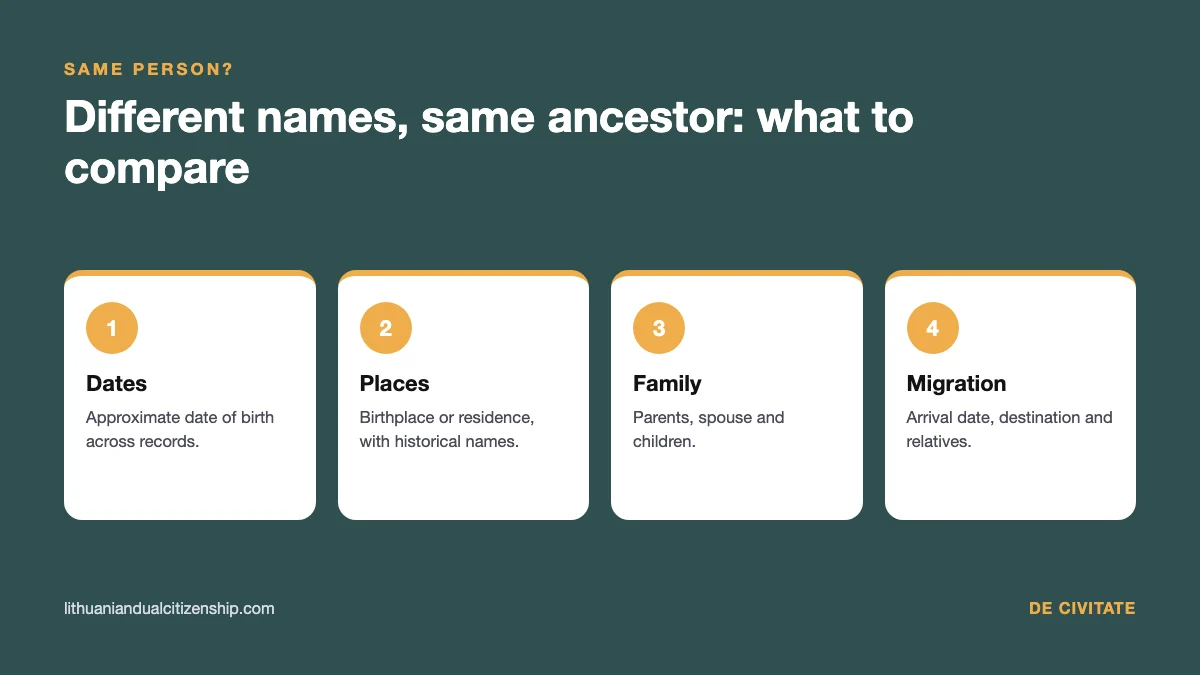
A name comparison should not focus only on letters. It should look at the full identity profile of the person. The strongest analysis usually compares the name, approximate date of birth, place of birth or residence, religion or community, spouse, parents, siblings, children, occupation, migration route, and known addresses.
Small inconsistencies are common in historical records. Ages may vary by a few years, place names may reflect different political periods, and surnames may shift between Lithuanian, Polish, Russian, Yiddish, and English forms. The more independent details point to the same person, the more coherent the record chain becomes.
However, it is also important not to force a match. If two people have similar names but different families, different places, different spouses, or conflicting timelines, the discrepancy may be more serious. In citizenship-related research, the goal is not simply to find a similar name. The goal is to show a reliable connection between the ancestor in the historical records and the applicant’s documented family line.
Common Patterns in Lithuanian Surname Changes
Many Lithuanian surname changes follow recognizable patterns. Some surnames lost Lithuanian endings after immigration. Others were adapted to Polish or Russian spelling conventions before later being rendered in English. Some names were shortened to make pronunciation easier in the United States.
In Jewish Lithuanian families, a person may appear with a Yiddish or Hebrew given name in one source and a Russian, Polish, or English equivalent in another. A surname may also appear in several transliterations depending on whether the source was written in Cyrillic, Hebrew script, Latin letters, or English.
Marriage can also create name discrepancies, especially for female ancestors. A woman may appear under her birth surname, married surname, Lithuanian feminine surname form, Polish form, Russian form, or Americanized surname. When building a citizenship by descent file, these transitions usually need to be traced through marriage, birth, and family records.
When a Name Discrepancy May Require Extra Explanation
A discrepancy may require extra explanation when the name difference is substantial, when there is no direct document linking the two versions, or when the surrounding details are incomplete. This can also happen when a family used more than one surname in the United States or when an ancestor appears under different first names in different records.
Additional explanation may also be needed if records use different alphabets. A Cyrillic record, a Polish-language record, a Yiddish or Hebrew-related source, and a U.S. English document may all represent the same name differently. In these cases, transliteration and historical context can be relevant.
A well-prepared explanation usually shows the sequence of records rather than treating each discrepancy as a separate problem. It may demonstrate how the name appeared in the old country, how it was recorded during migration, how it appeared in early U.S. records, and how the later family spelling became fixed.
How to Organize Records for a Citizenship Review
The most practical approach is to organize the documents chronologically and by family line. This helps show how the ancestor’s identity developed across time and across countries. Instead of presenting isolated documents, the record set should show a continuous path from the Lithuanian or old-world record to the U.S. family documents and then to the applicant.
It is also useful to keep variant spellings together. If the same person appears under several surnames or given names, each version should be treated as part of the same identity analysis. The explanation should be clear enough for a reviewer to understand why the records are connected despite different spellings.
Translations and transliterations should be handled carefully. A name in Russian, Polish, Lithuanian, Yiddish, or Hebrew-related records may have more than one possible English rendering. The chosen form should be consistent, but the underlying variants should not be hidden. In many cases, acknowledging the discrepancy directly is better than pretending it does not exist.
Why Name Changes Should Be Treated as Evidence Issues, Not Just Genealogy Issues
For family history research, a name variation may be an interesting discovery. For Lithuanian citizenship by descent, it can become an evidence issue. The applicant may need to show not only that an ancestor existed, but also that the ancestor in the Lithuanian or old-world record is the same person connected to the applicant through U.S. civil records.
This is why Lithuanian ancestor name changes in records should be reviewed in context. A spelling variation may be harmless when the record chain is strong. A seemingly small difference may become more important if other facts are missing. A dramatic name change may still be explainable if there is enough supporting documentation.
The safest approach is to treat name discrepancies as part of the broader proof of identity and descent. Each document should help answer the same question: does the evidence show a coherent, credible connection between the historical Lithuanian ancestor and the present-day applicant?
FAQ
Do Lithuanian surname changes in immigration records prevent citizenship by descent?
Not necessarily. Lithuanian surname changes in immigration records are common and do not automatically prevent a citizenship by descent or restoration review. The key issue is whether the available documents can reasonably connect the different name versions to the same ancestor and the same family line.
Why do Lithuanian names appear differently in Polish, Russian, and Yiddish records?
Lithuanian names may appear differently because historical records were created in different languages, alphabets, and administrative systems. A name could be adapted into Polish, written in Russian or Cyrillic, preserved in a Yiddish or Hebrew-related form, or later transliterated into English. These changes can produce several spellings for the same person.
Were Lithuanian surnames usually changed at Ellis Island?
Many Lithuanian surnames changed around the time of immigration, but they were not usually changed by Ellis Island officials in the way family stories often describe. Passenger lists were often prepared before arrival, and many name changes happened later through naturalization, employment, school records, marriage, or everyday American usage.
What documents help explain Lithuanian citizenship records name discrepancies?
Helpful documents may include passenger lists, naturalization files, birth records, marriage records, death certificates, census records, draft registrations, church or synagogue records, Lithuanian archive records, Russian Empire records, Polish-language records, and Jewish community records. The strongest evidence usually connects several identifying details, not just the name.
Are Yiddish names in Lithuanian records a problem for citizenship research?
Yiddish names in Lithuanian records are not automatically a problem. They may reflect the religious, cultural, or community context of the ancestor. The issue is whether the Yiddish, Hebrew-related, Russian, Polish, Lithuanian, or English versions can be connected through supporting details such as family members, dates, places, and migration history.
Find out if you qualify — free
Send us your family details and a Lithuanian citizenship specialist will review your case and explain your options.
Start free eligibility check