Many families with Lithuanian roots left Lithuania during or after World War II because of occupation, war, persecution, deportation, or displacement. For their descendants in the United States, this history can be directly relevant to Lithuanian citizenship restoration.
Lithuanian citizenship for descendants of WWII refugees is not based only on ethnic origin, family stories, or the fact that an ancestor was born in Lithuania. In most cases, the key question is whether the ancestor was a citizen of the Republic of Lithuania before June 15, 1940, and whether the family history fits the legal categories that allow citizenship to be reinstated, often without requiring the applicant to renounce U.S. citizenship.
This guide explains how Lithuanian citizenship by descent may apply to descendants of refugees, displaced persons, deportees, exiled persons, and families who left Lithuania during the period of occupation.
In short
- Descendants of Lithuanians who fled during WWII can often restore Lithuanian citizenship.
- The ancestor must have been a citizen of the Republic of Lithuania before 15 June 1940 and left before 11 March 1990.
- Displaced persons (DP) camp records help prove identity and migration, but not always citizenship.
- Dual citizenship is often possible but not automatic — the legal exception must be shown.
- Lost wartime records can often be replaced from archives, DP files and immigration records.
Why WWII Refugee History Matters for Lithuanian Citizenship
World War II and the Soviet occupation changed the lives of many Lithuanian families. Some people fled westward as the front moved across Europe. Others were deported, forcibly displaced, or unable to return to Lithuania after the war. Many later settled in the United States, Canada, Australia, the United Kingdom, Israel, South America, or other countries.
For citizenship restoration, this historical context matters because Lithuanian law recognizes certain categories of people who held Lithuanian citizenship before the occupation and later left or were forced out of Lithuania before March 11, 1990. Their descendants may have a route to Lithuanian citizenship restoration, depending on the available evidence and the applicant’s direct family line.
This is why Lithuanian citizenship by descent WWII refugees research often begins with two separate questions. First, was the ancestor a Lithuanian citizen during the relevant historical period? Second, can the applicant prove how the ancestor left Lithuania, where the family resettled, and how the applicant descends from that person?
Who May Qualify as a Descendant of a Lithuanian WWII Refugee
A descendant of a Lithuanian WWII refugee may be eligible to apply for reinstatement of Lithuanian citizenship if the family line can be documented through a qualifying ancestor. Usually, the qualifying ancestor must have been a citizen of the Republic of Lithuania before June 15, 1940.
In practice, this often involves parents, grandparents, or great-grandparents who were Lithuanian citizens before the Soviet occupation and later left Lithuania before March 11, 1990. Many U.S.-based applicants research Lithuanian citizenship restoration through grandparents WWII because their grandparents were the generation that left Lithuania, passed through displaced persons camps, or resettled abroad after the war.
However, being the descendant of someone born in Lithuania is not always the same as being the descendant of a Lithuanian citizen. Lithuania restored its statehood in 1918, so families whose ancestors emigrated before the formation of the modern Republic of Lithuania may require more careful analysis. The important issue is not only Lithuanian ethnicity or place of birth, but whether the ancestor held citizenship of the Republic of Lithuania during the legally relevant period.
Lithuanian Citizenship for Descendants of Displaced Persons
Lithuanian citizenship for descendants of displaced persons usually involves families whose ancestors left Lithuania during World War II and later lived in displaced persons camps in Germany, Austria, or other parts of post-war Europe before emigrating abroad.
Displaced person records can be highly useful because they may show names, dates of birth, places of birth, nationality, family relationships, camp locations, resettlement routes, and departure destinations. These records may help connect a U.S. applicant to a Lithuanian ancestor and support the broader historical narrative of displacement after the war.
At the same time, DP records do not automatically prove Lithuanian citizenship. A displaced persons camp document may describe someone as Lithuanian by nationality, origin, language, or place of birth, but the citizenship restoration process may still require stronger evidence that the person was legally a citizen of the Republic of Lithuania before June 15, 1940. DP records are often most useful when combined with Lithuanian archive documents, civil records, passports, military records, or other evidence.
Refugees, Deportees, and Exiled Persons: Important Differences
For many families, the words refugee, displaced person, deportee, and exile are used informally. In citizenship matters, these terms can have different legal implications.
A WWII refugee may have fled Lithuania because of war, persecution, fear of Soviet repression, or the inability to return after occupation. A displaced person may have been registered in post-war Europe and later resettled overseas. A deportee may have been forcibly removed by an occupation regime. An exiled person may refer to someone forced out of Lithuania or unable to remain because of political, social, ethnic, or occupation-related reasons.
Lithuanian citizenship restoration for descendants of refugees and Lithuanian citizenship restoration for descendants of deportees may overlap in family history, but the evidence needed can differ. A family that left Lithuania voluntarily for economic reasons may not be assessed the same way as a family that fled during wartime occupation or was deported. The applicant’s documents should therefore establish not only descent, but also the relevant facts around departure, displacement, deportation, or residence abroad.
| Family history | Typical records | What they usually prove |
|---|---|---|
| WWII refugee | Passenger lists, immigration files | Departure, route, identity |
| Displaced person (DP) | DP camp records in Germany or Austria | Identity, family, nationality as recorded, resettlement |
| Deportee or exile | Deportation and archive records | Forced removal from occupied Lithuania |
| Any of the above | Interwar passport, internal passport or military records | Lithuanian citizenship before 15 June 1940 |
Lithuanian Citizenship Restoration After Soviet Occupation
Lithuanian citizenship restoration after Soviet occupation is closely connected to the status of people who were citizens of the Republic of Lithuania before June 15, 1940. When Lithuania was occupied, many citizens lost the practical ability to exercise their citizenship, leave freely, return safely, or preserve official documents.
For descendants, the restoration process is generally not a standard naturalization route. It is based on the idea that citizenship rights may be reinstated where the applicant descends from a person who held Lithuanian citizenship before occupation and where the legal conditions are satisfied.
This distinction is important for U.S. applicants. Lithuanian citizenship restoration by descent is usually different from applying for citizenship through residence, marriage, language knowledge, or ordinary naturalization. The applicant normally focuses on historical citizenship, family continuity, and documentary proof rather than current residence in Lithuania.
Can Descendants of Lithuanian Refugees Keep U.S. Citizenship?
Lithuanian dual citizenship for descendants of Lithuanian refugees may be possible in many cases, but it should not be treated as automatic for every applicant with Lithuanian ancestry. Lithuania generally restricts dual citizenship, but the law provides exceptions for certain categories, including people who left Lithuania before March 11, 1990, people exiled from occupied Lithuania, and their descendants.
For many U.S.-based descendants of WWII refugees and displaced persons, this is one of the most important practical issues. If the applicant qualifies under the relevant exception, they may be able to reinstate Lithuanian citizenship without renouncing U.S. citizenship. However, the exact outcome can depend on the ancestor’s citizenship status, the circumstances of departure, the family line, and the documents submitted.
Applicants should be careful with simplified online claims that “all descendants qualify” or that “dual citizenship is always allowed.” Lithuanian citizenship law contains specific categories, and the authorities may review the documentation closely.
Documents That May Help Prove Eligibility
A strong citizenship restoration file usually has to prove several things at the same time. It should identify the Lithuanian ancestor, show that the ancestor held Lithuanian citizenship before June 15, 1940, document the applicant’s direct descent, and explain the ancestor’s departure, displacement, exile, deportation, or permanent residence abroad.
Useful documents may include Lithuanian passports, internal passports, military service records, civil registry records, birth certificates, marriage certificates, archival certificates, naturalization records, immigration files, passenger records, displaced persons camp records, International Refugee Organization records, Arolsen Archives records, and documents issued in the United States after resettlement.
For descendants applying through grandparents or great-grandparents, civil records are especially important because they connect each generation in the family line. A birth certificate may connect the applicant to a parent, a parent’s birth certificate may connect that parent to the Lithuanian grandparent, and marriage records may explain surname changes across generations.
Why Name Changes and Inconsistent Records Are Common
Many descendants of Lithuanian WWII refugees encounter inconsistent names in U.S., European, and Lithuanian records. This is common and does not necessarily prevent an application from being prepared.
Lithuanian names may have been transliterated, shortened, misspelled, Americanized, translated, or recorded differently by immigration officials, camp administrators, military authorities, or local civil registries. A person might appear under a Lithuanian spelling in one document, a Polish or Russian form in another, and an Americanized surname after arrival in the United States.
These differences should be addressed carefully. Minor spelling variations may be explainable through supporting records, but larger discrepancies may require additional evidence. The goal is to show that the records refer to the same person and that the family line remains continuous.
What If the Ancestor’s Records Were Lost During the War?
Many families do not have original Lithuanian documents because records were lost during war, displacement, deportation, migration, or later family moves. This is common in cases involving Lithuanian citizenship by descent displaced persons.
Missing family documents do not always mean the case is impossible. In many situations, records may still exist in Lithuanian archives, church books, civil registry collections, displaced persons camp files, immigration records, naturalization files, or foreign archival databases. The availability of records depends on the ancestor’s place of birth, religion, residence, migration route, and the historical period involved.
When direct proof of citizenship is unavailable, supporting documents may become more important. However, applicants should avoid assuming that any single document will be enough. A persuasive file often depends on how multiple records work together.
Common Eligibility Problems for Descendants of WWII Refugees
One common issue is that the ancestor may have been born in Lithuanian territory but may not have held citizenship of the Republic of Lithuania before June 15, 1940. This can happen in families that left before Lithuanian independence or where the citizenship status is unclear.
Another issue is an incomplete family line. If the applicant cannot connect themselves to the Lithuanian ancestor through birth, marriage, adoption, or name-change records, the case may be difficult even if the ancestor was clearly Lithuanian.
A third issue involves the route of departure. Some legal categories distinguish between people who left Lithuania for permanent residence abroad and people who moved to territories of the former Soviet Union after June 15, 1940. This can affect how the case is assessed.
Finally, applicants sometimes rely too heavily on ethnicity. Lithuanian ancestry, language, surname, religion, or family tradition may support genealogical research, but citizenship restoration usually requires documentary proof of legal and family facts.
How the Application Process Usually Works
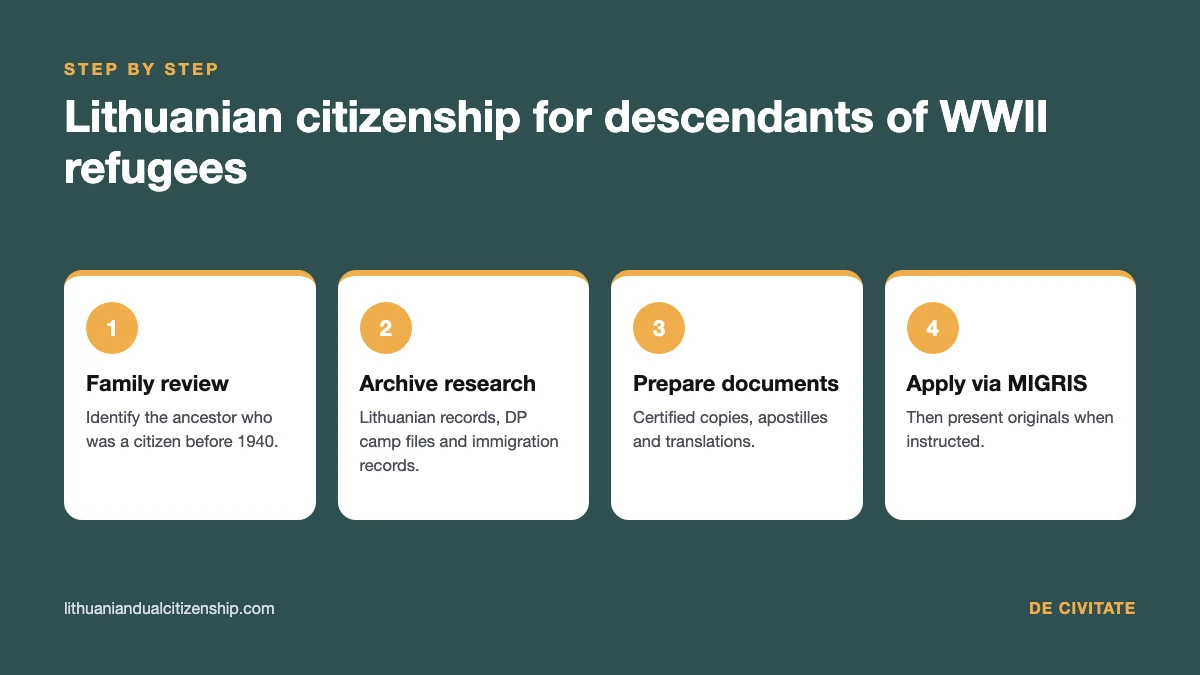
The process usually begins with a document review and family history analysis. The applicant identifies the Lithuanian ancestor, gathers available family records, and determines whether the case appears to fit the legal framework for reinstatement.
The next stage is archival and documentary research. This may involve searching Lithuanian records, displaced persons camp files, immigration files, naturalization records, and civil status documents from the United States or other countries where the family lived.
After the documents are collected, they may need to be prepared for official use. Depending on the country of issue and the type of document, this can involve certified copies, apostilles, translations, and formatting according to the requirements of the Lithuanian authorities.
Applications for reinstatement are generally submitted through the Lithuanian Migration Information System, commonly known as MIGRIS. In many cases, applicants must later present original documents or certified copies through the relevant Lithuanian consular office or another competent institution, depending on the procedure and the applicant’s location.
Lithuanian Citizenship Restoration Through Grandparents from WWII
Lithuanian citizenship restoration through grandparents WWII is a common path for U.S.-based applicants because many Lithuanian refugees and displaced persons who left Europe after the war were grandparents or great-grandparents of today’s applicants.
The key is to document each generation clearly. If the qualifying ancestor is a grandparent, the applicant usually needs records connecting the grandparent to the applicant’s parent and the parent to the applicant. If the qualifying ancestor is a great-grandparent, an additional generation must be documented.
This is also where surname changes can become important. If a grandmother’s Lithuanian surname changed after marriage, or if a family surname was Americanized after arrival in the United States, the file should include records that explain the transition. The clearer the chain of identity, the easier it is to understand the family connection.
What Descendants Should Understand Before Starting
Lithuanian citizenship for descendants of WWII refugees is a document-based process. Family history is important, but the application depends on evidence that fits the legal requirements.
Applicants should begin by identifying the strongest possible qualifying ancestor. In some families, more than one grandparent or great-grandparent may have Lithuanian roots, but one line may be easier to prove than another. The best route is usually the one with the clearest evidence of Lithuanian citizenship, departure or displacement, and direct descent.
It is also important to separate citizenship restoration from passport issuance. A Lithuanian passport is usually relevant after citizenship status has been recognized or restored. The first question is not whether the applicant can get a passport, but whether the applicant can establish the right to Lithuanian citizenship restoration.
FAQ
Can descendants of Lithuanian WWII refugees apply for Lithuanian citizenship?
Descendants may be able to apply if they can prove that a parent, grandparent, or great-grandparent was a citizen of the Republic of Lithuania before June 15, 1940, and that the case fits the relevant legal requirements. The result depends on the documents, the family line, and the circumstances of departure or displacement.
Do displaced persons camp records prove Lithuanian citizenship?
Displaced persons camp records can be useful, but they do not always prove Lithuanian citizenship by themselves. They may help show identity, origin, family members, migration route, and post-war displacement. In many cases, they should be combined with Lithuanian archival records or other documents showing citizenship before June 15, 1940.
Can I apply through my Lithuanian grandparent who left after World War II?
You may be able to apply through a Lithuanian grandparent if the grandparent was a Lithuanian citizen before June 15, 1940, left Lithuania before March 11, 1990, and the family line can be documented. Additional evidence may be needed to explain the circumstances of departure, refugee status, or displaced persons history.
Is Lithuanian dual citizenship allowed for descendants of refugees?
Lithuanian dual citizenship may be allowed for descendants of people who left Lithuania before March 11, 1990, or were exiled from occupied Lithuania, but it is not automatic in every ancestry case. The applicant must usually prove that the legal exception applies to their family situation.
What documents are usually needed for Lithuanian citizenship restoration?
Documents often include proof of the ancestor’s Lithuanian citizenship before June 15, 1940, records showing departure or displacement, and civil records proving direct descent. Birth certificates, marriage certificates, passports, archive records, immigration files, naturalization records, and displaced persons records may all be relevant.
What if my Lithuanian ancestor’s name changed in U.S. records?
Name changes and spelling variations are common in refugee and immigration records. They do not necessarily prevent an application, but they should be explained with supporting documents. The main goal is to show that the records refer to the same person and that the family line is consistent.
Find out if you qualify — free
Send us your family details and a Lithuanian citizenship specialist will review your case and explain your options.
Start free eligibility check