Many people with Lithuanian ancestry wonder whether they must move to Lithuania before applying for citizenship restoration. For applicants living in the United States, this is often one of the first practical questions: can you restore Lithuanian citizenship without living in Lithuania, or does the process require physical residence in the country?
In many Lithuanian citizenship restoration cases, the answer is that residence in Lithuania is not the main requirement. The process is usually based on ancestry, historical citizenship, family documents, and the circumstances under which the former Lithuanian citizen or their descendants left Lithuania. However, this does not mean that every person with Lithuanian roots automatically qualifies, or that the process is the same as naturalization.
Understanding the difference between citizenship restoration, citizenship by descent, and residence-based naturalization is essential. The residency requirement depends on the legal route, not only on the applicant’s ethnic background or family history.
In short
- You usually do not need to live in Lithuania to restore Lithuanian citizenship by descent.
- Residence requirements belong to naturalization, a different legal route.
- Many Americans apply from abroad, through MIGRIS and Lithuanian consulates.
- What matters more is the documentary chain and your ancestor’s citizenship.
- Applying from abroad still means formal steps: apostilles, translations and original documents.
Do You Need to Live in Lithuania for Lithuanian Citizenship?
In many cases involving Lithuanian citizenship restoration by descent, an applicant does not need to live in Lithuania before applying. The right to restore Lithuanian citizenship is generally connected to a former Lithuanian citizen and their descendants, rather than to the applicant’s current place of residence.
This is especially relevant for Americans with Lithuanian ancestry whose parents, grandparents, or great-grandparents left Lithuania during the twentieth century. A person may live in the United States, Canada, the United Kingdom, Australia, or another country and still explore Lithuanian citizenship restoration from abroad.
The key issue is not whether the applicant currently resides in Lithuania. The more important questions are whether the family line can be documented, whether the ancestor held Lithuanian citizenship during the relevant historical period, and whether the applicant’s situation falls within the rules for restoration and, where relevant, dual citizenship.
Why Residency Is Often Confused With Citizenship Restoration
Confusion usually comes from mixing two different legal concepts: restoration of citizenship and naturalization.
Naturalization is typically a residence-based path. In that context, a person may need to live in Lithuania for a required period, meet language or integration requirements, and satisfy other legal conditions. This route is usually relevant to foreign nationals who are building a life in Lithuania and later want to apply for citizenship through residence.
Lithuanian citizenship restoration is different. It is commonly discussed in the context of people whose ancestors were citizens of the Republic of Lithuania before the loss of independence in 1940, and whose family history may involve emigration, exile, displacement, or other historical circumstances. For this reason, Lithuanian citizenship restoration residency requirements are not the same as naturalization requirements.
A person researching “Lithuanian citizenship by descent residency requirement” should therefore be careful not to rely on general naturalization information. Articles about ten-year residence, language exams, or permanent residence may be accurate for naturalization, but they may not describe the restoration route for descendants of Lithuanian citizens.
Lithuanian Citizenship Restoration From Abroad
Lithuanian citizenship restoration from abroad is a common scenario for descendants of Lithuanian citizens. Many applicants are not living in Lithuania when they begin researching their eligibility, gathering family documents, or preparing an application.
For U.S.-based applicants, the process often starts with family records: birth certificates, marriage certificates, naturalization records, old passports, archival documents, immigration files, displaced persons records, or other documents that help connect the applicant to a Lithuanian citizen ancestor. These records may come from Lithuania, the United States, or other countries where the family lived after leaving Lithuania.
Applying from abroad does not remove the need to follow procedural rules. Documents may need to be properly issued, legalized or apostilled where required, translated into Lithuanian, and submitted in the correct form. In some cases, an applicant may also need to present original documents or interact with Lithuanian authorities or a Lithuanian diplomatic mission. This is different from a residency requirement. A procedural appointment or document verification step does not necessarily mean the applicant must live in Lithuania.
| Route | Need to live in Lithuania? | Main focus |
|---|---|---|
| Restoration by descent | Generally no | Ancestor’s citizenship and documented family line |
| Naturalization | Yes — a required residence period | Residence, language, integration |
| Archive research trip | Optional | Practical help finding records |
What Actually Matters More Than Residence
For citizenship restoration, the strongest part of the case is usually the documentary chain. The applicant generally needs to show a direct family connection between themselves and the relevant Lithuanian citizen ancestor. This often means connecting each generation with civil records, such as birth and marriage certificates, and explaining any name changes along the way.
Another important issue is whether the ancestor was actually a citizen of Lithuania, not merely born in a territory that is now or was historically associated with Lithuania. This distinction matters because citizenship restoration is usually based on citizenship status, not only ethnicity, language, place of birth, or family stories.
The applicant may also need documents showing when and under what circumstances the ancestor left Lithuania or was removed from Lithuania. This can be especially important when the applicant wants to understand whether they may be eligible to restore Lithuanian citizenship while retaining another citizenship, such as U.S. citizenship.
Because family histories vary, the same general rule can lead to different outcomes in different cases. A clean document chain involving a parent or grandparent may be more straightforward than a case involving missing archives, inconsistent names, undocumented migration, or an ancestor who left before the relevant period.
Lithuanian Citizenship Through Grandparents and Residency
Many U.S. applicants search specifically for Lithuanian citizenship through grandparents residency requirement because their closest Lithuanian-born or Lithuanian-citizen ancestor was a grandparent or great-grandparent.
In many restoration cases, the applicant’s current residence is not the decisive issue. A person may be able to apply through a parent, grandparent, or great-grandparent if the legal and documentary requirements are met. However, the family relationship must be proven with reliable records, and the ancestor’s Lithuanian citizenship must be supported by appropriate documents.
This is where many applications become complex. A family may know that a grandparent was “from Lithuania,” but the available documents may not clearly show citizenship. Some records may use different spellings, different languages, changed surnames, or historical place names. In such cases, the practical challenge is not moving to Lithuania. The challenge is proving the legal facts required for restoration.
Lithuanian Citizenship Restoration for Americans
Lithuanian citizenship restoration for Americans is often researched by descendants of Lithuanian emigrants who settled in the United States before, during, or after World War II. For these applicants, U.S. records can be highly important. Naturalization files, arrival records, draft cards, marriage certificates, death certificates, and Social Security-related records may help establish identity, family links, or migration history.
However, U.S. documents alone may not always be enough. Lithuanian archival records may be needed to show that the ancestor held Lithuanian citizenship during the relevant period. The applicant may also need to reconcile differences between Lithuanian, Polish, Russian, German, Yiddish, or anglicized versions of names and places.
For Americans, the key point is that living in the United States does not automatically prevent a person from exploring Lithuanian citizenship restoration. At the same time, U.S. citizenship does not by itself guarantee that Lithuanian citizenship can be restored or retained as dual citizenship. The result depends on the applicant’s family line, documents, and the applicable legal grounds.
When Living in Lithuania May Matter
Living in Lithuania may matter if the person is not eligible for restoration and instead needs to consider another legal route, such as naturalization. In that situation, residence, language ability, legal status, income, and other requirements may become relevant.
Living in Lithuania may also be relevant for practical reasons. Some people choose to travel to Lithuania to search archives, handle family records, or resolve document issues. Others may visit a Lithuanian consulate or embassy abroad instead. These practical steps should not be confused with a legal requirement to reside in Lithuania before applying for restoration.
In short, residency can matter in Lithuanian citizenship law, but it does not apply in the same way to every citizenship route. A person asking about a Lithuanian citizenship reinstatement residency requirement should first confirm whether their situation is truly a restoration case or a different type of citizenship case.
Common Misunderstandings About Residency and Restoration
One common misunderstanding is that every citizenship process requires living in the country. That may be true for many naturalization routes around the world, but restoration by descent is usually structured differently. It focuses on a historical connection to citizenship and a documented family line.
Another misunderstanding is that Lithuanian ancestry alone is enough. It is not always enough to say that a family was Lithuanian, spoke Lithuanian, or came from a town that is now in Lithuania. The application usually depends on whether the ancestor had Lithuanian citizenship and whether this can be shown through documents.
A third misunderstanding is that applying from abroad is the same as an informal online process. Even when the application can be started or submitted electronically, citizenship restoration remains a formal legal procedure. Documents must be consistent, complete, and prepared according to the applicable requirements.
How to Think About Your Own Situation
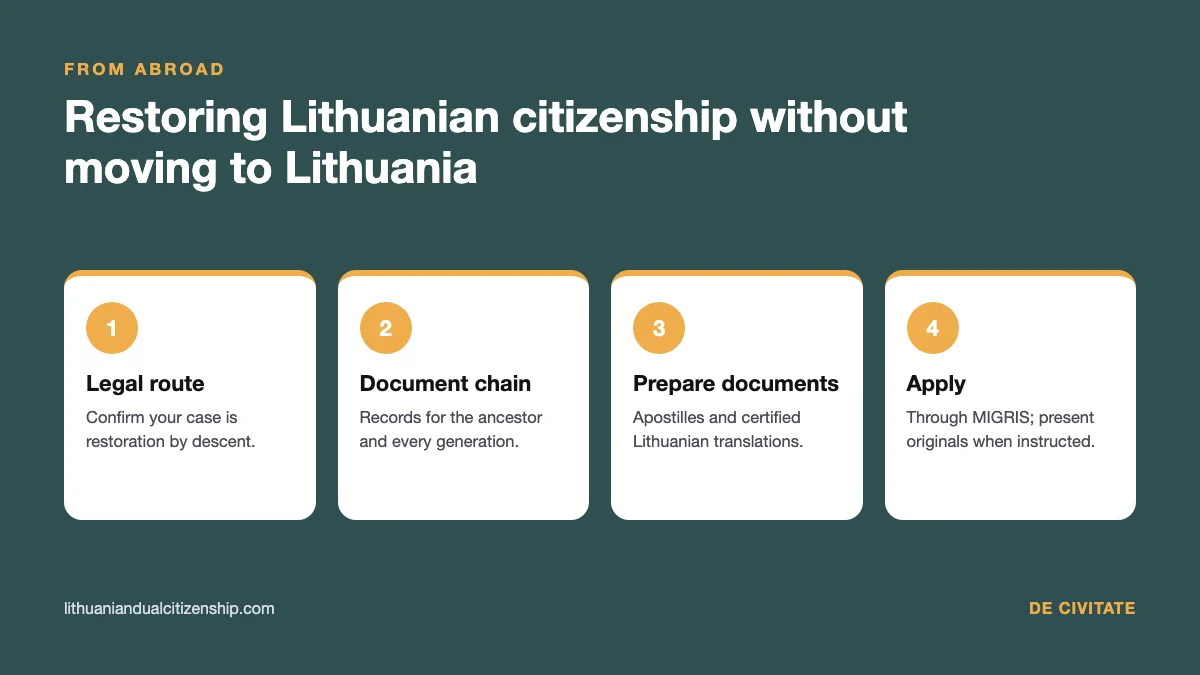
If you are trying to understand whether you need to live in Lithuania for Lithuanian citizenship, start by identifying the legal route. If your case is based on a parent, grandparent, or great-grandparent who was a Lithuanian citizen, you are likely researching restoration or citizenship by descent rather than naturalization.
Next, focus on the document chain. You need to understand what records exist for the Lithuanian ancestor, what records connect each generation, and whether there are name changes or gaps that need to be addressed. The stronger and clearer the documentation, the easier it is to assess the case.
Finally, separate eligibility from procedure. You may not need to reside in Lithuania, but you may still need to follow formal steps, provide original or certified documents, obtain translations, and respond to requests from the authorities. The fact that a person applies from abroad does not make the process automatic or less document-driven.
FAQ
Can you restore Lithuanian citizenship without living in Lithuania?
In many citizenship restoration by descent cases, an applicant can apply without living in Lithuania. The case is usually based on descent from a former Lithuanian citizen and supporting documents, not on the applicant’s current residence. However, the exact assessment depends on the applicant’s family history, documents, and legal grounds.
Is there a Lithuanian citizenship restoration residency requirement?
For restoration by descent, residence in Lithuania is generally not the central requirement. The more important issues are whether the applicant descends from a person who held Lithuanian citizenship during the relevant historical period and whether the family line and migration history can be documented. Residency requirements are more commonly associated with naturalization.
Is Lithuanian citizenship by descent the same as naturalization?
No. Lithuanian citizenship by descent or restoration is usually based on a family connection to a former Lithuanian citizen. Naturalization is generally a separate route that may involve residence in Lithuania, language requirements, and other conditions. These routes should not be evaluated using the same criteria.
Can Americans apply for Lithuanian citizenship restoration from abroad?
Yes, many Americans with Lithuanian ancestry research and pursue Lithuanian citizenship restoration while living in the United States. They may still need Lithuanian, U.S., and sometimes other foreign records to prove the family line, the ancestor’s citizenship, and relevant migration facts.
Do you need to speak Lithuanian to restore citizenship by descent?
In many restoration by descent cases, the process is not based on a Lithuanian language exam. This differs from some residence-based naturalization routes, where language and integration requirements may be relevant. The main focus in restoration cases is usually documentary proof.
Can you apply through a Lithuanian grandparent without moving to Lithuania?
In many cases, a person may explore Lithuanian citizenship through a grandparent without moving to Lithuania, provided the legal and documentary requirements are met. The applicant usually needs to prove the grandparent’s Lithuanian citizenship and the direct family relationship through each generation.
Does applying from abroad mean the process is simpler?
Not necessarily. Applying from abroad may be possible, but the process can still require detailed document preparation, translations, apostilles or legalization where applicable, and consistency across records. The main difficulty is often proving the family line and historical citizenship, not satisfying a residence requirement.
Find out if you qualify — free
Send us your family details and a Lithuanian citizenship specialist will review your case and explain your options.
Start free eligibility check