Finding a historical document that describes a Lithuanian ancestor as “stateless” can create uncertainty for descendants researching Lithuanian citizenship by descent. A U.S. immigration file, naturalization petition, displaced-person record, census entry, or other historical document may identify the ancestor as stateless even though earlier records connect that person with Lithuania.
A stateless designation does not, by itself, answer the Lithuanian citizenship question. The important issue is usually the ancestor’s citizenship history: whether the person held citizenship of the Republic of Lithuania during the legally relevant historical period, when the stateless status appeared, why it appeared, and whether there is evidence of a formal loss of Lithuanian citizenship.
For a Lithuanian citizenship by descent stateless ancestor case, chronology is therefore critical. A document describing an ancestor as stateless decades after the person left Lithuania may have a very different significance from evidence showing that Lithuanian citizenship was formally terminated before June 15, 1940.
In short
- A “stateless” label on a later foreign record does not by itself prevent Lithuanian citizenship by descent.
- The key question is whether the ancestor held Lithuanian citizenship before 15 June 1940 — after the 2022 amendments, at any time before that date.
- Statelessness and a formal loss of Lithuanian citizenship are different things; only a completed legal procedure of loss can exclude the ancestor.
- U.S. naturalization records help date events — a declaration of intention is not the same as completed naturalization.
- Build a timeline: Lithuanian citizenship, departure, first “stateless” record, later citizenship.
Does a Stateless Ancestor Prevent Lithuanian Citizenship by Descent?
Not automatically. Lithuanian citizenship restoration is generally connected to whether the relevant ancestor held citizenship of the Republic of Lithuania before June 15, 1940 and whether the applicant falls within the qualifying line of descent.
Lithuanian law provides an indefinite right to reinstate citizenship for persons who held citizenship of the Republic of Lithuania before June 15, 1940 and their qualifying descendants. The law defines a descendant for this purpose as a child, grandchild, or great-grandchild.
The present legal definition is particularly important when an ancestor later became stateless. Following amendments adopted in 2022, a person who held Lithuanian citizenship before June 15, 1940 is generally understood as someone who held that citizenship at any time before the date. The definition excludes persons whose citizenship was lost through the mandatory procedures established by Lithuanian law and for whom the required formal decision on loss of citizenship was adopted.
This means that the word “stateless” on a later foreign record should not automatically be treated as proof that the ancestor had legally lost Lithuanian citizenship in a way that defeats a restoration claim. The underlying events and documents need to be examined.
Why the Date of Statelessness Matters
The first question is not simply whether the ancestor was stateless, but when that status was recorded.
Suppose an ancestor held a Lithuanian passport during the interwar period, emigrated from Lithuania, and was recorded as stateless after World War II. That later classification does not erase the earlier documentary evidence showing Lithuanian citizenship. The relevant analysis would consider the ancestor’s full citizenship history and whether any formal legal event affected that status.
A different situation may arise if documents from the interwar period show that the ancestor took formal steps relating to the loss or renunciation of Lithuanian citizenship. In such a case, the records surrounding that process may become central to Lithuanian citizenship eligibility.
For this reason, a useful timeline normally separates several dates: when the ancestor obtained or held Lithuanian citizenship, when the ancestor left Lithuania, when a foreign authority first described the person as stateless, whether another citizenship was later acquired, and whether Lithuanian records contain a formal decision concerning loss of citizenship.
The sequence is often more important than a single nationality label appearing on one document.
Statelessness and Loss of Lithuanian Citizenship Are Not the Same Thing
“Stateless” is a description of a person who was not considered a national of any state under the relevant legal framework. “Loss of Lithuanian citizenship,” however, is a specific citizenship event.
The two concepts can overlap, but they should not automatically be treated as interchangeable.
A foreign document might describe an individual as stateless because the issuing authority did not recognize the person as holding a current nationality. It might also reflect the consequences of war, occupation, displacement, border changes, missing documents, or the administrative terminology used at the time.
That foreign classification does not necessarily establish how Lithuanian authorities regarded the person’s earlier citizenship status.
Conversely, if Lithuanian records establish that the ancestor formally lost citizenship according to the procedures applicable at the time, that evidence may have considerably greater legal significance than a later foreign record simply using the term “stateless.”
The practical objective is therefore to determine what actually happened to the ancestor’s citizenship rather than relying on a label alone.
What If the Ancestor Lost Lithuanian Citizenship Before 1940?
This is one of the most important distinctions in a stateless-ancestor case.
Current Lithuanian legislation recognizes persons who held Lithuanian citizenship at any time before June 15, 1940, but the statutory definition does not include individuals whose Lithuanian citizenship was lost after the mandatory procedures prescribed by Lithuanian law were completed and the legally required decision on loss of citizenship was adopted.
Accordingly, evidence that an ancestor merely intended to change nationality, described themselves differently in a foreign document, or was later recorded as stateless should not automatically be equated with a completed formal loss of Lithuanian citizenship.
The relevant historical records may need to show whether a legal procedure actually occurred.
This distinction can be particularly important for families whose ancestors emigrated before World War II. Historical citizenship rules changed over time, and the legal effect of acquiring another nationality or seeking release from Lithuanian citizenship cannot always be determined from a single U.S. document.
| Record or event | What it means for the claim |
|---|---|
| Interwar Lithuanian passport or identity record | Evidence that the ancestor held Lithuanian citizenship before 1940 |
| Later foreign record describing the ancestor as stateless | Does not erase earlier Lithuanian citizenship; must be placed on the timeline |
| Formal loss of Lithuanian citizenship completed before 15 June 1940 | Can exclude the ancestor under the current legal definition |
| Declaration of intention to naturalize | Not the same as completed naturalization |
| Later naturalization in another country | A separate event; relevant to the timeline and to dual citizenship |
Start With Proof of Lithuanian Citizenship Before 1940
Before focusing heavily on the stateless designation, it is usually useful to establish whether there is proof of Lithuanian citizenship before 1940.
Lithuanian law identifies several categories of documents that may establish earlier citizenship. These include internal or foreign passports of the Republic of Lithuania issued before June 15, 1940, certain Lithuanian passports issued abroad after that date, records of service in the Lithuanian armed forces or civil service, documents directly referring to Lithuanian citizenship, and certain personal certificates.
When those direct records are unavailable, documents relating to the ancestor’s studies, work, residence in Lithuania, foreign passports, and other evidence may also be considered.
The absence of an old Lithuanian passport therefore does not necessarily end the research. Many families need to reconstruct the ancestor’s status from multiple archival sources.
Lithuanian Passports and Internal Identity Records
An interwar Lithuanian passport can be particularly useful because it directly connects an identified person with the Lithuanian state.
Families should also investigate internal passport records. These records may contain identifying details such as names, dates and places of birth, residence information, family details, photographs, or references to other documents. Their usefulness depends on what survives in the archives and whether the record can be connected confidently to the ancestor.
If a later record describes the same individual as stateless, an earlier Lithuanian identity record can help establish the chronological sequence rather than leaving the stateless classification as the only available evidence.
Military, Civil Service, and Other Lithuanian Records
Military and civil-service documents can also be important because Lithuanian law expressly recognizes records of service in the Lithuanian armed forces or employment in state service among the documents that may prove pre-1940 citizenship.
Other archival evidence may help identify where the ancestor lived, which family they belonged to, and how Lithuanian authorities recorded them.
The objective is not to collect the largest possible number of documents. It is to build a coherent evidentiary record showing the ancestor’s identity and citizenship history.
Why U.S. Naturalization Records Can Be Important
For American descendants, U.S. naturalization records may provide critical chronological evidence.
A declaration of intention, petition for naturalization, oath record, certificate of naturalization, or related immigration file can reveal when an ancestor sought U.S. citizenship, what nationality or former allegiance was recorded, and whether naturalization was actually completed.
These distinctions matter because declaring an intention to become a U.S. citizen is not necessarily the same as completing naturalization.
U.S. naturalization records can also contain an original name, an Americanized name, birthplace, date of arrival, spouse, children, previous nationality, or country of former allegiance. Those details may make it possible to connect an American record with Lithuanian archival material.
A document stating that the person was “stateless” should be read in the context of the complete file. The date, type of document, questions asked by the issuing authority, and other nationality information can all affect how useful the record is.
The site’s existing guidance on U.S. naturalization records also reflects this distinction: American records may support a citizenship analysis without necessarily proving the Lithuanian legal status by themselves.
What If Different Documents Give Different Nationalities?
Historical records frequently contain inconsistent nationality descriptions.
The same person may be described in different documents as Lithuanian, Russian, Polish, stateless, alien, or a national of another state. These differences are not necessarily contradictory once the historical timeline is reconstructed.
For example, a person born when Lithuanian territory formed part of the Russian Empire might be described as Russian in an early U.S. record. A later document might identify the person as Lithuanian. A postwar record might use “stateless.” Each record may reflect a different political period or administrative purpose.
Birthplace, ethnicity, nationality, and citizenship should therefore be separated rather than treated as interchangeable concepts.
A record saying that an ancestor was born in Lithuania can support identification and archival research, but birthplace alone does not necessarily establish citizenship of the Republic of Lithuania. Similarly, a record stating “stateless” does not necessarily prove when or how Lithuanian citizenship ended.
Name Changes Can Complicate a Stateless-Ancestor Case
Name changes and spelling variations are another frequent problem in U.S.-Lithuanian family records.
Lithuanian surnames may have been shortened, anglicized, transliterated, translated, or recorded differently in Lithuanian, Polish, Russian, Yiddish, German, or English documents. Given names may also change significantly after immigration.
This becomes especially important when the document describing the ancestor as stateless uses a different name from the Lithuanian citizenship record.
The file may need to show that both documents refer to the same individual. Dates of birth, parents’ names, spouse information, children’s names, addresses, birthplace, immigration dates, and other identifying details can help establish continuity between records.
An unexplained difference does not necessarily mean the records concern different people, but the connection should not simply be assumed.
Build the Ancestor’s Citizenship Timeline
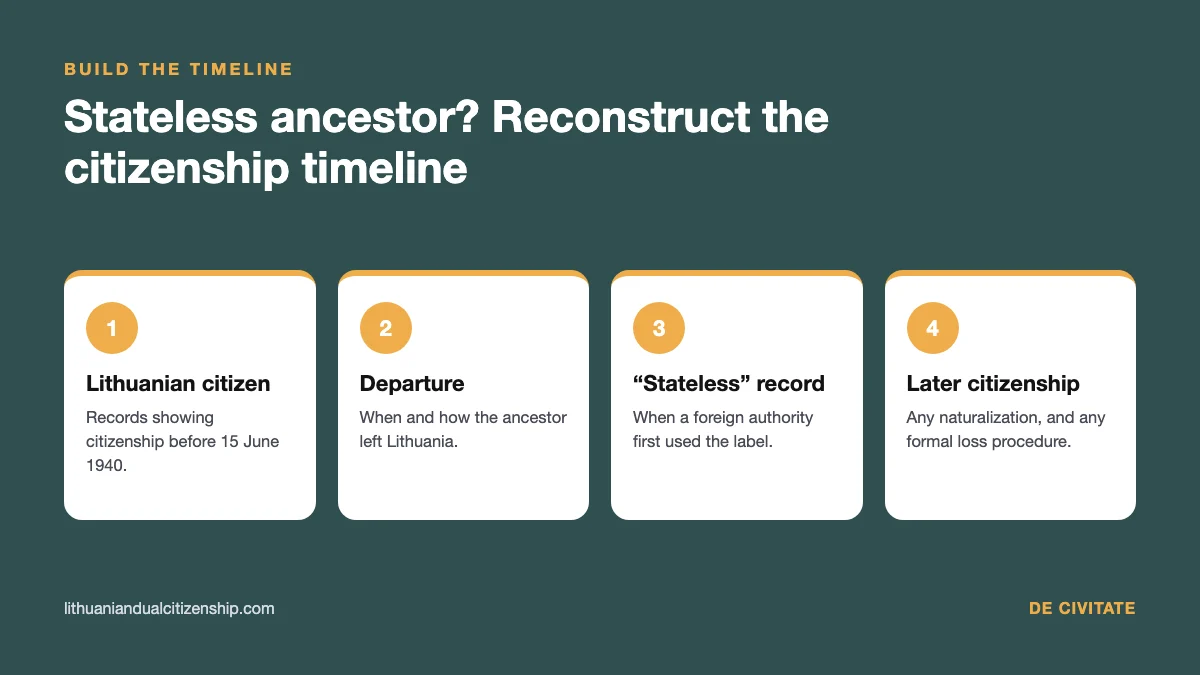
A practical way to assess a stateless-ancestor case is to reconstruct the ancestor’s legal history chronologically.
Begin with the earliest reliable Lithuanian documents. Establish the ancestor’s date and place of birth, parents, residence, and any evidence showing Lithuanian citizenship.
Next, identify the date and circumstances of departure from Lithuania. Passenger records, passports, immigration files, residence records, and foreign government documents may help.
Then determine when the first reference to statelessness appears.
Finally, look for any later acquisition of another citizenship and any evidence relating to formal loss, renunciation, or release from Lithuanian citizenship.
A timeline might therefore look substantially different depending on the family:
Lithuanian citizenship record → emigration → later stateless record → later foreign naturalization.
Another case might show:
Lithuanian citizenship record → formal citizenship-loss proceeding → stateless status → later foreign citizenship.
Although both families have a “stateless” document, the legal and evidentiary circumstances are not the same.
What If No Lithuanian Passport Survives?
Many descendants do not have an original passport.
Lithuanian law allows other documentation to be used to establish prior citizenship. The evidence expressly recognized by law includes specified Lithuanian identity records, military or state-service records, and documents directly referring to citizenship. Where those records are unavailable, additional evidence concerning life, work, or study in Lithuania and foreign documents may also be relevant.
Archive research can therefore become particularly important.
The applicant may need to identify the ancestor through civil records first and then locate corresponding citizenship-related records. A precise birthplace, former address, parents’ names, approximate departure date, or original Lithuanian surname can significantly narrow the historical search.
An American immigration or naturalization file may function as a bridge between the family records held in the United States and the records preserved in Lithuania.
Proving the Family Line Is a Separate Requirement
Establishing that an ancestor held Lithuanian citizenship is only one part of a descent-based case.
The applicant must also connect themselves to that ancestor through the relevant family line. Birth certificates, marriage certificates, adoption records where applicable, legal name-change documents, and other civil records may be needed to connect one generation to the next.
This means that a strong archive record concerning the ancestor will not necessarily resolve problems elsewhere in the family chain.
For example, if the ancestor appears under one surname in Lithuanian records and another surname in the child’s U.S. birth certificate, additional evidence may be needed to show that the records concern the same person.
Likewise, discrepancies in dates or places of birth may require supporting records rather than assumptions.
Does the Ancestor’s Later Statelessness Affect Dual Citizenship?
This is a separate question from whether the ancestor qualifies as the historical Lithuanian citizen through whom restoration is claimed.
The possibility of holding Lithuanian citizenship together with another citizenship depends on the legal basis applicable to the applicant and the circumstances recognized under Lithuanian citizenship law.
The fact that an ancestor was once stateless does not itself determine whether the modern applicant may retain U.S. citizenship.
For a U.S.-based descendant, the analysis may therefore involve two related but distinct questions: whether the family line provides a right to reinstate Lithuanian citizenship and whether the applicant falls within a category allowing Lithuanian and another citizenship to be held simultaneously.
These questions should not be collapsed into a single test.
What Records Should Be Checked in a Stateless-Ancestor Case?
A useful review usually begins with documents that establish four separate points: the ancestor’s identity, evidence of Lithuanian citizenship, the migration and citizenship timeline, and the applicant’s direct descent.
Depending on the family’s circumstances, relevant material may include Lithuanian passports, internal identity files, Lithuanian archive certificates, military or civil-service records, birth and marriage records, U.S. passenger records, naturalization files, census records, displaced-person documents, foreign passports, and records concerning any change of nationality.
Particular attention should be paid to documents that establish dates.
A statement that an ancestor became stateless is much more informative when it can be placed between documented events. Without the timeline, it may be impossible to determine whether statelessness occurred before, during, or long after the period relevant to the citizenship analysis.
When a Stateless Record May Require Additional Evidence
A stateless designation may create a need for additional documentation when it conflicts with other records or leaves an unexplained gap in the ancestor’s citizenship history.
Authorities may need sufficient evidence to determine whether the ancestor actually held Lithuanian citizenship and whether any legally significant loss of that citizenship occurred.
Additional records may therefore become important when the file contains inconsistent nationality descriptions, missing dates, multiple identities, unexplained name differences, conflicting places of birth, or indications that the ancestor sought another nationality.
The significance of these issues depends on the complete file. A discrepancy that can be explained through contemporaneous records may be very different from a contradiction for which no supporting documentation exists.
The Key Question Is the Ancestor’s Legal History, Not the Label Alone
The safest way to analyze Lithuanian citizenship if an ancestor was stateless is to avoid treating “stateless” as a standalone eligibility rule.
Instead, the case should be divided into specific historical questions.
Was the ancestor ever a citizen of the Republic of Lithuania before June 15, 1940? What documents prove that status? When did the person leave Lithuania? When did the stateless designation first appear? Was there a formal procedure resulting in loss of Lithuanian citizenship? Did the ancestor later acquire another citizenship? Can the applicant document the complete line of descent?
Current Lithuanian law makes the distinction between historical possession of citizenship and formal loss especially important. The outcome can depend on the available documents and the precise legal history rather than on a single word appearing in a foreign record.
For descendants researching a Lithuanian citizenship restoration stateless ancestor case, reconstructing that chronology is therefore usually the most useful starting point.
Frequently Asked Questions
Does a stateless ancestor automatically prevent Lithuanian citizenship by descent?
No. A record describing an ancestor as stateless does not automatically prevent Lithuanian citizenship by descent. The analysis usually depends on whether the ancestor held citizenship of the Republic of Lithuania before June 15, 1940, when the stateless status arose, and whether there is evidence that Lithuanian citizenship was formally lost under the procedures applicable at the time.
What if my ancestor became stateless after leaving Lithuania?
Later statelessness does not by itself establish that the ancestor never held Lithuanian citizenship. The timeline should be reconstructed using Lithuanian records, migration documents, foreign citizenship records, and any evidence concerning loss or renunciation of citizenship. A stateless designation appearing after emigration may need to be assessed together with earlier evidence of Lithuanian citizenship.
What if one record says my ancestor was Lithuanian and another says stateless?
Different descriptions can appear in historical records because they were created at different times and for different administrative purposes. The records should be compared using names, dates of birth, family members, residence, migration dates, and other identifying details. The important question is what the combined evidence shows about the ancestor’s actual citizenship history.
Can U.S. naturalization records help explain an ancestor’s stateless status?
Yes. U.S. naturalization records may show when the ancestor sought or acquired U.S. citizenship, their former nationality or allegiance, birthplace, arrival information, and name changes. They can help reconstruct the timeline, although a U.S. naturalization record normally should not be treated as the only evidence of the ancestor’s Lithuanian citizenship status.
How can I prove Lithuanian citizenship before 1940 if no passport survives?
Other evidence may be available. Lithuanian law recognizes several types of records relating to prior citizenship, including certain identity documents, military or civil-service records, and documents directly referring to Lithuanian citizenship. When direct evidence is unavailable, records relating to the person’s life, work, or studies in Lithuania and other historical documents may also be relevant.
What if my ancestor formally lost Lithuanian citizenship before June 15, 1940?
A formal loss can be legally significant. Current Lithuanian law distinguishes between a person who held Lithuanian citizenship at some point before June 15, 1940 and a person whose citizenship was lost after the required legal procedures were completed and a formal decision on loss was adopted. The effect therefore depends on the historical documents and the specific circumstances of the loss.
Find out if you qualify — free
Send us your family details and a Lithuanian citizenship specialist will review your case and explain your options.
Start free eligibility check