
For many U.S.-based applicants with Lithuanian family history, the terms used in Lithuanian citizenship procedures can be confusing. Two documents often appear in research: the certificate of Lithuanian descent and the certificate of right to restore Lithuanian citizenship. They may sound similar because both relate to a person’s connection with Lithuania, but they are not the same document and they do not usually serve the same legal purpose.
The difference matters because each certificate is based on a different type of connection. One focuses on Lithuanian ethnic origin. The other focuses on the historic citizenship status of the applicant or the applicant’s ancestor before the Soviet occupation period. Understanding this distinction can help applicants evaluate which route may be relevant before collecting archives, U.S. vital records, naturalization documents, translations, and other supporting evidence.
This article explains how a Lithuanian descent certificate differs from a certificate confirming the right to restore Lithuanian citizenship, what each document generally confirms, and why the correct choice depends on the facts of the family line.
In short
- The certificate of Lithuanian descent confirms Lithuanian origin; the certificate of right to restore confirms a right based on former citizenship.
- Lithuanian origin and Lithuanian citizenship are not the same: an ancestor could be ethnically Lithuanian without being a citizen before 15 June 1940.
- The right-to-restore certificate is relevant when the family line leads to a citizen of the Republic of Lithuania before 15 June 1940.
- Neither certificate is an automatic grant of citizenship or a passport — a separate procedure and decision follow.
- For citizenship restoration, the certificate of right to restore is usually the more directly relevant document.
What Is a Certificate of Lithuanian Descent?
A certificate of Lithuanian descent, sometimes called a Lithuanian descent certificate, is an official document confirming that a person is of Lithuanian origin. In practice, it is usually relevant when the applicant can show that at least one parent or grandparent was Lithuanian by origin, nationality, or ethnic affiliation.
This document is also commonly described as a certificate confirming Lithuanian origin. The wording may vary in English translations, so users may see phrases such as Lithuanian origin certificate Lithuania, certificate confirming Lithuanian origin, or certificate of Lithuanian descent. These expressions generally refer to the same category of document: official confirmation of Lithuanian origin rather than confirmation of former Lithuanian citizenship.
The key point is that Lithuanian descent is not always the same as Lithuanian citizenship. A person’s ancestor may have been ethnically Lithuanian without having been a citizen of the Republic of Lithuania before 15 June 1940. That distinction is especially important for descendants whose family records show Lithuanian nationality, Lithuanian language, Lithuanian ethnic identity, or a Lithuanian place of origin, but do not clearly prove citizenship of the interwar Republic of Lithuania.
A certificate of Lithuanian descent may be relevant for future immigration or citizenship-related procedures, depending on the applicant’s situation. However, by itself, it should not be understood as the same as a decision granting Lithuanian citizenship or as proof that the applicant already has Lithuanian citizenship.
What Is a Certificate of Right to Restore Lithuanian Citizenship?
A certificate of right to restore Lithuanian citizenship is a different type of document. It confirms that a person has the right to restore, or reinstate, citizenship of the Republic of Lithuania based on prior Lithuanian citizenship in the family line.
This document is also described in English as a certificate confirming the right to restore Lithuanian citizenship, a certificate confirming the right to reinstate Lithuanian citizenship, or a right to restore Lithuanian citizenship certificate. These variations usually point to the same core idea: the applicant is not merely proving Lithuanian origin, but a legal right connected to Lithuanian citizenship held by the applicant or an ancestor before 15 June 1940.
This route is usually relevant for descendants of people who were citizens of the Republic of Lithuania before 15 June 1940. In many family cases, the ancestor may be a parent, grandparent, or great-grandparent, but the exact relevance depends on the documented family line and how the available evidence fits the legal requirements.
The certificate does not automatically mean that a Lithuanian passport has been issued. It is a document confirming a legal right that may later be used in the citizenship restoration process. The actual restoration of citizenship involves a separate procedure and a formal decision by the competent Lithuanian authorities.
| Certificate of Lithuanian descent | Certificate of right to restore citizenship | |
|---|---|---|
| Confirms | Lithuanian origin | The right to restore citizenship of the Republic of Lithuania |
| Based on | A parent or grandparent of Lithuanian origin | Citizenship in the family line before 15 June 1940 |
| Key evidence | Records showing Lithuanian nationality or origin | Interwar passports, military or internal passport records, plus the family chain |
| Grants citizenship? | No | No — it confirms the right; restoration is a separate decision |
| Most relevant when | Origin is documented but citizenship before 1940 is not | You plan to restore Lithuanian citizenship |
Lithuanian Origin vs Former Lithuanian Citizenship
The central difference is the basis of the claim. A certificate confirming Lithuanian origin is based on Lithuanian descent or ethnic origin. A certificate confirming the right to restore Lithuanian citizenship is based on former citizenship of the Republic of Lithuania.
This distinction can be difficult for U.S. applicants because American records often use broad or inconsistent historical labels. A U.S. census, passenger list, naturalization record, death certificate, or marriage record may describe someone as Lithuanian, Russian, Polish, Hebrew, Jewish, or from Kovno, Vilna, Suwalki, Russia, Poland, or Lithuania depending on the year and the official who recorded the information. These labels can help reconstruct family history, but they do not always answer the legal question.
For a Lithuanian origin certificate, evidence that an ancestor was Lithuanian by nationality or origin may be central. For a certificate confirming the right to restore Lithuanian citizenship, the more important question is whether the ancestor was a citizen of the Republic of Lithuania before 15 June 1940 and whether the applicant can prove the family connection through civil status records.
This is why the phrase Lithuanian origin certificate vs right to restore citizenship certificate is not just a naming issue. It reflects two different legal concepts: ethnic origin on one side and citizenship continuity on the other.
When a Certificate of Lithuanian Descent May Be Relevant
A certificate of Lithuanian descent may be relevant when the family history supports Lithuanian origin but does not clearly support a restoration claim based on former Lithuanian citizenship. For example, the applicant may have a parent or grandparent whose documents identify them as Lithuanian, but the available evidence may not show that this person was a citizen of the Republic of Lithuania during the relevant historical period.
This can happen in families whose ancestors left the region before the modern Lithuanian state was established, whose records identify ethnicity but not citizenship, or whose family line is easier to prove through nationality entries than through interwar Lithuanian citizenship documents.
The certificate can be useful because it creates official recognition of Lithuanian origin. Depending on the circumstances, it may support certain future procedures connected with residence or citizenship. However, applicants should be careful not to assume that a certificate of Lithuanian descent produces the same result as citizenship restoration. It is a recognition document, not a Lithuanian passport and not a final citizenship decision.
For U.S. applicants, the practical value often depends on what they want to do next. Some people want official proof of Lithuanian roots. Others want to preserve a documented connection for a possible future application. Others may be comparing this option with direct citizenship restoration and need to know which evidentiary standard their documents can meet.
When a Certificate of Right to Restore Lithuanian Citizenship May Be Relevant
A certificate confirming the right to restore Lithuanian citizenship may be relevant when the applicant can connect their family line to a person who held citizenship of the Republic of Lithuania before 15 June 1940. This route is generally more directly connected to Lithuanian citizenship restoration than a certificate of Lithuanian descent.
In many cases, the applicant must show two categories of evidence. First, there must be documents proving that the ancestor held Lithuanian citizenship during the relevant period. Second, there must be documents proving the applicant’s direct family connection to that ancestor. These may include birth, marriage, name change, naturalization, archive, passport, military, residence, or other records, depending on the facts.
For U.S.-based applicants, a right to restore Lithuanian citizenship certificate can be especially relevant when the person is not ready to complete the full citizenship restoration process immediately but wants formal confirmation of the right. It may also be useful when family documents have been assembled and the applicant wants the Lithuanian authorities to recognize the restoration basis before deciding on further steps.
Still, the certificate should not be confused with the final act of restoring citizenship. It may confirm the right, but the applicant may still need to complete the appropriate citizenship procedure if they later decide to proceed.
Why These Certificates Are Often Confused
The confusion usually comes from English translations and overlapping family-history language. In everyday speech, many people say “Lithuanian citizenship by descent” to describe any ancestry-based connection to Lithuania. In legal procedures, however, descent, origin, former citizenship, restoration, reinstatement, and simplified citizenship may refer to different concepts.
The phrase certificate of Lithuanian descent sounds similar to a citizenship restoration certificate because both may involve ancestors, archives, and proof of family line. Both may require foreign civil records to be translated, legalized, or apostilled where applicable. Both may involve MIGRIS or communication with Lithuanian authorities. Both may be relevant to a person born outside Lithuania who has Lithuanian family history.
But their legal logic is different. A Lithuanian descent certificate answers the question of whether the applicant can be officially recognized as being of Lithuanian origin. A certificate confirming the right to restore Lithuanian citizenship answers the question of whether the applicant has a legal right tied to former Lithuanian citizenship.
For SEO and research purposes, this is why searches such as Lithuanian descent certificate vs Lithuanian citizenship restoration certificate usually indicate a comparison intent. Users are not simply looking for definitions. They want to know which document fits their family situation and what the practical consequences may be.
Documents Commonly Reviewed in These Cases
Both procedures are document-driven. The exact documents depend on the applicant’s family history, country of residence, name changes, and available archives, but the logic is usually similar: authorities need to see who the applicant is, who the ancestor was, and how the family line connects each generation.
For a certificate confirming Lithuanian origin, the evidence often focuses on documents showing that a parent or grandparent was Lithuanian. This may include birth records, marriage records, archival extracts, or other documents where Lithuanian nationality or origin is recorded.
For a certificate confirming the right to restore Lithuanian citizenship, the evidence usually has to go further. It may need to prove that the ancestor was a citizen of the Republic of Lithuania before 15 June 1940. Records such as interwar Lithuanian passports, military documents, internal passport files, residence documents, archival records, or other official evidence may become important.
In both cases, U.S. documents can also matter. Birth certificates, marriage certificates, death certificates, naturalization records, census records, passenger lists, and court name-change documents may help connect the generations or explain why names appear differently across records.
Does Either Certificate Automatically Grant Lithuanian Citizenship?
Neither certificate should be treated as an automatic grant of Lithuanian citizenship. A certificate of Lithuanian descent confirms Lithuanian origin. A certificate of right to restore Lithuanian citizenship confirms a right that may be used in a citizenship restoration procedure. Neither should be understood as the same thing as already holding a Lithuanian passport.
This distinction is important because some applicants assume that once they receive a certificate, the citizenship process is complete. In practice, a certificate may simplify or support a later procedure, but a separate application and decision may still be required.
The consequences may also differ depending on whether the person applies under Lithuanian origin rules, restoration rules, or another citizenship basis. Issues such as dual citizenship, renunciation of current citizenship, and the type of procedure available can depend on the specific legal basis and the facts of the case.
Which Certificate Should a U.S. Applicant Consider?
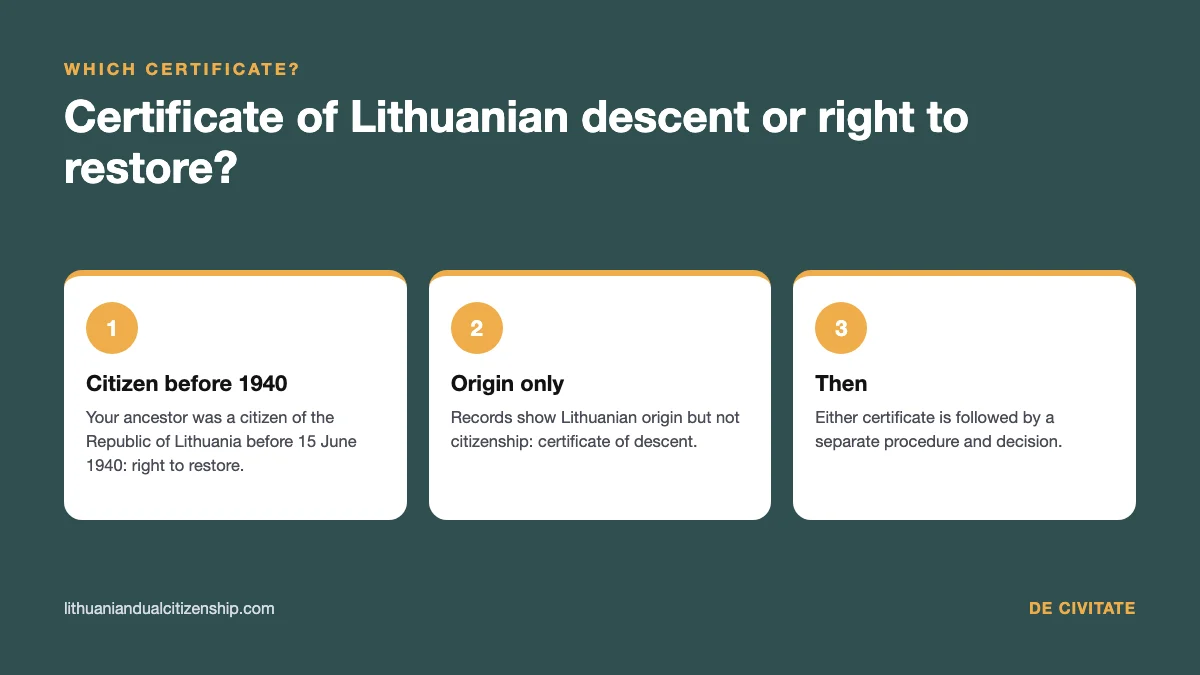
A U.S. applicant should start by identifying what the documents can actually prove. If the family line shows Lithuanian ethnic origin through a parent or grandparent but does not prove interwar Lithuanian citizenship, a certificate of Lithuanian descent may be the more relevant document to examine.
If the family line can be connected to a person who was a citizen of the Republic of Lithuania before 15 June 1940, the certificate confirming the right to restore Lithuanian citizenship may be more relevant. This is especially true where the applicant is considering citizenship restoration and wants formal recognition of the restoration basis.
The decision should not be based only on the family’s oral history or the modern name of a birthplace. Historical borders, changing state authority, different spellings, and inconsistent U.S. records can all affect the analysis. A person may have Lithuanian roots but not enough evidence for restoration, or they may have a strong restoration claim even if some U.S. documents describe the birthplace using older regional terms.
Common Mistakes When Comparing the Two Certificates
One common mistake is assuming that Lithuanian origin and Lithuanian citizenship are interchangeable. They are related concepts, but they are not identical. A document showing that an ancestor was Lithuanian by nationality may help one type of application, while a document proving citizenship before 15 June 1940 may be needed for another.
Another mistake is focusing only on the ancestor and ignoring the chain of descent. Even if an ancestor had the required status, the applicant usually still needs to prove each generation through civil records. Name changes, spelling differences, missing marriage certificates, adoption, divorce, or inconsistent birthplaces can create evidentiary gaps.
A third mistake is assuming that a certificate removes all future requirements. A Lithuanian origin certificate or a right to restore Lithuanian citizenship certificate can be valuable, but it does not eliminate every procedural step. Applicants may still need to submit documents, present originals, provide translations, respond to requests for clarification, or complete a later citizenship application.
FAQ
Is a certificate of Lithuanian descent the same as Lithuanian citizenship?
No. A certificate of Lithuanian descent is not the same as Lithuanian citizenship. It is an official confirmation of Lithuanian origin. It may be useful for certain future procedures, but it does not by itself mean that the person has become a citizen of Lithuania or has received a Lithuanian passport.
What is the difference between a Lithuanian origin certificate and a right to restore citizenship certificate?
A Lithuanian origin certificate generally confirms that a person is of Lithuanian descent or origin. A certificate confirming the right to restore Lithuanian citizenship confirms a legal right connected to former citizenship of the Republic of Lithuania, usually through an applicant or ancestor who held Lithuanian citizenship before 15 June 1940.
Can a certificate confirming Lithuanian origin help with citizenship later?
It may help in some situations, especially where the applicant is proceeding under rules connected to Lithuanian origin. However, it should not be treated as a guarantee of citizenship. The outcome depends on the legal basis, the documents submitted, and the assessment of the competent Lithuanian authorities.
Do U.S. applicants need Lithuanian archive records for these certificates?
In many cases, archive records are important, especially when U.S. documents do not clearly prove Lithuanian origin or former Lithuanian citizenship. Lithuanian archives may contain records that help confirm nationality, citizenship, residence, military service, family relationships, or other facts relevant to the application.
Which certificate is better for Lithuanian citizenship restoration?
For citizenship restoration, the certificate confirming the right to restore Lithuanian citizenship is usually the more directly relevant document because it relates to the restoration basis. A certificate of Lithuanian descent may be relevant in a different legal context, but it does not serve the same function as confirmation of the right to restore citizenship.
Find out if you qualify — free
Send us your family details and a Lithuanian citizenship specialist will review your case and explain your options.
Start free eligibility check