
When researching Lithuanian citizenship through ancestry, families often know how old an ancestor was when they emigrated but know much less about that person’s legal citizenship status. A family story may say that a great-grandfather left Lithuania at age six, that a grandmother crossed the Atlantic with her parents as a teenager, or that an ancestor departed before reaching adulthood.
This leads to an understandable question: does an ancestor’s age at emigration affect Lithuanian citizenship eligibility?
Usually, age is not the decisive factor by itself. The more important questions are whether the relevant ancestor held citizenship of the Republic of Lithuania before June 15, 1940, when the ancestor or family left Lithuania, what happened to the ancestor’s citizenship afterward, whether the applicant falls within the qualifying direct family line, and whether those facts can be established with reliable documents. Lithuanian official guidance recognizes an indefinite right to reinstate citizenship for persons who held Lithuanian citizenship before June 15, 1940 and their qualifying descendants.
An ancestor’s young age can nevertheless matter indirectly. A child may not have had an individual passport, may appear only in a parent’s records, or may have had a citizenship status that has to be reconstructed by examining the parents’ citizenship and the law applicable at that time. For this reason, a Lithuanian citizenship ancestor who emigrated as a child may require a different evidentiary analysis from an adult who left Lithuania with an individual Lithuanian passport.
In short
- An ancestor’s age at emigration is usually not a standalone eligibility test.
- What matters: citizenship of the Republic of Lithuania before 15 June 1940 and when the family left.
- Departure before 16 February 1918 makes a case harder — official guidance says such emigrants most probably did not hold citizenship of the restored republic.
- A child ancestor may lack their own passport; the parents’ citizenship records can become important.
- U.S. naturalization records help build the timeline but rarely prove Lithuanian citizenship alone.
Age at Emigration Is Usually Not a Standalone Eligibility Test
There is no general rule under which a Lithuanian ancestor had to be a particular age when leaving Lithuania for a descendant to pursue reinstatement. The central legal question is generally the ancestor’s citizenship status rather than whether the ancestor was five, fifteen, or twenty-five years old when emigrating.
Consider two ancestors who both left Lithuania at age ten. One departed in 1910. The other departed in 1928. Their ages are identical, but their citizenship histories can be fundamentally different because the first departure occurred before the restoration of Lithuanian statehood in 1918, while the second occurred during the interwar Republic of Lithuania.
The same principle applies in the opposite direction. An ancestor who left Lithuania as an adult does not create eligibility merely because that person had reached legal adulthood. If the required Lithuanian citizenship status cannot be established, adulthood at emigration does not replace proof of citizenship.
For this reason, eligibility for Lithuanian dual citizenship should not be assessed by looking at the ancestor’s age in isolation. The age can provide useful context, but the citizenship timeline and supporting evidence are normally more significant.
Why the Date of Emigration Matters More Than the Ancestor’s Age
When someone asks, “does it matter when my ancestor left Lithuania?”, the answer is generally yes. The departure date can place the family history within a legally significant historical period.
February 16, 1918 is particularly important because Lithuania restored its statehood on that date. June 15, 1940 is another central date in citizenship reinstatement cases because Lithuanian law protects the reinstatement rights of persons who held Lithuanian citizenship before that date and their qualifying descendants.
The Lithuanian Embassy in the United States specifically explains that an applicant generally needs to establish that the relevant ancestor was a Lithuanian citizen at some point between February 16, 1918 and June 15, 1940. It also distinguishes actually holding citizenship from merely having been born or having lived in Lithuanian territory.
This distinction is particularly important for U.S.-based families. American census records, passenger manifests, naturalization documents, military registrations, marriage records, and death certificates may describe an ancestor as Lithuanian. Such records can be valuable for reconstructing the family history, but the description “Lithuanian” may refer to ethnicity, birthplace, former nationality, language, or geographic origin rather than conclusively establishing citizenship of the Republic of Lithuania.
What If a Lithuanian Ancestor Emigrated as a Child?
A Lithuanian citizenship ancestor who emigrated as a child should not automatically be considered ineligible merely because the person was a minor.
Instead, the practical question becomes: what was that child’s citizenship status at the relevant time, and how can it be established?
Children frequently leave a smaller individual documentary trail than adults. An adult emigrant may have held an internal passport, foreign passport, military document, employment record, or other record in their own name. A young child may instead appear in family, parental, residence, consular, birth, or emigration records.
This can make an application involving Lithuanian citizenship by descent when an ancestor left Lithuania as a minor more document-intensive. The absence of a personal passport is not necessarily the same as evidence that the child lacked Lithuanian citizenship.
The citizenship of the child’s parents may therefore become highly relevant. Historical rules governing citizenship by birth, parental citizenship, registration, foreign nationality, and loss of citizenship can also matter. These questions should be evaluated according to the law and evidence applicable to the specific historical period rather than through assumptions based on modern citizenship rules.
Recent Lithuanian administrative litigation illustrates why these cases can be fact-specific: courts have had to examine the citizenship position of children and parents, historical law, documentary evidence, and the circumstances surrounding a family’s residence abroad rather than treating minority alone as determinative.
What If the Ancestor Left Lithuania Before 1918?
Lithuanian citizenship eligibility when an ancestor left before 1918 presents a different problem. Here, the main difficulty is generally not that the ancestor was a child. It is that the person may have left before the modern Republic of Lithuania existed.
Official guidance from the Lithuanian Embassy in the United States states that people who left Lithuania before February 16, 1918 most probably did not hold citizenship of the Republic of Lithuania. The same guidance emphasizes that an applicant must establish actual Lithuanian citizenship rather than merely proving that an ancestor was born or lived in Lithuanian territory.
For example, suppose a great-grandparent was born in an area that is now Lithuania in 1898 and emigrated to the United States in 1910 at age twelve. The fact that the ancestor was only twelve does not create the primary difficulty. The more significant issue is that the ancestor left before Lithuanian statehood was restored.
Family descriptions such as “born in Lithuania,” “Lithuanian nationality,” or “Lithuanian-speaking” can support genealogical research but do not necessarily establish citizenship of the later Republic of Lithuania.
A pre-1918 departure should not necessarily end the investigation immediately, however. Later Lithuanian records may sometimes show that the person subsequently obtained, retained, or was recognized as holding Lithuanian citizenship. The relevant question is whether there is evidence connecting that ancestor to Lithuanian citizenship during the legally relevant period.
What If the Ancestor Left Lithuania Between 1918 and 1940?
A Lithuanian citizenship ancestor who left Lithuania between 1918 and 1940 creates a different factual pattern because the departure occurred during the period of the independent Republic of Lithuania.
Suppose a great-grandfather was born in 1917 and left Lithuania with his parents in 1927 when he was ten. His age at departure does not determine the answer. The investigation should focus on whether he held Lithuanian citizenship before June 15, 1940 and whether that status can be supported with appropriate documentation.
The same analysis applies to a child who left at age five, twelve, or sixteen. Being a minor does not automatically eliminate a potential claim, but it may change the evidence needed to prove the ancestor’s status.
The parents’ records may become particularly important. An applicant might need to examine the father’s or mother’s Lithuanian passport, citizenship records, family documents, residence files, archive certificates, or other material that helps establish the child’s position.
This is one reason why Lithuanian citizenship by descent ancestor citizenship before 1940 should be investigated independently from the ancestor’s age. A minor may have had citizenship even though the surviving records primarily concern the parents.
| Ancestor left Lithuania | What it means |
|---|---|
| Before 16 February 1918 | Harder case — most probably no citizenship of the restored republic |
| Between 1918 and 1940 | Possible — citizenship of the interwar republic must be established |
| As a minor before 1940 | Assessed under historical rules; parents’ records may be key |
| After 15 June 1940 | Common qualifying scenario if citizenship before that date is proven |
What If the Ancestor Was a Minor Before 1940 but Left Later?
Another common situation involves an ancestor who was born before June 15, 1940 but emigrated later, sometimes during or after World War II.
Here again, two timelines must be kept separate.
The first concerns citizenship: did the ancestor hold Lithuanian citizenship before June 15, 1940?
The second concerns departure: when, where, and under what circumstances did the ancestor or relevant family members leave Lithuania?
These distinctions can become especially important for a U.S. citizen who wants to reinstate Lithuanian citizenship while retaining U.S. citizenship. Official Lithuanian consular information identifies departure from Lithuania before March 11, 1990 or exile from occupied Lithuania among circumstances relevant to the dual-citizenship exception.
However, current Lithuanian case law indicates that the legal analysis may require more than simply identifying a departure date. A March 2026 decision of the Supreme Administrative Court of Lithuania examined the circumstances surrounding an ancestor’s emigration when determining whether descendants could rely on an exception allowing another citizenship to be retained. This makes a fact-specific analysis of the migration history important, particularly in dual-citizenship cases.
Age remains contextual rather than decisive. A child who departed with parents may have had no control over the family’s migration decision, but the legal effect still depends on the applicable citizenship provisions, historical circumstances, and evidence.
Why a Minor Ancestor May Have Fewer Individual Records
Document availability is one of the main reasons an ancestor’s age can indirectly affect a citizenship case.
An adult emigrant may have applied personally for identification documents, registered a residence, entered military service, worked for a public institution, completed independent immigration documents, or naturalized abroad in their own name.
A child may appear primarily as part of a household or family unit.
As a result, someone trying to prove Lithuanian citizenship before 1940 should not necessarily expect to find the same type of document for a six-year-old ancestor that could be found for the child’s thirty-year-old father.
The absence of an individual Lithuanian passport therefore needs context. It may mean that no such document survives, that the child was documented elsewhere, or that other forms of evidence must be used. It should not automatically be interpreted as proof that the person was not a Lithuanian citizen.
Lithuanian official guidance expressly recognizes the importance of documentation that directly or indirectly establishes the ancestor’s citizenship, rather than treating birthplace or residence alone as sufficient.
The Parents’ Citizenship Can Become Important
When the ancestor was a minor, researching only that child can leave an important gap in the evidence.
Suppose a great-grandparent left Lithuania at age four. There may be no individual passport under the great-grandparent’s name. The records of that person’s parents may therefore be central to understanding the child’s citizenship status.
An archival search may reveal that a parent held a Lithuanian internal passport, was registered as a Lithuanian citizen, served in a Lithuanian institution, or appeared in another official record that helps reconstruct the family’s legal status.
This does not mean that proof of a great-great-grandparent automatically makes the applicant eligible through that great-great-grandparent. The qualifying direct relationship and the citizenship status of the ancestor relied upon still have to satisfy the applicable requirements. Rather, records belonging to an earlier generation may serve as evidence relevant to determining the citizenship status of the child through whom the applicant is claiming.
This distinction can be particularly important where a Lithuanian citizenship great-grandparent left Lithuania as a child.
U.S. Naturalization Records Can Help Establish the Timeline
For Lithuanian-American families, U.S. naturalization records can be particularly useful when the ancestor left Lithuania as a minor.
These records may establish dates of arrival, names used after immigration, place of birth, nationality descriptions, residence history, and the date on which U.S. citizenship was acquired. When parents and children emigrated together, the parents’ naturalization files may also help reconstruct what happened to the family after arrival.
However, U.S. naturalization records should not automatically be treated as conclusive proof of Lithuanian citizenship or its loss. Historical citizenship rules changed over time, and the legal effect of acquiring another nationality can depend on the date, applicable Lithuanian law, and the circumstances documented in the file.
The safer approach is to treat foreign naturalization evidence as one part of the citizenship chronology. It can help answer when the family arrived, when another citizenship was acquired, and which names were used, while Lithuanian records may still be necessary to establish the original Lithuanian citizenship status.
Birthplace Is Not the Same as Citizenship
A particularly common mistake is to assume that a Lithuanian birth record alone proves Lithuanian citizenship.
Birthplace can be extremely useful. It may identify the correct parish, municipality, archive collection, family members, or historical jurisdiction. But it does not necessarily answer the separate legal question of citizenship.
This is especially important for ancestors born before 1918. A person might have been born in Kaunas, Vilnius, Šiauliai, Panevėžys, or another location associated with Lithuania decades before the restored Republic of Lithuania existed.
Likewise, an American record describing an ancestor’s birthplace as Lithuania does not establish on its own that the person later became a citizen of the Republic of Lithuania.
Official Lithuanian guidance specifically distinguishes between evidence showing that an ancestor was born or lived in Lithuania and evidence demonstrating that the ancestor was actually a Lithuanian citizen.
Name and Date Differences Can Complicate a Child-Ancestor Case
Age-related cases frequently overlap with another evidentiary problem: inconsistent personal data.
A child who arrived in the United States may later appear under an Anglicized surname. Lithuanian, Polish, Russian, Yiddish, German, or English records may use different spellings. Dates of birth may differ by a day, month, or year. A place of birth may be recorded under different historical countries or administrative regions.
These inconsistencies do not necessarily mean that the records concern different people, but they may need to be explained and connected.
The younger the ancestor was at emigration, the more likely it may be that later American records were created many years after the departure and under a different linguistic or administrative system. This makes the entire chain of documents important rather than any single record.
The objective is to establish that the Lithuanian records, immigration documents, foreign civil records, and later family documents refer to the same person and lead through an uninterrupted direct family line to the applicant.
What Evidence Should Be Checked When an Ancestor Left as a Minor?
The strongest evidence will depend on the period and individual family history.
Lithuanian archival documents may help establish citizenship, residence, parentage, identity, or other relevant facts. Records connected with the ancestor’s parents can become particularly important where the ancestor was too young to have accumulated substantial documentation independently.
Foreign records can then help connect the Lithuanian history with the later family line. Passenger manifests may identify accompanying parents. Naturalization files may establish migration dates and later nationality. Birth and marriage certificates can connect generations. Name-change documentation can explain why a Lithuanian surname appears differently in later U.S. records.
The evidence should ultimately answer separate questions rather than simply produce a large collection of genealogy documents. Which person held Lithuanian citizenship? When was that citizenship held? When did the family leave Lithuania? What happened after emigration? How is the applicant directly related to the qualifying person?
Three Similar Ages Can Produce Three Different Cases
The indirect role of age becomes clearer when comparing hypothetical examples.
Imagine first that an ancestor was ten years old when the family left Lithuania in 1910. The key problem is the pre-1918 departure. The family may have Lithuanian heritage, but proof would be needed that the relevant person subsequently held citizenship of the Republic of Lithuania.
Now imagine an ancestor who was also ten but left in 1928. The age is identical, yet the historical context is different. The central question becomes whether the child held Lithuanian citizenship during the interwar period and whether that citizenship can be documented.
Finally, imagine an ancestor who was ten in 1939 and left Lithuania several years later during wartime displacement. In that scenario, the investigation may involve pre-1940 citizenship, parental records, the later departure history, destination, and potentially the rules governing retention of another citizenship.
The examples show why “How old was my ancestor?” is usually less useful than “What was my ancestor’s citizenship status at that age, and what happened before and after the family emigrated?”
How to Assess Your Family History
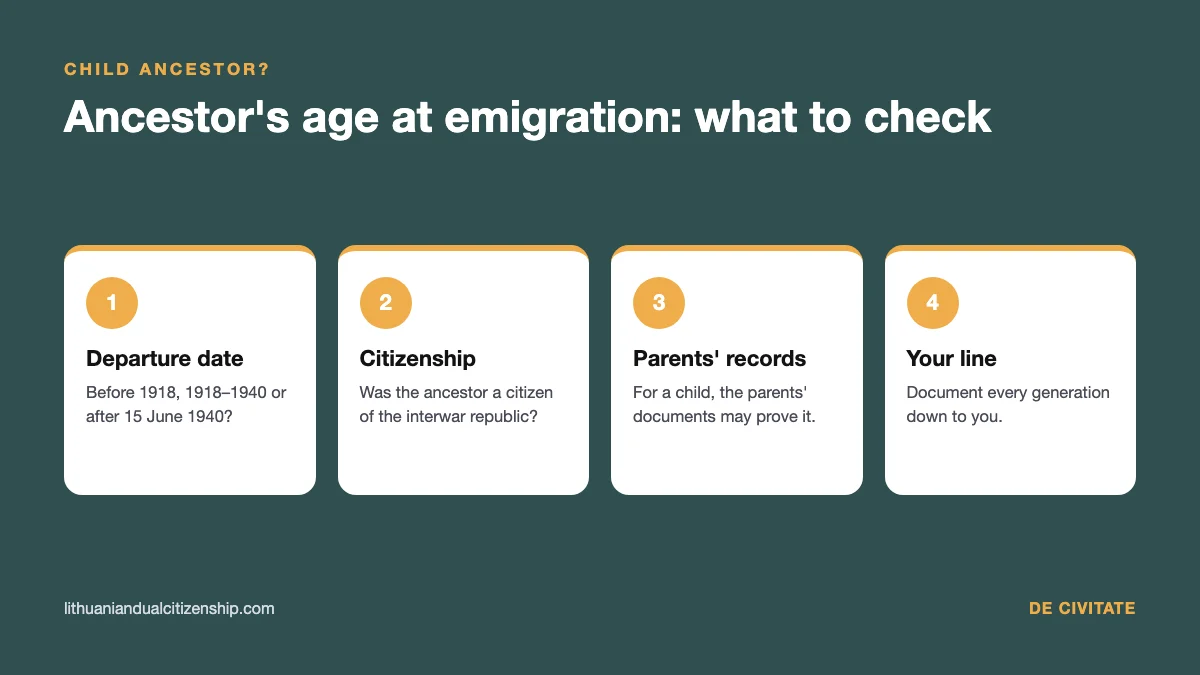
A useful starting point is to build a chronological record of the relevant ancestor rather than beginning with the assumption that being a child either helps or hurts eligibility.
Start with the ancestor’s exact or approximate date and place of birth. Establish the parents’ identities and citizenship history. Determine when the family left the territory of present-day Lithuania and where they went. Identify any Lithuanian documents issued to the ancestor or parents. Then reconstruct later immigration and naturalization events abroad.
The next step is to separate evidence of heritage from evidence of citizenship. A Lithuanian surname, church record, passenger list, or U.S. census entry may establish useful facts without independently proving Lithuanian citizenship.
Finally, the family connection from the relevant pre-1940 citizen to the applicant must be documented. Official U.S. consular guidance currently identifies children, grandchildren, and great-grandchildren as descendants within the reinstatement framework.
This timeline-based approach is more reliable than attempting to decide eligibility from the ancestor’s age alone.
The Key Question Is Citizenship Status, Not Adulthood
So, does an ancestor’s age at emigration affect Lithuanian citizenship eligibility?
Usually, age does not operate as an independent requirement. A Lithuanian citizenship ancestor who emigrated as a child is not automatically excluded, and an ancestor who emigrated as an adult does not automatically create eligibility.
Age matters mainly because it can change how the ancestor’s citizenship is established. A minor may have fewer individual records, may need to be connected to citizenship through parental documentation, and may have been affected differently by later migration or foreign citizenship events.
The date of departure is generally more significant. An ancestor left Lithuania before 1918 presents a substantially different historical question from one who left during the interwar Republic. Likewise, a person who held Lithuanian citizenship before June 15, 1940 but departed later may require a separate review of the emigration history, particularly where the applicant seeks to retain another citizenship.
The most useful analysis therefore combines the ancestor’s citizenship status, date of departure, parents’ status, later nationality history, direct family relationship, and available documentary evidence.
Frequently Asked Questions
Does it matter how old my ancestor was when they left Lithuania?
Usually, the ancestor’s age at emigration is not a standalone eligibility requirement. The more important questions are whether the ancestor held Lithuanian citizenship before June 15, 1940, when the family left Lithuania, how the applicant is related to that person, and whether those facts can be documented. Age can matter indirectly because a minor may have fewer individual records and their citizenship status may need to be established through parental or family documentation.
Can I qualify if my great-grandparent left Lithuania as a child?
Potentially. A great-grandparent’s departure as a child does not by itself prevent a descendant from pursuing Lithuanian citizenship reinstatement. The key issue is whether the great-grandparent can be established as a person who held Lithuanian citizenship before June 15, 1940 and whether the applicant can prove the required direct family relationship. Other requirements, including those relevant to retaining another citizenship, may also need to be considered.
What if my ancestor left Lithuania before 1918?
A pre-1918 departure can make the case more difficult because the Republic of Lithuania restored its statehood on February 16, 1918. Lithuanian official guidance states that people who left before that date most probably did not hold citizenship of the restored Republic. However, later documents or circumstances may still need to be examined to determine whether the ancestor subsequently held Lithuanian citizenship.
What if my ancestor was a minor between 1918 and 1940?
Being a minor during the interwar period does not automatically establish or exclude Lithuanian citizenship. The ancestor’s citizenship must be assessed using the applicable historical rules and available evidence. Because children may not have had the same individual documents as adults, records concerning their parents, household, birth, residence, or other official registrations may become particularly important.
Does a child ancestor need to have had their own Lithuanian passport?
Not necessarily. The absence of an individual passport should not automatically be treated as proof that a child was not a Lithuanian citizen. Depending on the ancestor’s age and historical circumstances, citizenship may need to be established through other Lithuanian records or documentation concerning the child’s parents. The evidentiary value of those records depends on the individual case.
Can U.S. naturalization records prove my ancestor’s Lithuanian citizenship?
U.S. naturalization records can be valuable evidence of immigration dates, names, residence, nationality descriptions, and acquisition of U.S. citizenship, but they do not necessarily prove Lithuanian citizenship by themselves. They are generally most useful when combined with Lithuanian records that establish the ancestor’s citizenship status and civil records that establish the direct family line.
Find out if you qualify — free
Send us your family details and a Lithuanian citizenship specialist will review your case and explain your options.
Start free eligibility check