For many families in the United States, Lithuanian citizenship by descent research begins with a simple question: which documents can prove the family line back to Lithuania? In practice, the answer often involves both Lithuanian church records and Lithuanian civil records.
These two categories of documents can overlap, but they are not the same. Church records were usually created by religious institutions and may include baptism, marriage, and burial entries. Civil records were created or maintained by state or municipal authorities and may include birth, marriage, death, residence, identity, or civil status records.
Understanding Lithuanian church records vs civil records is important because citizenship restoration research is not only about proving ancestry in a general genealogical sense. It usually requires a clear documentary chain connecting the applicant to an ancestor who may have held Lithuanian citizenship, lived in Lithuania, or belonged to a family line relevant to the application. Depending on the period, location, religion, and survival of records, one type of document may be more useful than the other.
In short
- Church and civil records overlap but are not the same: churches recorded baptisms, marriages and burials; authorities kept civil registers.
- Civil records are not automatically better — church records sometimes contain more family detail.
- A baptism record records a religious event but often gives the birth date, parents and parish.
- Both mainly prove the family line; citizenship before 1940 may need other evidence.
- If records cannot be found, archive certificates, residence, military or U.S. records may fill the gap.
Why Records Matter in Lithuanian Citizenship by Descent Research
Lithuanian citizenship by descent is document-based. Family stories, DNA test results, online family trees, and oral history can be useful starting points, but they usually do not replace official records. A citizenship-related file normally has to show who the ancestor was, where they were from, how the family line continued, and whether the available evidence supports the legal position of the applicant.
This is where Lithuanian birth records for citizenship by descent, Lithuanian marriage records for citizenship by descent, baptism entries, death records, and archival extracts become important. A birth or baptism record may identify a child and parents. A marriage record may connect two surnames, explain a woman’s maiden name, or confirm residence. A death record may help confirm identity when other documents are missing. Civil records may provide a more formal administrative link, while church records may preserve information from a period or locality where civil registration was incomplete, unavailable, or organized differently.
In many cases, a single record is not enough. The stronger approach is to build a consistent chain of documents across generations. Each document should support the next step in the family line, especially where names were changed, translated, shortened, or written in different languages after immigration to the United States.
What Are Lithuanian Church Records?
Lithuanian church records are historical records created by religious communities. They may include baptism, marriage, burial, confirmation, and other parish entries. For genealogy and citizenship research, the most important church records are usually baptism, marriage, and burial or death-related records.
A Lithuanian baptism record genealogy search can be especially useful when a civil birth record is unavailable. In older records, the baptism entry may function as the closest available evidence of birth. It may include the child’s name, date of baptism, sometimes the date of birth, the parents’ names, the father’s residence or occupation, the mother’s maiden name, godparents, parish, and denomination.
Marriage records can be equally important. A church marriage entry may confirm the spouses’ names, ages, places of origin, parents, previous marital status, and witnesses. For citizenship by descent research, this can help connect a Lithuanian-born ancestor to the next generation, especially where U.S. records show an Americanized surname or incomplete birthplace.
Burial records are usually less detailed than baptism or marriage records, but they can still help identify a person, estimate birth year, confirm residence, or distinguish between relatives with similar names.
What Are Lithuanian Civil Records?
Lithuanian civil records are records created, issued, or maintained through civil authorities rather than religious institutions. In the context of citizenship by descent, the phrase can refer to civil birth records, civil marriage records, civil death records, civil status extracts, residence records, identity documents, administrative files, and other state or municipal records.
Lithuanian civil records for citizenship by descent are often valuable because they may be closer to the type of official documentation expected in an administrative procedure. A civil birth extract, for example, may be easier to use in a modern application than a handwritten parish register image, provided that the extract correctly identifies the person and is issued by the competent authority.
Civil records can also help when church records are difficult to interpret, written in old script, damaged, or incomplete. In some cases, a civil record may confirm details first discovered in a church record. In other cases, the civil record may be the primary document, while the church record functions as supporting evidence.
The practical distinction is important: a church book entry may prove a historical event, but a civil or archival certificate may be needed to present that evidence in a form more suitable for official review. The exact document requirements can depend on the applicant’s situation and the authority reviewing the file.
Lithuanian Church Records vs Civil Records: The Main Difference
The main difference between Lithuanian church records and civil records is who created the document and for what purpose. Church records were created for religious and parish administration. Civil records were created for legal, administrative, or state registration purposes.
This difference affects how the records are used. Church records are often extremely valuable for reconstructing family history, especially before modern civil registration became consistent. They may preserve information that no longer exists elsewhere. However, they can also present challenges: old handwriting, Latin, Polish, Russian, Lithuanian, Hebrew, Yiddish, or other linguistic forms; parish-based organization; spelling variation; and gaps in surviving registers.
Civil records may be more standardized, especially for later periods. They may be issued as official extracts, certificates, or archival statements. However, civil records are not always available for older events, and in some areas or periods the surviving source may still be a religious metric book rather than a modern civil register.
For citizenship by descent, the question is not simply which type of record is “better.” The more important question is whether the document proves the necessary fact clearly and fits into the broader chain of evidence.
| Church records | Civil records | |
|---|---|---|
| Created by | Religious institutions (parishes) | State or municipal authorities |
| Typical entries | Baptism, marriage, burial | Birth, marriage, death, residence, identity |
| Strength | Often detailed family information: parents, godparents, parish | Formal and easier to present in an administrative file |
| Proves citizenship? | Usually not by itself | Usually not by itself, unless it refers to citizenship |
When Church Records Can Be More Useful
Lithuanian genealogy church records can be more useful when the relevant event happened before modern civil registration was widely available, when a family lived in a rural parish, or when the only surviving evidence is in religious metric books. This is common in historical research involving ancestors born in the 19th century or early 20th century.
Church records can also be useful when U.S. records are vague. For example, an American census or naturalization record may list a birthplace only as “Lithuania,” “Russia,” “Poland,” “Kovno,” “Vilna,” or another historical place name. A parish baptism or marriage entry may identify a specific locality, parents, and religious community, making it easier to connect the immigrant ancestor to a real family in Lithuania.
For descendants of Lithuanian Jews, Catholics, Orthodox Christians, Lutherans, Old Believers, and other communities, the relevant record trail may differ significantly. The availability of Lithuanian birth marriage death records depends heavily on the town, denomination, archive, period, and survival of the original books.
Church records are particularly useful when they help answer identity questions. If two people had similar names, a baptism or marriage entry may separate them by parents, spouse, village, parish, witnesses, or dates. This can be critical when preparing a citizenship-related document file.
When Civil Records Can Be More Useful
Civil records can be more useful when the applicant needs a formal extract, a clearer administrative document, or evidence from a later period. For example, Lithuanian civil records for citizenship by descent may help confirm a birth, marriage, death, residence, identity, or legal status in a way that is easier to present than a handwritten church register.
Civil records may also be more useful for proving direct family links across generations. If a parent’s or grandparent’s civil birth certificate identifies both parents, and a marriage record confirms a surname change, the chain can become clearer. This matters because citizenship restoration research often depends on proving not only that the ancestor existed, but also that the applicant descends from that person through a documented line.
Civil records are also important when the issue is not only ancestry but citizenship-related status. A birth record may support descent, but other documents may be needed to show Lithuanian citizenship, residence in Lithuania, service, identity, or other legally relevant facts before 1940. In such cases, civil and administrative archives may become more important than church books alone.
Birth, Baptism, Marriage, and Death Records: How They Work Together
Lithuanian vital records genealogy research usually requires several types of records working together. A baptism record may identify the ancestor’s parents. A marriage record may confirm the spouse and maiden name. A birth record for the next generation may connect the ancestor to the applicant’s parent or grandparent. A death record may confirm that a record can be requested by descendants or may help distinguish one person from another.
For U.S.-based applicants, the documentary chain often crosses countries. Lithuanian archives birth marriage death records may prove the older part of the family line, while U.S. vital records prove the later generations. The challenge is to make both sides match: names, dates, places, spouses, parents, and sequence of events should be consistent enough to support the file.
Some differences are normal. Lithuanian names may appear with endings that changed by gender or grammar. Surnames may be Polonized, Russified, Lithuanianized, Yiddishized, or Americanized. First names may appear as their Lithuanian, Polish, Russian, Hebrew, English, or Latin equivalents. A person known as John in the United States may appear as Jonas, Jan, Ivan, or another form in older records. These variations do not automatically make a record unusable, but they usually need to be explained through a coherent document chain.
Common Problems in Lithuanian Record Research
One common problem is not knowing the exact town or parish. Lithuanian church records are often organized by parish, not by the modern surname search logic that users expect from online databases. Without a locality, the search can become broad and uncertain.
Another problem is historical geography. A family may have lived in a place that was recorded under Russian Empire, Polish, German, Yiddish, or Lithuanian forms. U.S. documents may list a broad region instead of a precise town. In citizenship by descent research, identifying the correct historical locality can be as important as finding the correct surname.
Record survival is another issue. Not all records survived wars, occupation, administrative transfers, fires, and archival losses. Some communities have stronger surviving record sets than others. Catholic parish records are often comparatively abundant, while records for other communities may be more fragmented depending on the place and period.
Language and handwriting also create difficulties. Older Lithuanian church records may be written in Latin, Polish, Russian, Lithuanian, or other languages. Jewish metrical records may involve Hebrew, Yiddish, Russian, or other administrative languages depending on the period. A literal translation is not always enough; the record must be interpreted in context.
Are Church Records Enough for Citizenship by Descent?
Church records may support a citizenship by descent file, but they are not always enough by themselves. A baptism or marriage record can help prove identity, parentage, religion, residence, or family continuity. However, citizenship restoration may also require evidence that the relevant ancestor held Lithuanian citizenship or belonged to a legally relevant category under Lithuanian citizenship rules.
This means a church record may be one part of the evidence package rather than the entire case. For example, a baptism record may show that an ancestor was born in a Lithuanian parish, but additional documents may be needed to establish citizenship, residence, departure history, or the family line to the applicant. The required combination depends on the applicant’s facts and the available evidence.
A careful approach is to treat church records as strong genealogical evidence and civil or administrative records as potential legal evidence, while recognizing that either type may become essential depending on what is missing.
Are Civil Records Always Better Than Church Records?
Civil records are not automatically better than church records. A modern-looking civil extract can be very useful, but it may still be based on an underlying church or metric book. Conversely, a church record image may contain more detailed historical information than a later extract.
The value of a document depends on what it proves. If a civil extract gives only a name and date but omits parents, it may be less useful for proving descent than a detailed baptism entry. If a church marriage record names both parents and the place of origin, it may solve a problem that a civil record does not address. If an official archival certificate confirms a birth, parents, and source details, it may be easier to use administratively than a raw register image.
For citizenship by descent research, the best result is often not choosing one source over the other. It is using both where possible and making sure the records support the same identity and family chain.
How to Start Researching Lithuanian Church and Civil Records
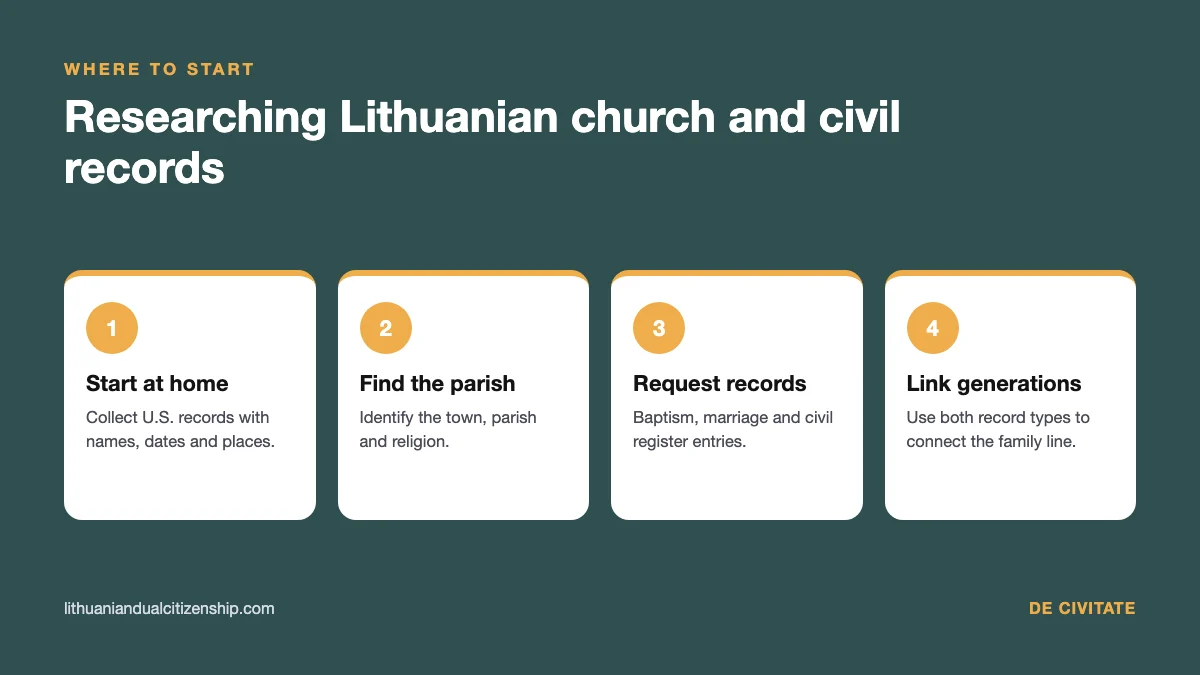
The best starting point is to gather all known information from family and U.S. records before searching in Lithuania. Useful details include the ancestor’s full name, alternative spellings, approximate date of birth, place of birth, religion, spouse, parents, date of emigration, U.S. residence, and names of siblings or children.
Once the basic profile is clear, the next step is to identify the relevant locality and time period. If the ancestor was born before 1940, historical archives and metric books may be central to the search. If the person was born after 1940, civil registry records may be more relevant. For older generations, Lithuanian genealogy church records may be the only practical way to establish the family line.
It is also important to compare records across countries. A Lithuanian baptism record should be checked against U.S. marriage records, death certificates, naturalization files, passenger lists, census records, and other documents. When details differ, the goal is not to force a match, but to determine whether the differences can be reasonably explained.
How These Records Fit Into a Citizenship File
A citizenship by descent file should usually show a clear progression from the Lithuanian ancestor to the applicant. Lithuanian birth records for citizenship by descent may prove the ancestor’s identity. Lithuanian marriage records for citizenship by descent may connect spouses and surname changes. U.S. birth and marriage records may connect later generations. Additional Lithuanian civil or administrative records may support citizenship, residence, or identity before 1940.
The strongest files usually avoid relying on assumptions. If a surname changed, the documents should show how. If a birthplace appears under different country names, the historical context should be clear. If a church record and a civil record differ slightly, the inconsistency should be evaluated rather than ignored.
Because Lithuanian citizenship restoration can depend on individual facts, records should be reviewed for both genealogical and legal relevance. A document that is excellent for family history may still be insufficient for a legal file if it does not prove the necessary point.
Final Thoughts
Lithuanian church records vs civil records is not a question of one source replacing the other. Church records can be essential for tracing older family lines, especially through baptism, marriage, and burial entries. Civil records can provide formal documentation, official extracts, and administrative evidence that may be easier to use in a citizenship-related process.
For U.S.-based descendants, the best approach is usually to combine Lithuanian vital records genealogy research with U.S. documents and, where necessary, archival searches in Lithuania. The goal is to create a reliable, consistent chain of evidence that connects the applicant to the Lithuanian ancestor and supports the specific citizenship question being reviewed.
FAQ
Are Lithuanian church records accepted for citizenship by descent research?
Lithuanian church records may be useful in citizenship by descent research, especially when they help prove birth, baptism, marriage, parentage, residence, or family continuity. However, they may not be sufficient by themselves if the application also requires evidence of Lithuanian citizenship, residence, or another legally relevant fact. Their value depends on the applicant’s situation and the other documents available.
What is the difference between Lithuanian baptism records and birth records?
A baptism record was created by a church and records a religious event, although it may also include the child’s birth date, parents, parish, residence, and godparents. A birth record or civil birth extract is created or issued through civil or archival authorities. In older Lithuanian research, a baptism record may be the closest surviving evidence of birth, but the most useful document depends on what information it contains and how it fits into the family chain.
Are Lithuanian civil records better than church records?
Lithuanian civil records are not automatically better than church records. Civil records may be more formal or easier to present in an administrative file, but church records can sometimes contain more detailed family information. For citizenship by descent research, the stronger document is the one that clearly proves the necessary fact, such as identity, parentage, marriage, residence, or connection between generations.
What records are most important for proving Lithuanian ancestry?
Birth, baptism, marriage, and death records are often important because they help connect one generation to the next. Lithuanian birth marriage death records may prove the older part of the family line, while U.S. records may prove the later generations. In some cases, additional administrative records may be needed to support Lithuanian citizenship, residence, or identity before 1940.
What if Lithuanian church or civil records cannot be found?
If Lithuanian church or civil records cannot be found, the research may need to rely on alternative evidence such as archival certificates, residence records, identity records, military or employment records, U.S. immigration records, naturalization files, census records, or other documents that help establish the same facts. Missing records do not always end the research, but they usually require a more careful review of available evidence.
Find out if you qualify — free
Send us your family details and a Lithuanian citizenship specialist will review your case and explain your options.
Start free eligibility check