
Many families considering Lithuanian citizenship restoration ask the same practical question: can children inherit Lithuanian citizenship after a parent restores it? The answer depends mainly on when the child was born, whether the parent was already a Lithuanian citizen at that time, the child’s age, and whether the child already holds another citizenship.
Lithuanian citizenship is not “inherited” in the same way as family property. It is acquired or restored under legal rules. In many family-based cases, a child may have a pathway to Lithuanian citizenship either because one parent is already a Lithuanian citizen at the time of birth, or because the child independently qualifies for Lithuanian citizenship restoration through the same family line.
For U.S.-based families, the difference between children born before and after a parent restores Lithuanian citizenship is especially important. A parent’s successful restoration may be highly relevant, but it does not always mean that every child automatically becomes a Lithuanian citizen without a separate legal basis or registration process.
In short
- Children do not automatically inherit Lithuanian citizenship in every case — timing is decisive.
- A child born after a parent restored citizenship can acquire Lithuanian citizenship by birth, even if born abroad.
- A child born earlier may not acquire it through the parent’s later restoration, but may qualify through the same ancestor.
- Adult children are separate applicants and must prove their own descent.
- Dual citizenship for children depends on how Lithuanian citizenship is acquired.
What It Means to “Inherit” Lithuanian Citizenship
When people ask whether children can inherit Lithuanian citizenship, they usually mean whether Lithuanian citizenship can be passed from a parent to a child. In citizenship law, this is more accurately described as citizenship by descent, citizenship by birth through a parent, or citizenship restoration through ancestry.
Lithuanian citizenship by descent through parent may apply in different ways. A child may acquire Lithuanian citizenship at birth if at least one parent is a Lithuanian citizen when the child is born. Separately, a child may be eligible to restore Lithuanian citizenship if the child is a descendant of a person who held Lithuanian citizenship before June 15, 1940, and the family situation meets the relevant legal conditions.
These are not always the same process. A child born after a parent becomes a Lithuanian citizen is usually in a different position from a child who was already born before the parent restored citizenship. That timing can affect whether the issue is treated as registration of a child born to a Lithuanian citizen or as a separate Lithuanian citizenship restoration for children.
Can Lithuanian Citizenship Be Passed to Children?
Lithuanian citizenship can be passed to children in certain situations, but not every child of a restored Lithuanian citizen automatically receives citizenship in the same way. The key question is whether the parent was already a Lithuanian citizen at the legally relevant time.
If one parent is a Lithuanian citizen when the child is born, Lithuanian citizenship by birth through one parent may apply even if the child is born abroad. This is why Lithuanian citizenship for children born abroad is often possible when the parent already has Lithuanian citizenship before the child’s birth.
If the child was born before the parent restored Lithuanian citizenship, the situation is more complex. The parent may later become a Lithuanian citizen, but that does not necessarily make the child a Lithuanian citizen retroactively from birth. In many cases, the child’s own eligibility must be reviewed separately.
Children Born After a Parent Restores Lithuanian Citizenship
Children born after a parent restores Lithuanian citizenship are usually in the strongest position. If the parent is already a Lithuanian citizen at the time of the child’s birth, the child may acquire Lithuanian citizenship by birth through that parent, regardless of whether the birth takes place in Lithuania, the United States, or another country.
This does not mean that no formal steps are needed. A child born abroad may still need to have the foreign birth registered with Lithuanian civil registry authorities before Lithuanian citizenship documents or a Lithuanian passport can be issued. For a U.S.-born child, this usually involves properly documenting the child’s birth, the parent-child relationship, and the Lithuanian citizenship status of the parent.
In this scenario, the child’s right is generally connected to the parent’s status at the time of birth. The fact that the parent restored Lithuanian citizenship by descent before the child was born can be decisive, because the child is then born to at least one Lithuanian citizen.
Children Born Before a Parent Restores Lithuanian Citizenship
Children born before a parent restores Lithuanian citizenship are not usually in the same position as children born after restoration. If the parent was not yet formally a Lithuanian citizen when the child was born, the child may not be treated as having acquired Lithuanian citizenship at birth through that parent.
However, this does not necessarily mean the child has no path. A child born before parent restores Lithuanian citizenship may still be eligible for Lithuanian citizenship restoration through the same ancestral line. For example, if the parent restored citizenship because a grandparent or great-grandparent was a Lithuanian citizen before June 15, 1940, the child may also be a descendant of that same qualifying Lithuanian citizen.
In that case, the child’s application is not simply based on “inheriting” the parent’s restored citizenship. It is usually based on proving the child’s own descent from the qualifying ancestor and meeting the conditions for restoration or dual citizenship under Lithuanian law.
| Child’s situation | Usual path |
|---|---|
| Born after the parent restored citizenship | Citizenship by birth through the parent; register the foreign birth |
| Born before the restoration, still a minor | Not automatic — may qualify through the same Lithuanian ancestor |
| Adult child | Separate application proving their own descent |
| Child with another citizenship | Dual citizenship depends on the legal basis |
What If the Child Is Still a Minor?
When a parent restores Lithuanian citizenship while the child is still under 18, the child’s age may matter. Lithuanian law contains specific rules for children after one or both parents acquire or restore Lithuanian citizenship. The application of those rules can depend on the child’s age, whether the child consents if old enough, and whether the child already has another citizenship.
This point is particularly important for U.S.-based families. Many children born in the United States acquire U.S. citizenship at birth. Because Lithuanian dual citizenship rules are limited and depend on specific exceptions, the child’s U.S. citizenship status may affect how the case is reviewed.
For children between 14 and 18, consent may also become relevant in certain citizenship procedures. Parents should not assume that a minor child is automatically included in the parent’s restoration decision without checking the child’s specific legal position.
What If the Child Is Already an Adult?
Adult children generally need to be assessed as separate applicants. A parent’s restored Lithuanian citizenship can be helpful evidence because it may show that the family line has already been reviewed and accepted. Still, the adult child usually needs to prove their own identity, their direct relationship to the parent, and their descent from the qualifying Lithuanian citizen.
For adult children, the question is often not “can Lithuanian citizenship be passed to children automatically?” but “can the adult child independently restore Lithuanian citizenship by descent through parent, grandparent, or great-grandparent?” In many cases, the answer may be yes, but it depends on the documents and the family history.
An adult child’s application may involve many of the same documents used in the parent’s case, but additional records are usually needed to connect the adult child to the restored parent and to the original Lithuanian ancestor.
Lithuanian Citizenship for Children Born Abroad
Lithuanian citizenship for children born abroad often depends on whether one parent was a Lithuanian citizen at the time of birth. A child does not usually need to be born in Lithuania to acquire Lithuanian citizenship through a Lithuanian parent.
For a child born in the United States, the foreign birth certificate is usually a key document. Lithuanian authorities may need to see a properly issued birth certificate showing the child’s parents, along with evidence of the Lithuanian parent’s citizenship. Depending on the documents, apostilles, certified translations, and registration of the foreign civil status act may be required.
The process is document-driven. Even where the legal basis appears clear, inconsistencies in names, dates, places of birth, or parentage records can create delays or requests for additional evidence.
Lithuanian Dual Citizenship for Children
Lithuanian dual citizenship for children is a separate issue from eligibility for Lithuanian citizenship itself. Lithuania generally restricts dual citizenship, but there are recognized exceptions. These exceptions may be relevant for children who acquire Lithuanian citizenship at birth together with another citizenship, or for descendants of certain Lithuanian citizens who left Lithuania before the restoration of independence.
For U.S.-based families, this matters because a child may already be a U.S. citizen. Whether the child can also hold Lithuanian citizenship depends on the legal basis for acquisition or restoration and the applicable dual citizenship exception.
Parents should avoid assuming that every child can automatically keep both citizenships in every situation. The answer may differ depending on whether the child was born before or after the parent restored Lithuanian citizenship, whether the child acquired another citizenship at birth, and whether the case falls within an exception recognized by Lithuanian law.
Documents Usually Needed to Prove the Child’s Eligibility
The documents needed depend on the type of case. For a child born after the parent restored Lithuanian citizenship, the focus is often on the child’s birth certificate, the parent’s Lithuanian citizenship documents, and registration of the child’s birth abroad.
For a child born before the parent restored citizenship, the file may need to prove the full family line. This usually includes the child’s birth certificate, the parent’s birth certificate, documents showing name changes or marriages, and records proving descent from the Lithuanian ancestor. If the parent has already restored Lithuanian citizenship, that decision or related documentation may support the child’s case, but it may not replace every required document.
Where the child is an adult, the documentation is usually closer to a standard citizenship restoration file. The applicant must show their own place in the family chain and may need evidence confirming the ancestor’s Lithuanian citizenship before June 15, 1940, as well as the relevant emigration history.
Why Timing Matters So Much
Timing matters because Lithuanian citizenship after parent restores citizenship can fall into different legal categories. A child born after restoration may be treated as a child born to a Lithuanian citizen. A child born before restoration may need to rely on their own restoration rights as a descendant.
This distinction can affect the documents, procedure, dual citizenship analysis, and expected complexity of the case. It can also affect whether the child’s application is relatively straightforward or whether it requires deeper genealogical and legal review.
For families planning future children, restoring Lithuanian citizenship before the child is born may create a clearer citizenship-by-birth pathway. For families with children who were already born, the child’s eligibility should be reviewed separately rather than assumed.
Common Mistakes Families Make
One common mistake is assuming that a parent’s restored citizenship automatically covers all children, regardless of age or birth date. In practice, the child’s situation may require a separate registration or restoration process.
Another mistake is assuming that a child born in the United States cannot have Lithuanian citizenship because the child is already a U.S. citizen. A child born abroad to a Lithuanian parent may still have a Lithuanian citizenship pathway, but dual citizenship rules must be considered carefully.
Families also sometimes assume that a parent’s successful case means no additional proof is needed for the child. The parent’s case can be valuable, but the child still needs to be linked to the parent and, where relevant, to the original Lithuanian ancestor through proper civil records.
How to Understand Your Child’s Path
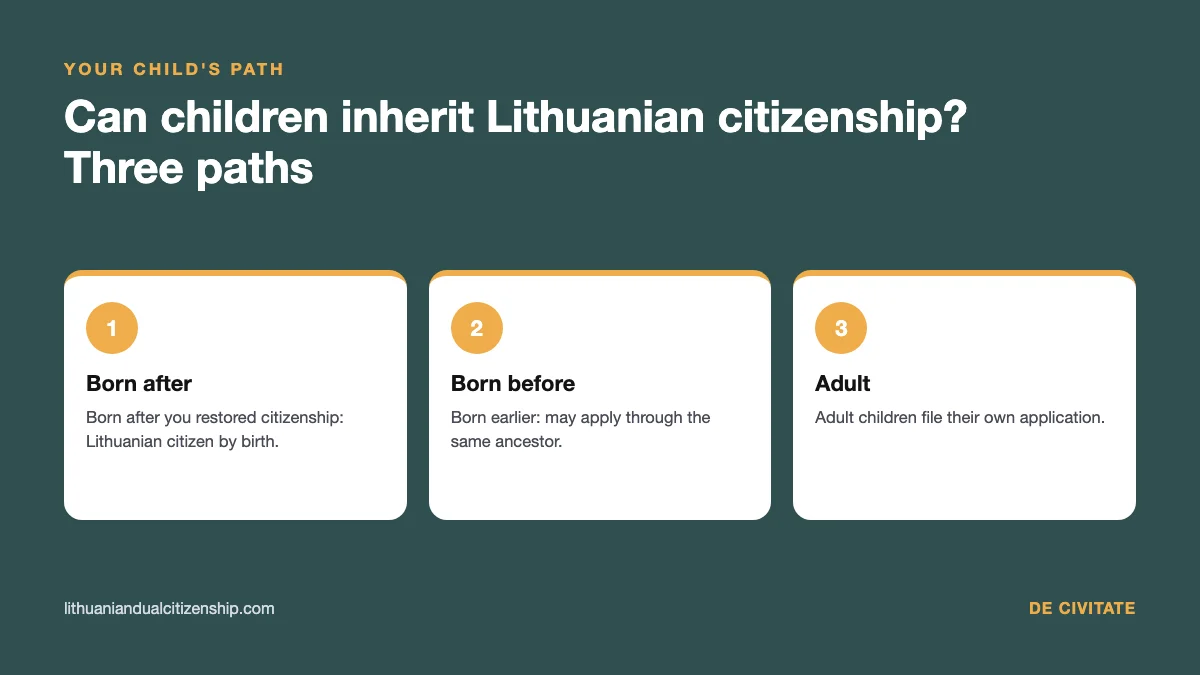
The most practical way to understand a child’s path is to start with the birth timeline. First, determine whether the child was born before or after the parent restored Lithuanian citizenship. Then determine whether the child is still a minor or already an adult. Finally, review whether the child already has another citizenship and whether dual citizenship may be allowed under the relevant exception.
If the child was born after the parent became a Lithuanian citizen, the case may be closer to registration of a child born abroad to a Lithuanian citizen. If the child was born before the parent restored citizenship, the case may be closer to Lithuanian citizenship restoration for children or adult descendants through the same family line.
Because Lithuanian citizenship cases are document-specific, the final answer often depends on records rather than family history alone. Birth certificates, marriage certificates, name-change documents, archive records, and citizenship decisions can all affect the outcome.
FAQ
Can children inherit Lithuanian citizenship after a parent restores it?
Children may be able to receive or restore Lithuanian citizenship after a parent restores it, but it is not always automatic. The answer depends on whether the child was born before or after the parent became a Lithuanian citizen, the child’s age, and whether the child already has another citizenship.
Can Lithuanian citizenship be passed to children born abroad?
Yes, Lithuanian citizenship may be passed to children born abroad if at least one parent is a Lithuanian citizen at the time of the child’s birth. In practice, the child’s foreign birth may need to be registered in Lithuania before citizenship documents or a Lithuanian passport can be issued.
What happens if the child was born before the parent restored Lithuanian citizenship?
A child born before the parent restored Lithuanian citizenship may not automatically acquire citizenship through the parent’s later restoration. However, the child may still qualify for Lithuanian citizenship restoration through the same Lithuanian ancestor if the child can prove the direct family line and meets the applicable conditions.
What happens if the child was born after the parent restored Lithuanian citizenship?
If the child was born after the parent restored Lithuanian citizenship, the child may acquire Lithuanian citizenship by birth through that parent. This can apply even if the child was born in the United States or another country outside Lithuania.
Can adult children apply after a parent restores Lithuanian citizenship?
Yes, adult children may be able to apply, but they are usually treated as separate applicants. The parent’s restored citizenship can support the case, but the adult child generally still needs to prove their own descent and eligibility.
Can a child have both Lithuanian and U.S. citizenship?
A child may be able to hold both Lithuanian and U.S. citizenship if the case falls within a recognized dual citizenship exception. The analysis depends on how the child acquired or seeks to acquire Lithuanian citizenship and whether the child already holds another citizenship.
Does a child need to live in Lithuania to receive Lithuanian citizenship through a parent?
In many descent-based or birth-through-parent cases, residence in Lithuania is not the central requirement. The key issue is usually the legal basis for citizenship and the documents proving the child’s eligibility, parentage, and family line.
Find out if you qualify — free
Send us your family details and a Lithuanian citizenship specialist will review your case and explain your options.
Start free eligibility check