Adoption can make a Lithuanian citizenship case more complex, but it does not necessarily prevent an adopted person from qualifying. The outcome usually depends on which family relationship forms the basis of the claim, when the adoption occurred, whether the adoption is legally recognized, and what documents are available.
Several distinct situations may be described as Lithuanian citizenship by descent adoption cases. A child may have been adopted by a person who was already a Lithuanian citizen. An adult adoptee may be trying to qualify through an adoptive parent’s Lithuanian ancestry. Alternatively, an adoptee may be relying on a biological Lithuanian parent or ancestor whose identity is not shown on the applicant’s current birth certificate.
These situations should not be treated as interchangeable. Citizenship acquired as a result of adoption and citizenship restored through historical descent may involve different legal provisions, evidence, and procedural questions.
In short
- Adoption does not by itself prevent an adoptee from qualifying for Lithuanian citizenship.
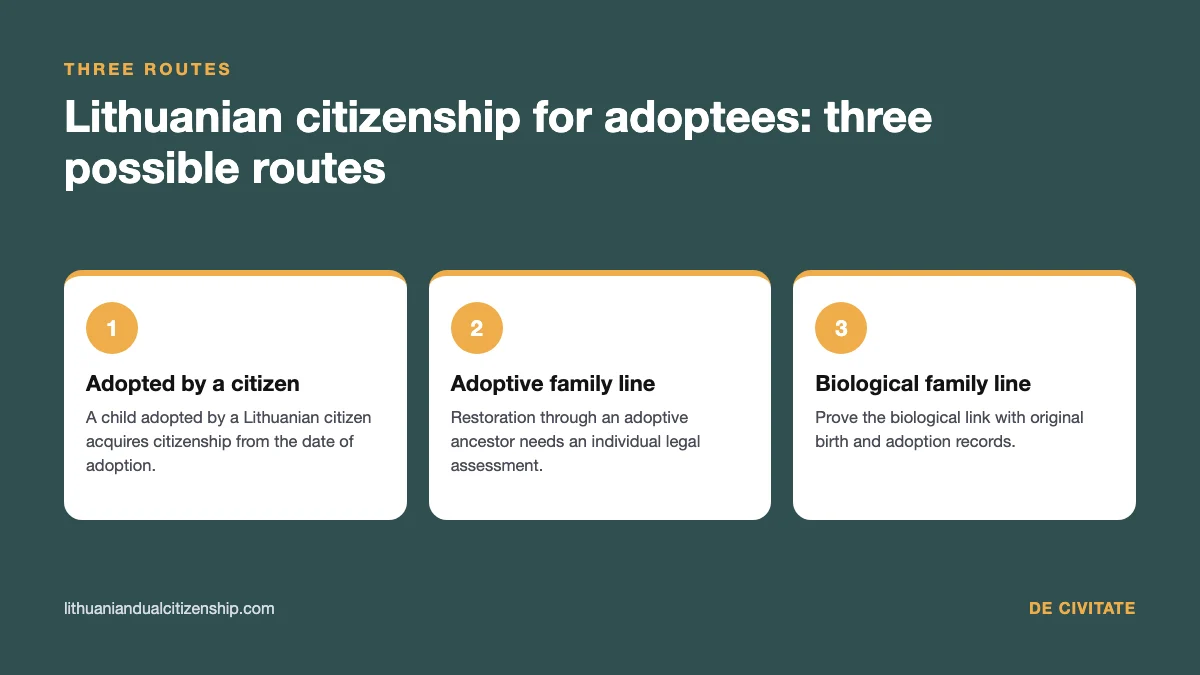
- A child adopted by a person who was already a Lithuanian citizen acquires Lithuanian citizenship from the date of adoption.
- Restoration through an adoptive grandparent or great-grandparent is not automatic and needs an individual assessment.
- Claims through a biological line after adoption must prove both the biological link and its legal relevance.
- Dual citizenship after international adoption applies only in specific situations defined by Lithuanian law.
Citizenship Through Adoption and Citizenship Through Descent Are Different Routes
Lithuanian law expressly provides that a child adopted by a Lithuanian citizen acquires Lithuanian citizenship from the date of adoption. It also provides that a child who is already a Lithuanian citizen and is adopted by foreign citizens does not lose Lithuanian citizenship solely because of that adoption.
This direct rule for an adopted child is different from the restoration route commonly called Lithuanian citizenship by descent. Restoration generally concerns people who held citizenship of the Republic of Lithuania before June 15, 1940, and qualifying descendants within the legally recognized generational range. Official consular guidance identifies children, grandchildren, and great-grandchildren as descendants for this purpose.
An applicant should therefore begin by identifying the actual basis of the case:
- Citizenship acquired because a Lithuanian citizen adopted the applicant as a child.
- Restoration through the historical citizenship of an adoptive parent, grandparent, or great-grandparent.
- Restoration through a biological parent or ancestor after the applicant was adopted.
- Confirmation or retention of Lithuanian citizenship following an international adoption.
The applicable route can determine which relationship must be proved and which dates are legally significant.
| Situation | Legal basis | Key documents |
|---|---|---|
| Adopted as a child by a Lithuanian citizen | Citizenship acquired from the date of adoption | Final adoption decree, adoptive parent’s citizenship documents, birth records |
| Restoration through an adoptive family line | Restoration — the adoptive line must qualify as the relevant line of descent | Adoption judgment, generation-by-generation records, proof of the ancestor’s citizenship |
| Restoration through a biological line after adoption | Restoration — biological link and its legal effect both assessed | Original birth certificate, adoption file, records linking the biological parent to the ancestor |
| Lithuanian child adopted by foreign citizens | Does not lose Lithuanian citizenship solely because of the adoption | Adoption decree, child’s Lithuanian citizenship documents |
Can a Child Adopted by a Lithuanian Citizen Qualify?
The clearest adoption-based situation is generally one in which a child was legally adopted by a person who was already a Lithuanian citizen when the adoption became effective.
In this situation, Lithuanian law provides a direct citizenship basis connected to the adoption itself. The issue may therefore involve confirming that citizenship was acquired rather than proving eligibility through a more remote historical ancestor.
Several facts may still need to be documented. The authorities may examine whether the adoption was final, when it became legally effective, whether the adoptive parent held Lithuanian citizenship on that date, and whether the foreign adoption can be recognized for Lithuanian legal purposes.
The applicant may need to provide a final adoption decree, the adoptive parent’s Lithuanian citizenship documents, the applicant’s birth records, and evidence of any subsequent name changes. Where the adoption occurred outside Lithuania, the form and legal effect of the foreign judgment may also require review.
A different analysis may apply when the adoptive parent was not a Lithuanian citizen at the time of adoption but restored citizenship years later. The parent’s later restoration should not be assumed to grant citizenship retroactively to the adopted child. The relevant dates and the child’s status under the applicable citizenship provisions must be assessed separately.
Can an Adoptee Qualify Through an Adoptive Family Line?
Lithuanian citizenship through adoptive parents may be possible in some circumstances, but a legally valid adoption does not automatically answer every citizenship question.
An adoption normally creates a legally recognized parent-child relationship. However, a restoration application must also satisfy the definitions and requirements contained in Lithuanian citizenship law. Authorities may need to determine whether the adoptive relationship places the applicant within the permitted line and generation of descent from the historical Lithuanian citizen.
For example, an adult applicant may have been adopted by a person whose parent or grandparent held Lithuanian citizenship before June 15, 1940. The applicant may be able to prove the adoption and the ancestor’s citizenship, but the authorities must still determine whether the adoptive relationship qualifies as the relevant line of descent for restoration.
Publicly available official guidance clearly addresses children adopted by existing Lithuanian citizens. It does not expressly confirm that every adult adoptee automatically qualifies through a remote adoptive grandparent or great-grandparent. Such cases may therefore require an individual assessment of the adoption judgment, the applicable law, the family structure, and the citizenship basis being claimed.
An amended birth certificate naming the adoptive parents may support the relationship, but it may not be sufficient by itself. A final adoption decree can be important because it shows when the legal relationship was created and may explain why earlier and later civil records contain different parents, surnames, or identifying information.
Lithuanian Citizenship Through Biological Parents After Adoption
An adoptee may also investigate Lithuanian citizenship through biological parents after adoption. Adoption does not change the historical fact of biological parentage, but it can alter the legally recognized family relationship and make the biological line more difficult to prove.
The first challenge is often documentary. An amended birth certificate may identify only the adoptive parents. The biological parent may instead appear in an original birth certificate, adoption file, relinquishment document, court judgment, agency record, or another sealed or restricted document.
After identifying the biological parent, the applicant must establish the rest of the family chain. This normally means connecting the biological parent to the relevant Lithuanian parent, grandparent, or great-grandparent through civil records.
The authorities may also need to consider the legal effect of the adoption. Depending on the jurisdiction and form of adoption, the original legal relationship with the biological parents may have been modified or terminated. The existence of biological ancestry alone should therefore not be treated as a guaranteed legal basis for restoration.
A strong file will distinguish between two separate issues:
- Whether the records reliably establish the biological relationship.
- Whether that relationship is accepted as the legally relevant line of descent under the applicable Lithuanian citizenship provisions.
Both questions may need to be resolved before the applicant’s eligibility can be determined.
Does International Adoption Affect Dual Citizenship?
International adoption can involve both Lithuanian citizenship rules and the citizenship law of the child’s or parents’ other country.
Official Lithuanian guidance identifies specific dual-citizenship situations involving adoption. These include a person adopted by a Lithuanian citizen before turning 18 who acquired Lithuanian citizenship as a result, and a Lithuanian citizen adopted by foreign citizens before turning 18 who acquired another citizenship because of the adoption.
These provisions are important for Lithuanian dual citizenship after international adoption, but they should not be interpreted as a general rule that every adoptee with Lithuanian ancestry may automatically retain two citizenships.
The analysis may depend on how Lithuanian citizenship was acquired, the applicant’s age at the time of adoption, when the other citizenship was acquired, and whether the case falls within one of Lithuania’s statutory dual-citizenship exceptions.
An applicant who already holds U.S. citizenship should therefore separate the eligibility question from the dual-citizenship question. First, the applicant must establish whether Lithuanian citizenship was acquired, retained, or may be restored. The applicant must then determine whether Lithuanian law permits both citizenships to be held in that particular situation.
What Documents May Be Needed in an Adoption-Based Case?
The exact evidence depends on whether the claim is based on the adoptive line, the biological line, or direct acquisition through adoption. Potentially relevant documents may include:
- The applicant’s current birth certificate.
- The applicant’s original birth certificate, if different.
- The final adoption decree or judgment.
- Documents showing when the adoption became legally effective.
- Evidence that a foreign adoption is legally valid and recognizable.
- Records identifying the biological parents.
- Records confirming the adoptive parent’s identity and citizenship.
- Birth, marriage, divorce, and death certificates connecting each generation.
- Documents explaining name changes and spelling variations.
- Documents establishing the historical ancestor’s citizenship.
- Records showing when the ancestor left Lithuania or acquired another citizenship.
- Certified translations, apostilles, or other required authentication.
Official consular guidance for restoration applications generally requires proof that the relevant ancestor held Lithuanian citizenship, documents connecting the applicant to that person, and records explaining changes to names or surnames. Foreign documents may also require Lithuanian translation and an apostille or legalization, depending on the document and issuing country.
Applicants should build the file around what each document actually proves. A birth certificate may prove parentage but not the historical ancestor’s citizenship. An adoption decree may prove legal parentage but not necessarily establish a remote Lithuanian ancestor. A Lithuanian passport may prove the ancestor’s citizenship but does not by itself connect that person to the applicant.
Proving the Lithuanian Ancestor’s Citizenship
Regardless of whether the applicant relies on an adoptive or biological family line, the historical ancestor’s status must usually be established independently.
Being born in Lithuania, having a Lithuanian surname, or identifying as ethnically Lithuanian may help with historical research, but these facts do not always constitute proof of Lithuanian citizenship before 1940. Official guidance lists records such as Lithuanian passports, military or civil-service documents, identity certificates, and certain records issued by Lithuanian authorities as potentially relevant evidence.
When family documents are incomplete, Lithuanian archive records may help establish the ancestor’s identity, citizenship, residence, military service, or civil status. Archive findings may also provide details needed to connect records that use different versions of a name or birthplace.
The applicant should avoid assuming that the adoption decree or a Lithuanian ancestor’s birth certificate resolves the entire case. A complete file normally needs evidence of both the ancestor’s qualifying status and the applicant’s legally relevant relationship to that ancestor.
Common Reasons Additional Documents May Be Requested
Adoption cases often contain more than one version of the applicant’s identity and family history. This can lead the authorities to request clarification or additional records.
Further evidence may be needed when:
- The current birth certificate identifies only the adoptive parents.
- The original birth record is unavailable or restricted.
- The adoption decree does not clearly identify the biological parents.
- The date on which the adoption became final is unclear.
- The adoptive parent’s Lithuanian citizenship status on the adoption date is uncertain.
- Different documents contain conflicting names, birth dates, or birthplaces.
- A foreign adoption judgment does not clearly establish a full parent-child relationship.
- The applicant cannot document every generation between themselves and the Lithuanian ancestor.
- The records show Lithuanian origin but do not establish Lithuanian citizenship.
- Documents have not been properly translated, certified, apostilled, or legalized.
A request for additional documents does not necessarily mean that the application will be refused. It usually indicates that the authority considers one or more facts insufficiently established. The response should address the specific evidentiary gap rather than simply resubmitting the same documents.
How to Evaluate an Adoptee’s Potential Eligibility
Before drawing a conclusion, the applicant should reconstruct the case chronologically.
First, identify whether the claim is based on an adoptive parent, a biological parent, or a direct acquisition of citizenship at the time of adoption. Mixing several possible routes without distinguishing them can make the application difficult to assess.
Second, determine the exact date of adoption and the citizenship status of the adoptive parent on that date. A person who was already a Lithuanian citizen when the adoption occurred may create a different legal situation from a person who restored citizenship later.
Third, establish whether the adoption is legally recognized and what effect it had on the applicant’s relationship with the biological parents. The wording of the judgment may matter, particularly in international or historical adoptions.
Fourth, create a generation-by-generation document chain. Each parent-child relationship should be supported by records, including any adoption documents needed to explain why the names of the parents changed.
Fifth, assess the evidence of the ancestor’s citizenship separately. A citizenship application document checklist can help distinguish proof of family relationships from proof of the ancestor’s Lithuanian status.
Finally, review inconsistencies before submission. Differences in surnames, translated names, dates, places, or parental details should be identified and supported with explanatory records where possible.
Key Takeaway
Lithuanian citizenship for adoptees depends on the legal basis being used and the evidence available.
A child legally adopted by a person who was already a Lithuanian citizen may have a direct citizenship basis connected to the adoption. An adult seeking restoration through an adoptive parent’s Lithuanian ancestor may need to show that the adoption created a legally relevant line of descent. An applicant relying on biological ancestry after adoption may need original birth and adoption records to reconstruct a family relationship that is no longer visible in current civil documents.
Adoption does not produce one automatic result. The outcome can depend on the date and legal effect of the adoption, the citizenship status of the adoptive parent, the identity of the biological family, the generational relationship to the Lithuanian ancestor, and the strength of the documentary record.
Frequently Asked Questions
Can adopted children qualify for Lithuanian citizenship?
Yes, adopted children may qualify in certain circumstances. Lithuanian law provides that a child adopted by a Lithuanian citizen acquires Lithuanian citizenship from the date of adoption. Other cases, including restoration through an adoptive or biological ancestor, may depend on the legal effect of the adoption, the relevant family line, the dates involved, and the available documents.
Can I claim Lithuanian citizenship through an adoptive parent?
Possibly. A legally recognized adoption may establish a parent-child relationship with the adoptive parent. However, an adult claim through the adoptive parent’s Lithuanian parent, grandparent, or great-grandparent should not be treated as automatically valid. The authorities may need to assess the adoption judgment, the generational relationship, and the applicable citizenship provisions.
Can I claim Lithuanian citizenship through a biological parent after adoption?
A biological family line may remain relevant, but the applicant may need to prove both the biological relationship and its legal relevance after the adoption. Original birth records, adoption files, court judgments, and civil records connecting the biological parent to the Lithuanian ancestor may be required. The outcome can depend on the legal effect of the adoption and the evidence available.
Does a parent’s later citizenship restoration automatically cover an adopted child?
Not necessarily. If an adoptive parent restores Lithuanian citizenship after the adoption, the restoration should not be assumed to apply retroactively to the child. The authorities may consider whether the parent was a Lithuanian citizen when the adoption occurred, the child’s age and status, and whether another citizenship provision applies.
What documents may an adoptee need for a Lithuanian citizenship application?
An adoptee may need an original and amended birth certificate, a final adoption decree, documents identifying the biological or adoptive parents, records explaining name changes, civil records connecting each generation, and evidence of the Lithuanian ancestor’s citizenship. Foreign documents may also require certification, translation, an apostille, or legalization.
Find out if you qualify — free
Send us your family details and a Lithuanian citizenship specialist will review your case and explain your options.
Start free eligibility check