
Two siblings may descend from the same Lithuanian ancestor, grow up with the same family history, and rely on many of the same archival records. It may therefore seem logical that they should receive identical Lithuanian citizenship decisions. In practice, however, each application is assessed separately.
This explains why siblings can have different citizenship decisions even when their cases appear almost identical. The result may depend on the documents submitted by each applicant, the legal basis selected in MIGRIS, discrepancies in personal records, evidence connecting each generation, and the information available when the application is reviewed.
Questions about MIGRIS citizenship application changes in 2026 have made this issue more visible. Although MIGRIS is the central system for submitting and managing citizenship applications, it does not turn applications submitted by relatives into a single family case. Each applicant remains responsible for establishing their own eligibility and documentary chain.
In short
- Siblings with the same Lithuanian ancestor can receive different citizenship decisions.
- Each sibling files a separate MIGRIS application with their own documents and legal basis.
- Differences in documents, name changes, discrepancies or the selected procedure can change the outcome.
- A sibling’s approval is useful context but does not guarantee yours.
- If you were refused, start with the reasons in your own decision.
A Shared Ancestor Does Not Create a Shared Citizenship Decision
Lithuanian citizenship restoration is based on an applicant’s individual legal and documentary position. A shared ancestor may provide the historical foundation for several family members, but it does not automatically create a shared application or a guaranteed result.
The authorities generally need to determine whether the relevant ancestor held citizenship of the Republic of Lithuania during the legally significant period and whether the applicant is a qualifying descendant. They must also assess whether the documents reliably connect the applicant to that ancestor and whether any additional conditions relevant to restoration or dual citizenship have been satisfied.
For this reason, the phrase “same ancestor, different citizenship decisions” does not necessarily indicate that the authorities reached contradictory conclusions about the family’s history. The applications may contain different documents, identify different legal grounds, or present the same evidence in different ways.
One sibling may provide a complete chain of birth, marriage, name-change, and citizenship records. Another may submit only part of that chain or rely on documents containing unresolved inconsistencies. Even when both applicants are potentially eligible, the evidentiary result can differ.
How MIGRIS Treats Sibling Applications in 2026
Under the current procedure, applications for reinstatement of Lithuanian citizenship are submitted electronically through MIGRIS personally by each applicant. Applicants create their own submissions, enter their own personal information, choose the relevant service and legal basis, and upload their own supporting documents.
MIGRIS is therefore an application and communication platform rather than a family eligibility database. It allows the Migration Department to receive documents, conduct a preliminary assessment, request additional information, and communicate procedural instructions. Submission through the system does not itself confirm eligibility or guarantee approval.
For U.S.-based applicants who choose to present originals through a Lithuanian consular post, the Migration Department may first conduct a preliminary assessment of the uploaded documents. When no deficiencies prevent the process from continuing, the applicant may receive a MIGRIS notification instructing them to visit the consular post within the specified period to present the originals.
These procedural steps apply to each sibling separately. One applicant may upload a complete and legible file, while another may omit a document, select an incorrect application category, fail to upload all pages, or provide a translation that does not correspond fully to the original.
Current MIGRIS procedures do not mean that one sibling’s file is automatically copied into another sibling’s application. Families may coordinate their evidence, but each person should ensure that the documents relevant to their own identity and descent are included in their submission.
The Ancestor’s Lithuanian Citizenship Must Be Proven
One of the most important Lithuanian citizenship proof of ancestry requirements is evidence that the relevant ancestor was actually a citizen of the Republic of Lithuania. Proof that a person was born, lived, married, studied, or owned property in Lithuania may support the historical narrative, but it may not always prove citizenship by itself.
For restoration cases, current official guidance refers to persons who held citizenship of the Republic of Lithuania before June 15, 1940 and their qualifying descendants. Applicants may need documents that directly establish the ancestor’s citizenship or a sufficiently coherent combination of records from which that status can be established.
This distinction can produce different sibling outcomes. One sibling may obtain an archival certificate, interwar passport record, military record, internal passport entry, or another document that was not available when the other sibling applied.
The first sibling’s application may have been based largely on a birth certificate showing that the ancestor was born in Lithuania. The later application may include additional evidence confirming that the ancestor was recognized as a Lithuanian citizen. Although the applicants rely on the same person, the evidentiary records are not equivalent.
Historical records can also reveal facts that complicate a claim. For example, a file may indicate that the ancestor formally lost Lithuanian citizenship or was treated as a foreign national before the relevant historical cutoff. Such information may affect restoration eligibility even when the person had strong personal or territorial connections to Lithuania.
Each Sibling Has a Separate Documentary Chain
Siblings usually share the same documents for their parents, grandparents, or great-grandparents. However, the final part of the documentary chain is different for every applicant.
Each sibling normally needs personal identity documents and civil status records connecting them to the shared parent or family line. If one sibling changed their surname through marriage, adoption, a court order, or another legal process, additional evidence may be required. A sibling who retained the family surname may have a simpler documentary connection.
Differences can also arise when siblings were born in different jurisdictions. Their birth certificates may use different formats, contain different versions of their parents’ names, or record different places of birth. One record may name both parents clearly, while another may contain an abbreviated name, a spelling variation, or information added through a later amendment.
Foreign documents generally need to meet formal requirements concerning translation, apostille or legalization, and the presentation of originals or properly certified copies. A document that was acceptable in one sibling’s file should not be assumed to be automatically acceptable in another file if the certification, translation, or document format is different.
Lithuanian Citizenship Document Discrepancies Can Affect the Outcome
Lithuanian citizenship document discrepancies are common in ancestry-based cases. Names may have been translated, shortened, anglicized, transliterated from different alphabets, or recorded according to the spelling conventions of different countries.
A Lithuanian name may appear differently in an interwar passport, a passenger record, a U.S. naturalization file, a marriage certificate, and a descendant’s birth certificate. Dates may differ by a day or year, and historical place names may change after borders or administrative divisions are reorganized.
Not every discrepancy results in a denial. The central question is usually whether the documents, considered together, establish a credible and continuous identity and family relationship. A minor spelling variation may be understandable when the remaining records clearly refer to the same person.
More significant inconsistencies may require additional evidence. Problems can arise when two records show materially different birth dates, different parents, incompatible places of birth, or unexplained surname changes. One sibling may address these issues with supplementary civil records, archive statements, court orders, naturalization documents, or official name-change evidence. Another may leave the discrepancies unexplained.
This is one reason why Lithuanian citizenship by descent may be denied in one case while a related family member succeeds. The issue may not be the shared ancestor, but whether each applicant’s documents establish that they descend from that ancestor.
Different Applications May Use Different Legal Grounds
Families sometimes use “citizenship by descent” as a general expression for several procedures connected with Lithuanian ancestry. Legally, however, restoration of citizenship, confirmation of Lithuanian origin, confirmation of a right to restore citizenship, and other citizenship-related procedures may have different purposes and evidentiary requirements.
One sibling may apply for reinstatement of citizenship based on a former citizen of the Republic of Lithuania. Another may select a procedure connected with Lithuanian origin or submit an application based on a different ancestor. The factual background may overlap, but the legal questions presented to the authorities are not necessarily the same.
The ability to retain another nationality may also require a separate assessment. Current official guidance identifies particular circumstances in which persons restoring Lithuanian citizenship may be permitted to retain another citizenship, including certain cases involving persons who left Lithuania before March 11, 1990, persons who were exiled, and their descendants.
Siblings can also have different personal citizenship histories. One may have acquired another nationality at birth, while another acquired or changed nationality later. Depending on the legal route and the applicant’s circumstances, these facts may need to be evaluated separately.
| Factor | How it can differ between siblings |
|---|---|
| Documents | One file has a complete chain; the other has gaps or unresolved inconsistencies |
| Personal records | Different birth places, surnames after marriage or court name changes |
| Legal basis | Reinstatement in one application, a Lithuanian-origin procedure in another |
| Ancestor’s evidence | New archive records found for a later application |
| Procedure | Missing translations, incomplete uploads or unanswered MIGRIS requests |
Does a Sibling’s Citizenship Approval Affect My Eligibility?
A sibling’s approval can be relevant evidence, but it does not automatically establish another sibling’s eligibility. The previous decision may show that the authorities accepted important facts concerning the ancestor, family history, or historical documents. It may also help the second applicant identify records that were considered persuasive.
However, the approval does not replace the second applicant’s personal documents or their obligation to establish the relationship to the ancestor. It also does not prevent the authorities from requesting updated, clearer, or additional evidence.
The value of a sibling’s approved case may depend on whether the second applicant can identify the earlier file and provide the relevant decision or documents. Merely stating that a brother or sister received Lithuanian citizenship may not be enough for the authorities to reconstruct the earlier evidence.
A previous approval should therefore be treated as potentially helpful context rather than a transferable citizenship entitlement.
Can One Sibling Qualify for Lithuanian Citizenship and Another Not?
In some situations, one sibling may qualify while another does not. This is more likely when the applicants are half-siblings, rely on different parents or family branches, have different legal relationships to the relevant ancestor, or have materially different personal citizenship circumstances.
Full siblings relying on the same ancestor will often have a similar substantive basis. Even then, different outcomes remain possible because eligibility must be proven through individual applications.
An approval followed by a denial may indicate that the later file contained missing or contradictory evidence. A denial followed by an approval may indicate that new archival documents were found, discrepancies were resolved, or the later applicant presented a more complete legal and factual record.
The correct comparison is therefore not simply whether the applicants have the same parents. It is whether their applications establish the same legal basis with comparable evidence.
Why Lithuanian Citizenship Restoration May Be Denied
When Lithuanian citizenship restoration is denied, the reason should be identified from the official decision rather than assumed from another family member’s experience.
A denial may relate to insufficient proof that the ancestor held Lithuanian citizenship, failure to establish the complete line of descent, unresolved identity discrepancies, missing evidence concerning departure or exile, or facts showing that the selected legal route does not apply.
Procedural deficiencies may also affect the application. Documents may lack required translations or authentication, uploaded copies may be incomplete, or the applicant may fail to provide additional information requested through MIGRIS.
Some deficiencies may be capable of correction through better records or a more complete explanation. Others may concern the underlying legal basis and cannot be resolved merely by resubmitting the same documents.
Applicants should distinguish between a case that is weak because evidence is missing and a case in which the available evidence shows that a statutory requirement may not be satisfied.
How Siblings Can Prepare More Consistent Applications
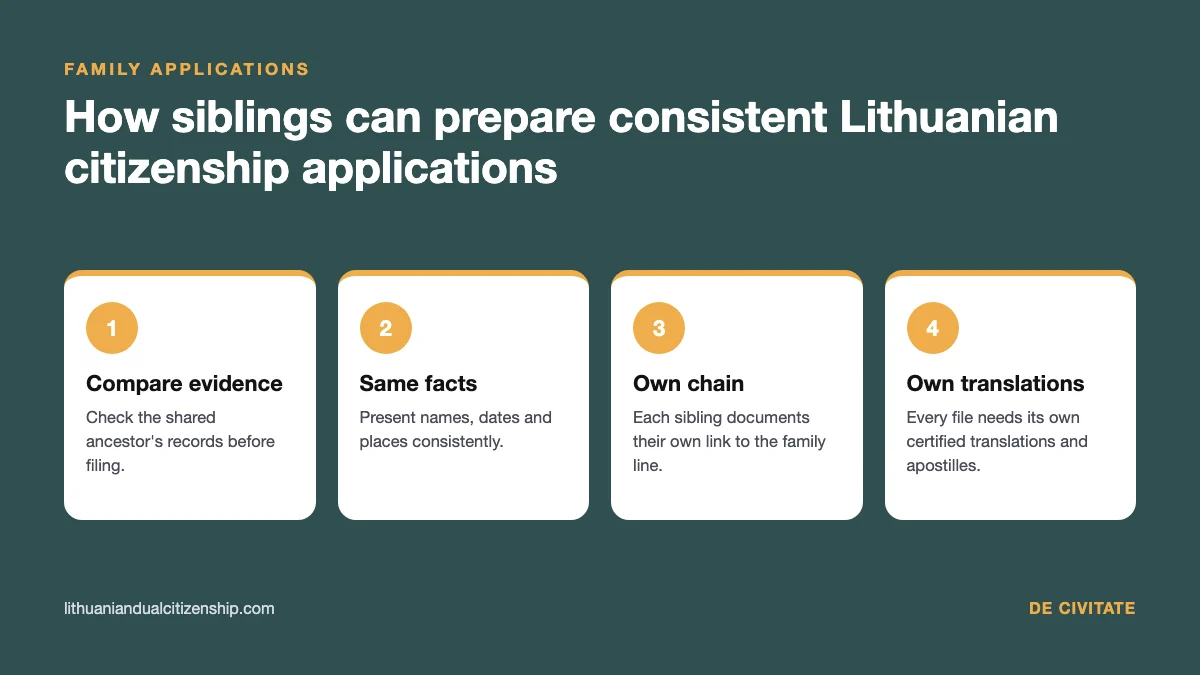
Siblings considering applications based on the same ancestor should compare their evidence before submitting separate MIGRIS files. The objective is not to make every application identical, but to ensure that the shared historical facts are presented consistently.
The names, dates, places, migration history, and citizenship status of the common ancestor should be checked across all available records. Where documents use different spellings or dates, the family should determine whether additional records can explain the variation.
Each sibling should then create a separate personal document chain. This includes confirming that their own birth, marriage, adoption, court, or name-change documents connect them clearly to the shared family line.
Translations and apostilles should be reviewed individually. A properly prepared document in one sibling’s application does not correct an uncertified or incomplete version uploaded by another sibling.
When a family member has already received a decision, later applicants should examine the complete basis of that case where possible. The useful material is not limited to the approval itself. The supporting archival records, civil documents, explanatory submissions, and responses to requests may be more important than the final decision.
What to Do If Your Sibling Was Approved but You Were Denied
Start with the written reasons in your own decision. Determine which fact, document, or legal requirement the authorities considered insufficient.
Next, compare your file with the approved sibling’s actual submission. Check whether the applications used the same ancestor, the same procedural route, and the same historical evidence. Pay particular attention to documents connecting each applicant to the shared parent and to records explaining surname or identity differences.
If the decision identifies missing evidence, determine whether an official record can be obtained from Lithuania, the United States, or another relevant country. If the issue is a contradiction between records, the solution may require an official correction, supplementary civil status record, archive response, court document, or a detailed explanation supported by evidence.
The decision may also provide information about available review or challenge procedures. Applicable steps and deadlines can depend on the type of decision and the applicant’s circumstances, so they should be checked directly in the decision and current official guidance.
A sibling’s approval can strengthen the factual context, but the response to a denial should address the specific reasons given in the denied applicant’s own case.
FAQ
Can siblings have different citizenship by descent outcomes?
Yes. Each sibling submits a separate application and must establish their own legal basis, identity, and connection to the Lithuanian ancestor. Differences in documents, name changes, record discrepancies, legal grounds, or responses to MIGRIS requests can lead to different outcomes.
Does my sibling’s Lithuanian citizenship approval guarantee my approval?
No. A sibling’s approval may support parts of the shared family history, but it does not automatically prove another applicant’s eligibility. Each applicant must provide the documents connecting them personally to the qualifying ancestor and satisfy the requirements relevant to their own case.
Can one sibling qualify for Lithuanian citizenship and another not?
Yes, depending on the applicants’ family relationships, documentary evidence, selected legal routes, and personal citizenship circumstances. Full siblings may have a similar underlying claim, but their applications can still produce different results if one file does not sufficiently prove the required facts.
Why was my Lithuanian citizenship by descent application denied if my sibling was approved?
The applications may not have contained the same evidence. Your file may have had missing civil records, unresolved name or date discrepancies, insufficient proof of the ancestor’s citizenship, or a different legal basis. The exact reason should be identified from your written decision.
Can I use the same ancestry documents as my sibling?
You may be able to rely on copies of many of the same historical and family records, but you still need your own application and personal document chain. You should also ensure that every document in your submission meets the applicable translation, authentication, and format requirements.
Does MIGRIS combine applications submitted by siblings?
No. MIGRIS processes each citizenship submission as an individual application. Siblings may coordinate their supporting evidence and refer to related family records, but one sibling’s MIGRIS file does not automatically become part of another sibling’s application.
Find out if you qualify — free
Send us your family details and a Lithuanian citizenship specialist will review your case and explain your options.
Start free eligibility check