Having unmarried parents does not automatically prevent a person from pursuing Lithuanian citizenship by descent. In many cases, the more important question is whether the applicant can establish a legally recognized and well-documented family connection to the Lithuanian parent, grandparent, or great-grandparent on whom the claim is based.
For U.S.-based families, this issue often arises when a father and mother were never married, a father was not named on the original birth certificate, paternity was recognized later, or different generations contain incomplete civil records.
Lithuanian authorities evaluating citizenship restoration require documents showing the relationship between the applicant and the person who held Lithuanian citizenship before June 15, 1940. Birth certificates are specifically identified as an example of this evidence. Documents explaining changes of name or surname may also be required.
The result is that the absence of a marriage certificate is not necessarily the central problem. The real issue is whether the documentary chain proves the relevant parent-child relationships.
In short
- Unmarried parents do not by themselves prevent Lithuanian citizenship by descent.
- What matters is whether official records establish each parent-child relationship.
- A claim through an unmarried father may need an amended birth certificate, acknowledgment of paternity or a court record.
- A marriage certificate is not always required; it matters when it explains a surname change.
- DNA can guide research but does not replace legally recognized records.
Does It Matter if Your Parents Were Not Married?
For many modern Lithuanian citizenship by descent cases, the parents’ marital status is not an independent reason for disqualification. What matters more is the legal basis for the citizenship claim and whether descent from the qualifying ancestor can be established.
Lithuania’s Citizenship Law provides that a child acquires Lithuanian citizenship by birth when either parent is a Lithuanian citizen, regardless of whether the child is born inside or outside Lithuania. The provision itself does not condition citizenship on the parents being married.
That rule should not, however, be confused with every citizenship restoration case involving earlier generations. An American applicant may be relying on a grandparent or great-grandparent who held Lithuanian citizenship before 1940 rather than on a parent who was already a Lithuanian citizen when the applicant was born.
In restoration cases, the applicant normally has to prove both the qualifying ancestor’s Lithuanian citizenship and the family relationship connecting that ancestor to the applicant. The official consular guidance identifies descendants of pre-June 15, 1940 Lithuanian citizens as potentially having the right to reinstate citizenship and separately requires documents showing the relationship to that ancestor.
The Main Issue Is Usually Proof of the Family Relationship
A Lithuanian citizenship by descent application is built as a documentary chain.
If an applicant relies on a Lithuanian great-grandfather, for example, the evidence may need to connect the great-grandfather to the grandparent, the grandparent to the applicant’s parent, and the parent to the applicant. Birth certificates and other civil records commonly perform this function.
When parents were married and both appear consistently in civil records, that chain may be relatively straightforward. When they were not married, additional questions may arise about whether the relevant parent was legally recorded or otherwise recognized.
The absence of a marriage itself does not necessarily break the chain. A problem is more likely to arise when the records do not clearly establish who the parent was.
Lithuanian Citizenship Through an Unmarried Mother
A claim through a mother can often be documented through the child’s birth certificate if the mother is clearly identified and the remaining generations can also be connected.
The same underlying evidentiary principles apply to the maternal line: the qualifying Lithuanian ancestor must be identified, direct descent must be documented, and differences in names or other identifying information may need explanation. Marriage records can become relevant where surnames changed, but marriage itself is not what creates the genealogical connection.
This can be particularly important for U.S. families in which women appear under maiden names, married surnames, Anglicized names, or several historical spellings.
Lithuanian Citizenship Through an Unmarried Father
Lithuanian citizenship through an unmarried father may require closer examination of the documents establishing paternity.
If the father is identified on the relevant birth certificate and the record is legally valid, the applicant may already have an important document connecting the two generations. Other documents may still be necessary to confirm identity, explain surname differences, or establish the remainder of the ancestral chain.
The situation becomes more complicated when the father was not included on the original birth certificate, was added later, or appears differently in other records. Because Lithuanian restoration proceedings depend on documents establishing the relationship to the qualifying ancestor, uncertainty at this point in the family line can create an evidentiary gap.
The question is therefore not simply whether the biological father was Lithuanian. It is whether the legal and documentary record can connect that father to the child and ultimately connect the applicant to the qualifying Lithuanian ancestor.
What if the Father Is Not Listed on the Birth Certificate?
A father not listed on a birth certificate can make Lithuanian citizenship by descent through the paternal line more difficult to document, but it should not automatically be treated as the end of the analysis.
The first step is to determine whether another official record establishes the parent-child relationship. Depending on the U.S. state, the date, and the family’s circumstances, potentially relevant records may include an amended birth certificate, acknowledgment or recognition of paternity, court determination of parentage, or another official civil-status record.
Whether a particular document will be sufficient for a Lithuanian citizenship proceeding depends on its legal effect, authenticity, and how the Migration Department evaluates the complete record set. The official requirements emphasize documents demonstrating the relationship rather than prescribing one universal document for every possible family situation.
This distinction is important. Genealogical evidence suggesting that a particular man was the biological father is not necessarily equivalent to official proof of the legal family relationship.
What Counts as Proof of Paternity for Lithuanian Citizenship?
There is no single piece of evidence that should be assumed to resolve every proof-of-paternity issue.
A birth certificate naming the father may provide direct civil evidence. Where the original record does not identify him, legally recognized records created to establish or amend parentage may become particularly important.
Supporting family documents can also help authorities understand the record set, but they should not automatically be treated as substitutes for legally recognized evidence of parentage.
For example, census records, obituaries, family trees, passenger records, church records, photographs, correspondence, or other genealogical materials may help research a relationship. Their value in a citizenship proceeding, however, can differ significantly from a civil certificate or court record.
The objective is to produce a coherent documentary chain in which each generation can be connected to the next.
| Situation | Records that may help |
|---|---|
| Claim through the mother | Birth certificate naming the mother; records of surname changes |
| Father named on the birth certificate | The birth certificate, plus records explaining surname differences |
| Father added later | Amended birth certificate or acknowledgment of paternity |
| Paternity established in court | Court determination of parentage |
| Biological father identified by DNA | An official civil or court record is still needed |
Is a Marriage Certificate Required?
A marriage certificate is not necessarily required simply because an applicant is pursuing Lithuanian citizenship by descent.
Official Lithuanian consular guidance requires documents indicating the relationship between the applicant and the qualifying ancestor and separately requires evidence of name or surname changes where relevant. Marriage certificates are among the documents that may serve these purposes, but the requirements do not state that every generation must have been born to married parents.
If two parents never married, there will obviously be no marriage certificate between them. The relevant question becomes whether other official documents adequately establish the parent-child relationship.
Marriage certificates become especially useful when they explain why the same person appears under different surnames or help connect records across generations.
When Historical Law May Matter
There is an important distinction between proving a family relationship today and determining whether someone historically acquired or held Lithuanian citizenship.
Citizenship rules have changed over time. Historical Lithuanian citizenship legislation contained rules dealing specifically with children and unmarried parents. Consequently, if a citizenship claim depends not merely on proving biological descent but on establishing whether a particular ancestor or intermediate family member acquired citizenship under the law applicable at the time of birth, the historical legal framework may need separate analysis. Contemporary rules should not simply be projected backward onto births that occurred under earlier citizenship legislation.
This issue can be especially relevant where the unmarried-parent relationship appears several generations ago rather than in the applicant’s own birth record.
The applicant may therefore need to answer two different questions: Was the parent-child relationship legally established, and what citizenship law applied to that person at the relevant time?
Building the Documentary Chain
For most U.S.-based applicants, the most useful approach is to work backward from the applicant rather than beginning only with the Lithuanian ancestor.
Start with the applicant’s birth record and identify the parent through whom Lithuanian descent is claimed. Then review that parent’s birth record and continue through every generation until reaching the qualifying Lithuanian ancestor.
A practical citizenship documents checklist should identify any generation where the relationship is unclear rather than simply counting how many certificates are available.
Particular attention should be given to situations where:
- a father is missing from a birth certificate;
- a parent was added to the birth record later;
- the child’s surname differs from the father’s surname;
- paternity was established through a court proceeding;
- a person used several legal names;
- a parent’s name differs substantially between records;
- the parents were never married and a marriage record therefore does not exist.
The objective is not to manufacture a perfectly uniform family history. It is to identify genuine gaps and determine which official records may explain them.
Name Differences Can Complicate an Unmarried-Parent Case
Parentage issues frequently overlap with name discrepancies.
An unmarried child may have received the mother’s surname even when the citizenship line runs through the father. A father’s surname may also have been Americanized, shortened, translated, or recorded differently from the version found in Lithuanian records.
Lithuanian and U.S. documents can contain additional differences caused by transliteration, historical languages, immigration practices, or later name changes. The same person may therefore appear under several forms without necessarily representing different individuals.
Where such differences affect the connection between generations, the file may need additional records showing why the names refer to the same people.
Can Lithuanian Archive Records Help?
Lithuanian archive records can become important once the more recent U.S. family relationship has been established.
Historical birth, marriage, church, internal passport, military, residence, and other records may help identify the Lithuanian ancestor and establish the ancestor’s status or family connections. Different archives preserve different types and periods of records.
Archive research is particularly useful when an old Lithuanian birth record identifies parents who are missing or inconsistently named in later foreign records.
It is important, however, to distinguish between proving the Lithuanian ancestor’s citizenship and proving every parent-child link between that ancestor and the applicant. One strong Lithuanian archive document cannot necessarily compensate for an undocumented generation in the United States.
Can DNA Testing Solve a Missing Paternity Link?
DNA testing may help identify a biological father or connect an applicant with relatives, but it should not automatically be treated as legal proof of descent for citizenship purposes.
Citizenship restoration generally depends on a documented family relationship and evidence concerning the qualifying ancestor’s Lithuanian citizenship. Commercial ancestry results do not themselves create a civil birth record or establish the legal status of a parent.
DNA can nevertheless be useful during research. It may reveal relatives who possess records, identify the likely paternal family, or help determine which archival collection should be investigated.
If DNA evidence reveals a previously unknown father, the next question is generally whether that relationship can also be established through an appropriate official civil or legal record.
Preparing Foreign Documents for a Lithuanian Application
Once the correct documents have been identified, their formal requirements also matter.
For applications submitted through the Lithuanian consular system in the United States, official guidance states that foreign documents other than passports must generally be officially translated into Lithuanian and authenticated by Apostille or legalization as applicable. Originals or properly validated copies are required under the stated procedure.
Citizenship reinstatement applications are currently submitted through MIGRIS, with the Migration Department reviewing the documentation and requesting presentation of originals according to the procedure described by Lithuanian consular authorities.
This means applicants should resolve significant parentage or document inconsistencies before assuming that simply uploading the existing family records will establish the required line of descent.
What to Check Before Relying on an Unmarried-Parent Line
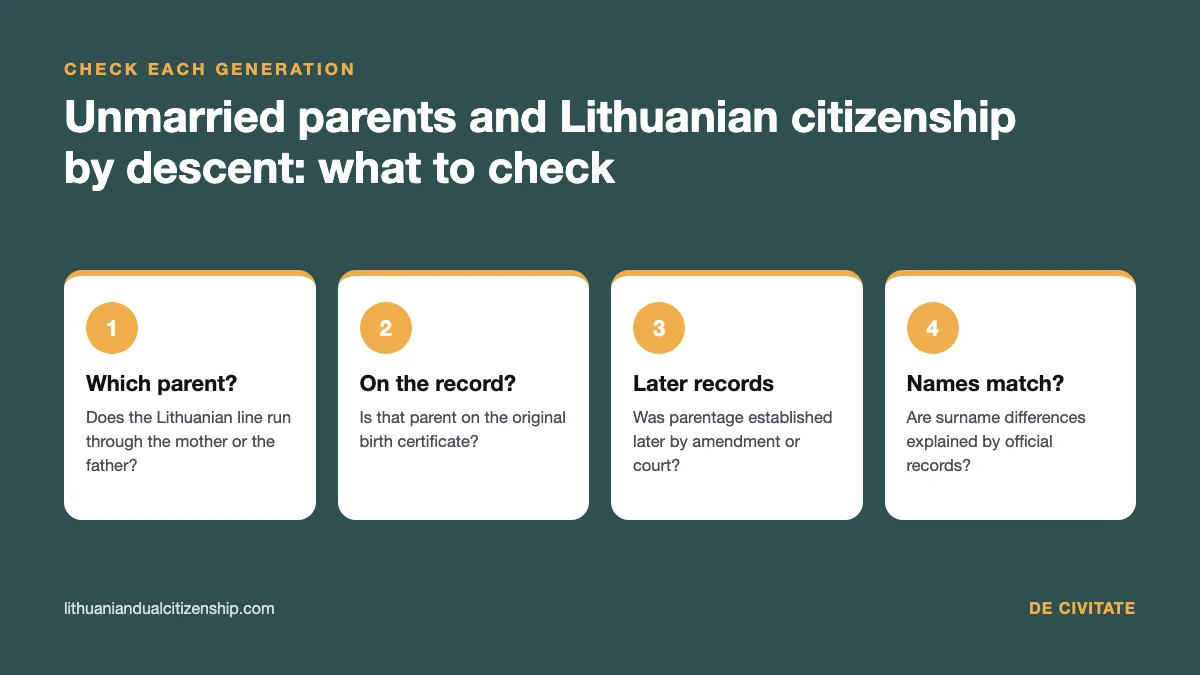
The most useful preliminary review is to identify exactly which generation creates the issue.
Determine whether the Lithuanian line runs through the mother or father, whether that parent appears on the child’s original birth record, and whether any later record formally established parentage.
Then compare the names, dates, and places across each generation. If a surname changed or the father and child used different surnames, look for the official record explaining the difference.
Finally, separate the parentage question from the historical citizenship question. Even a perfectly documented parent-child relationship does not by itself prove that the ancestor held qualifying Lithuanian citizenship. Conversely, strong evidence that an ancestor was Lithuanian does not remove the need to prove the family line connecting that ancestor to the applicant.
For applicants whose parents were not married, this distinction is usually the most important part of evaluating the case.
Frequently Asked Questions
Can I qualify for Lithuanian citizenship by descent if my parents were not married?
Possibly. The fact that your parents were not married does not by itself resolve eligibility. The key issues are whether you have a qualifying Lithuanian ancestor, whether the relevant legal basis applies, and whether official records can establish the parent-child relationship through each generation.
Can I claim Lithuanian citizenship through an unmarried father?
Potentially, yes. A paternal line can be relevant, but the applicant must be able to document the legal family relationship to the father and then connect that line to the qualifying Lithuanian ancestor. If the father is not identified in the birth record, additional legally recognized documentation may be necessary.
What if my father is not listed on my birth certificate?
A missing father entry can create a gap in the documentary chain. Depending on the jurisdiction and the facts, records such as an amended birth certificate, an acknowledgment of paternity, a court determination, or other official evidence may be relevant. The Lithuanian authorities determine whether the submitted documents are sufficient for the citizenship proceeding.
Is a marriage certificate required for Lithuanian citizenship by descent?
Not in every case. A marriage certificate can be important when it explains a surname change, connects records, or forms part of the evidence for a particular generation. If the parents were never married, the absence of a marriage certificate does not itself replace the need to prove the parent-child relationship through other official records.
Can a DNA test prove paternity for Lithuanian citizenship by descent?
DNA testing may be useful for genealogical research or for identifying a biological relationship, but it should not be assumed to replace legally recognized civil or court records. A citizenship application normally needs an official documentary chain connecting the applicant to the qualifying ancestor.
Find out if you qualify — free
Send us your family details and a Lithuanian citizenship specialist will review your case and explain your options.
Start free eligibility check