Lithuanian citizenship restoration often depends on historical documents that were created decades ago, sometimes in different countries, languages, legal systems, and political periods. For many U.S.-based applicants, the documents used to prove Lithuanian ancestry do not always match perfectly. A birth record may show one date, a U.S. naturalization file may show another, and an immigration record may list the same place of birth under a Russian, Polish, Yiddish, German, or older Lithuanian form.
These issues are common in genealogy-based citizenship cases. Lithuanian citizenship by descent document discrepancies do not automatically mean that a person is ineligible. However, they usually need to be reviewed carefully because the applicant must still show a consistent family line, the identity of the Lithuanian ancestor, and the connection between old records and modern civil documents.
The main question is not simply whether every document is identical. The more important question is whether the documents, when read together, can reasonably show that they refer to the same person and the same family line.
In short
- Different dates of birth or place names do not automatically make you ineligible.
- The question is whether the records, read together, show the same person and family line.
- Small spelling differences, a few days’ difference or a baptism date are usually manageable.
- A different birth year, different parents or an unconnectable place needs stronger evidence.
- Some modern records can be corrected; historical ones usually need to be explained.
Why Lithuanian Citizenship Records Often Contain Discrepancies
Lithuanian ancestry records discrepancies often appear because older records were not created for modern citizenship restoration. They were usually created for church registration, civil administration, military service, migration control, employment, census purposes, or naturalization in another country. Each record may have captured information differently depending on who provided the information, who wrote it down, and what language or alphabet was used.
Many Lithuanian families also lived through periods of changing borders and administrations. A person born in a village that is now in Lithuania may have seen the same place described as part of the Russian Empire, Poland, Kovno Governorate, Vilna Governorate, or another historical administrative unit. In U.S. records, clerks often wrote what they heard, what the immigrant reported, or what seemed familiar to American officials.
Dates of birth may differ because of transcription errors, unclear handwriting, calendar differences, estimated ages, delayed registration, or inconsistent reporting by the person or family members. Place names may differ because towns and villages had different names in Lithuanian, Polish, Russian, Yiddish, German, or English-language immigration records.
For Lithuanian citizenship restoration document discrepancies, context matters. A minor spelling variation or one-day difference may be easier to explain than a completely different birth year, different parent names, or a place name that points to another person entirely.
Different Dates of Birth in Lithuanian and U.S. Records
Different dates of birth in genealogy records are among the most common issues in citizenship by descent research. A Lithuanian birth record may show a precise date from a parish register, while a U.S. census record may show only an estimated age. A naturalization petition may contain a date supplied from memory many years later. A death certificate may have been completed by a relative who did not know the exact birth date.
In many cases, a small date difference does not necessarily destroy the evidentiary value of the record. For example, one document may show the date of birth, another may show the date of baptism, and a third may contain an approximate age rather than a precise date. Records created closer to the actual event, such as church birth or baptism records, may carry more genealogical weight than records created decades later, although each case depends on the full document set.
A Lithuanian records different date of birth issue becomes more serious when the variation affects the identity of the ancestor. If the year, parents’ names, spouse, occupation, and place of origin still match, the discrepancy may be explainable. If several core identifiers conflict at the same time, additional evidence may be needed to show that the records belong to the same person.
Applicants should avoid treating every record as equally reliable. A passenger list, census entry, marriage certificate, naturalization file, military document, internal passport record, and death certificate may all provide useful information, but they were produced in different circumstances. The strongest cases usually explain how the records connect rather than simply placing inconsistent documents side by side.
Place of Birth Discrepancies in Citizenship by Descent Cases
A place of birth discrepancy citizenship by descent issue can be especially confusing for applicants whose ancestors came from historical Lithuania. A U.S. document may say “Russia,” “Poland,” “Kovno,” “Vilna,” “Kovno Province,” “Russian Poland,” or a town name that no longer appears in modern maps. This does not always mean the ancestor was not Lithuanian. It may reflect the political geography of the time rather than the person’s ethnicity, citizenship, or exact town of origin.
For Lithuanian citizenship restoration, the key issue is usually whether the ancestor can be connected to the territory and citizenship of the Republic of Lithuania during the relevant historical period. A broad birthplace description such as “Russia” or “Poland” may need to be narrowed through other documents. A specific town, parish, district, or Lithuanian archive record can help clarify whether the person came from an area connected to Lithuania.
Lithuanian place names in old records may appear in several forms. A town might be written in Lithuanian in one record, Polish in another, Russian in Cyrillic in a third, and Yiddish or German-influenced spelling in immigration materials. U.S. records may also contain phonetic spellings that reflect how the name sounded to an English-speaking clerk.
Because of this, old Lithuanian place names genealogy research often requires comparing historical maps, parish jurisdictions, archive references, and multiple spelling variants. The goal is not only to translate the place name, but to identify the correct historical locality and connect it to the ancestor’s life events.
How Old Lithuanian Place Names Can Change Across Records
Lithuanian town names in immigration records can look very different from modern Lithuanian names. This is especially true for immigrants who arrived in the United States before standardized Lithuanian spellings became familiar to American institutions. A town name may have been shortened, anglicized, mistranscribed, or recorded according to the language used by the immigrant community.
For example, a Lithuanian village name may appear in an older Russian administrative form, a Polish spelling, a Yiddish community name, or a simplified English version. Sometimes the same town may be listed under a district name rather than the actual village. In other cases, the record may identify only a province, governorate, or nearby larger town.
Lithuanian birth records place names can also depend on the type of record. A church record may refer to a parish, a civil record may refer to an administrative district, and an immigration record may refer to the nearest recognizable town. These differences can create the appearance of a contradiction even when the records describe the same area.
This is why a place name should be evaluated together with family names, parents’ names, spouse names, religion, dates, siblings, and migration history. A place discrepancy is less problematic when the surrounding evidence consistently points to the same person and locality.
When a Discrepancy May Be Minor
Some discrepancies are usually easier to address because they are common in historical records. These may include small spelling differences, a date that varies by a few days, use of a baptism date instead of a birth date, a shortened town name, or a broad country description instead of a specific town.
A minor discrepancy may still need to be explained, especially if the citizenship application relies on that document to prove descent or identity. However, the issue may be manageable when the rest of the record set is consistent. If the ancestor’s name, spouse, children, occupation, migration route, and family relationships align, a small variation may be treated as part of the historical record rather than as proof of a different person.
In many Lithuanian citizenship by descent document discrepancies, the strongest approach is to show a chain of records that supports the same conclusion. A single inconsistent record may matter less when several independent records confirm the same identity and family relationship.
When a Discrepancy May Require More Evidence
A discrepancy becomes more serious when it affects a core element of the case. This may include a different birth year, different parents, a different spouse, a different place that cannot be connected to Lithuania, or records that suggest two possible people with similar names. In these situations, it may be necessary to locate additional archive records or civil documents before relying on the file for citizenship restoration.
For example, if a U.S. death certificate gives one place of birth but a Lithuanian archive record points to a different district, the discrepancy may need to be resolved by comparing parents’ names, marriage records, children’s birth records, naturalization records, and immigration documents. If two individuals with the same or similar names lived in nearby areas, the case may require a more detailed genealogical analysis.
A serious discrepancy does not always mean the application cannot proceed. It means the evidentiary chain may need to be stronger. The applicant may need to show why one record is more reliable than another, how the conflicting details arose, and which documents best establish the ancestor’s identity.
| Usually minor | May need more evidence |
|---|---|
| Small spelling differences | A different birth year |
| A date that varies by a few days | Different parents’ names |
| Baptism date instead of birth date | A different spouse |
| Shortened or historical town name | A place that cannot be connected to Lithuania |
How Applicants Can Approach Document Discrepancies
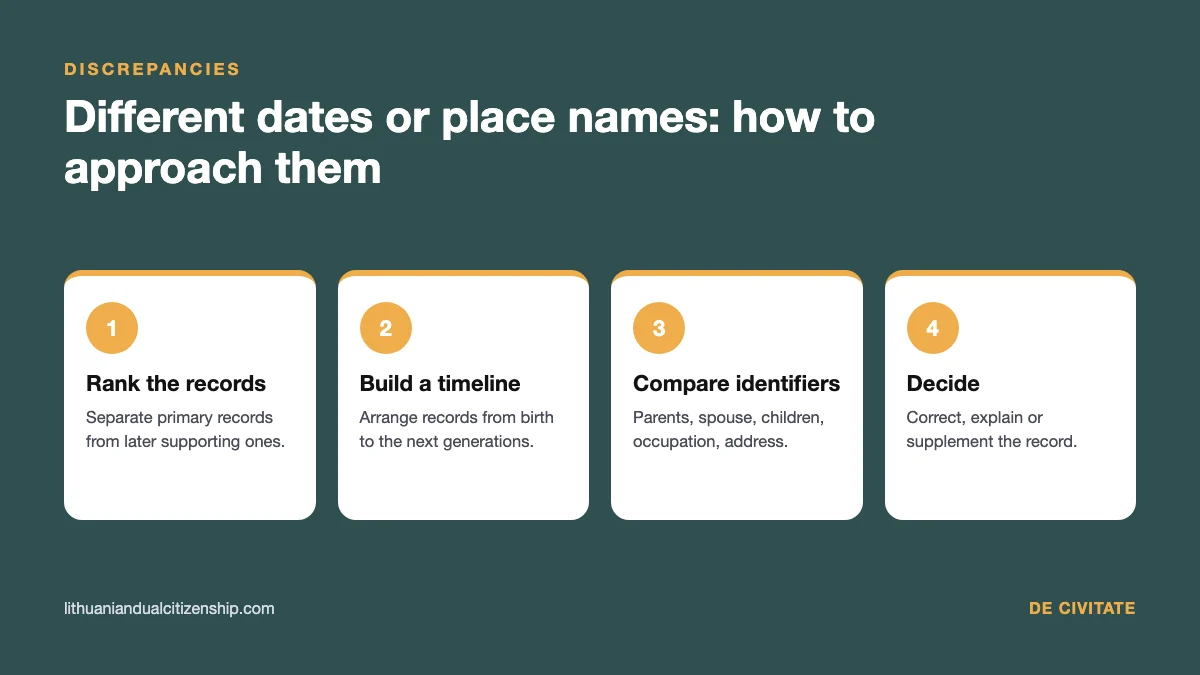
The first step is to separate primary evidence from supporting evidence. Records created close to the event, such as birth, baptism, marriage, or Lithuanian archive records, may help establish identity more directly. Later U.S. records, such as census entries, death certificates, obituaries, and some immigration documents, can still be useful, but they may contain information supplied long after the fact.
The second step is to build a chronological document chain. This means arranging the records from birth or baptism through marriage, migration, naturalization, death, and the next generations. When the timeline is clear, it becomes easier to see whether the discrepancy is isolated or whether it creates a genuine identity problem.
The third step is to compare all identifiers, not only the disputed date or place. Parent names, spouse names, children, siblings, occupation, religion, language, address, destination in the United States, and witnesses can all help connect records. A date or place discrepancy may be less significant when several other identifiers match.
The fourth step is to decide whether the document should be corrected, explained, or supplemented. Some U.S. civil records may be amendable depending on the issuing state and the type of error. Other historical records, especially old immigration or naturalization records, may not be practically amendable. In those cases, applicants may need to rely on additional documents or a clear explanation of the discrepancy.
Correcting Records vs. Explaining Records
Not every discrepancy can or should be corrected. Some records are historical documents and cannot easily be amended. Others may require a formal state-level procedure, court order, or supporting evidence. For citizenship restoration, the practical question is whether the discrepancy prevents the record from proving identity, descent, or Lithuanian citizenship.
If a modern civil document contains an obvious error, correction may be helpful. For example, if a parent’s name is misspelled on a birth certificate, correcting it may make the family line clearer. If an old U.S. census record lists an approximate age, correction may not be possible or necessary because census data often contains estimates.
An explanation may be appropriate when the discrepancy is historical, predictable, and supported by other documents. For example, a place listed as “Kovno, Russia” may be explainable if the ancestor was born in an area historically connected to Kaunas/Kovno during the Russian Empire period and other documents confirm the same person. A birth date difference may be explainable if one record uses a baptism date or if later U.S. records contain approximate ages.
The right approach depends on the document, the jurisdiction, the seriousness of the discrepancy, and the role of that record in the overall citizenship file.
Why Consistency Across Generations Matters
Lithuanian citizenship restoration is not only about proving that an ancestor was connected to Lithuania. The applicant must also show the line of descent from that ancestor to the present generation. This usually requires birth, marriage, name change, and sometimes death or naturalization records across several generations.
A discrepancy in one generation can affect the whole chain if it makes the relationship unclear. For example, if the ancestor’s date of birth differs but the parent-child relationship is clearly documented, the issue may be manageable. If the discrepancy also affects the parent names or legal identity of the ancestor, the case may need more support.
For U.S.-based applicants, the family line may pass through several types of American records. These records can contain Anglicized names, changed surnames, inconsistent birthplaces, and approximate dates. The goal is to make the connection understandable, documented, and internally coherent.
How Place Names Affect Lithuanian Citizenship Eligibility
Old place names matter because they can help identify where the ancestor lived, whether relevant archive records may exist, and whether the person may have been connected to the Republic of Lithuania during the relevant period. However, a place name alone is usually not enough. Being born in the territory of historical Lithuania and being a Lithuanian citizen before 1940 are related but not identical questions.
A record that lists a Lithuanian town may help support the case, but the applicant may still need documents showing citizenship, residence, military service, internal passport records, or other evidence depending on the situation. Similarly, a record that lists “Russia” or “Poland” does not automatically exclude Lithuanian ancestry if the place description reflects historical administration rather than the modern country.
This is why Lithuanian place names in old records should be interpreted historically. A modern map may not be enough. The same locality may need to be reviewed through historical borders, administrative divisions, parish records, and archive holdings.
What Makes a Stronger Evidence File
A stronger file usually does not depend on one isolated document. It shows the same person across different records and explains why variations appear. The most useful records are those that connect identity, family relationship, place of origin, and citizenship-related facts.
For Lithuanian citizenship restoration, documents may include Lithuanian internal passports, foreign passports, military service records, civil service records, personal certificates, archive records, birth and marriage records, naturalization records, refugee or displaced persons records, and U.S. civil records. Which documents matter most depends on the ancestor’s life history and the legal basis of the application.
When discrepancies exist, supporting records can help bridge the gap. A marriage record may confirm parents’ names. A naturalization file may confirm the town of birth. A passenger list may confirm the U.S. destination and family contact. A Lithuanian archive record may confirm the original form of the name, date, or place. Together, these documents may create a clearer evidentiary picture than any single record.
Practical Takeaway for Applicants
Different dates of birth or place names in Lithuanian and U.S. records are common, especially in families affected by migration, war, changing borders, language differences, and administrative transitions. These discrepancies should not be ignored, but they should also not be treated as automatically fatal.
The key is to determine whether the records can still identify the same person and support the same family line. Minor discrepancies may be explained through context and supporting records. More serious discrepancies may require additional archive research, corrected civil documents, or a more detailed explanation.
For applicants researching Lithuanian citizenship by descent, the safest approach is to review the full document chain before drawing conclusions. A record that looks inconsistent at first may become understandable when compared with historical place names, alternate spellings, family relationships, and the broader migration timeline.
FAQ
Do different dates of birth prevent Lithuanian citizenship by descent?
Different dates of birth do not automatically prevent a Lithuanian citizenship by descent case. Minor differences may be explainable, especially when other identifiers match. However, larger differences or repeated conflicts may require stronger supporting evidence to prove that the records refer to the same ancestor.
Why do Lithuanian records show different place names?
Lithuanian records may show different place names because towns and villages were recorded in different languages, alphabets, and administrative systems. A place may appear in Lithuanian, Polish, Russian, Yiddish, German, or an English phonetic spelling. Historical borders also affected how places were described in U.S. and European records.
Is “Russia” or “Poland” on a U.S. record a problem for Lithuanian citizenship restoration?
Not necessarily. Many people from historical Lithuanian territories were recorded in U.S. documents as being from Russia, Poland, Kovno, Vilna, or another historical region. The important question is whether the specific town, family line, and citizenship-related evidenc e can connect the ancestor to Lithuania during the relevant period.
Should old records be corrected before applying?
Some modern civil records may be correctable, depending on the issuing authority and the type of error. Older immigration, census, or naturalization records may not be easy or possible to amend. In many cases, applicants may need to explain the discrepancy and support the explanation with additional documents.
What evidence can help resolve Lithuanian ancestry records discrepancies?
Useful evidence may include Lithuanian archive records, birth and marriage records, internal passport records, military records, naturalization files, passenger lists, census records, church records, and documents showing name changes or family relationships. The best evidence depends on the specific discrepancy and the role of the document in the citizenship restoration file.
Find out if you qualify — free
Send us your family details and a Lithuanian citizenship specialist will review your case and explain your options.
Start free eligibility check