Lithuanian military records can be valuable evidence in a citizenship by descent case, especially when direct citizenship documents are missing or incomplete. For many families in the United States, the most familiar records are passenger lists, naturalization papers, birth certificates, marriage certificates, and census entries. However, military-related documents may also help establish who an ancestor was, where he lived, whether he served in the Lithuanian armed forces, and how he fits into the family line.
For Lithuanian citizenship restoration, the central question is usually not whether an ancestor was ethnically Lithuanian or born somewhere historically associated with Lithuania. The key issue is whether the ancestor can be connected to citizenship of the Republic of Lithuania during the relevant historical period and whether the applicant can prove descent from that person. In that context, Lithuanian army records, Lithuanian military service records, and related archival documents may become an important part of the evidence package.
Military records should be treated as supporting or, in some cases, direct evidence, depending on what they contain. A record that clearly confirms service in the Lithuanian armed forces may be much stronger than a record that only shows residence in a town, a birth location, or service in a foreign army. The value of the document depends on its date, issuing authority, wording, and connection to the applicant’s ancestor.
In short
- Lithuanian military records can be strong evidence of citizenship when direct citizenship documents are missing.
- Service in the Lithuanian armed forces links an ancestor to the interwar Lithuanian state.
- Records may include name, birth year and place, residence, father’s name, occupation, rank, unit and service dates.
- Russian Empire, Soviet, German or Polish military records do not prove Lithuanian citizenship by themselves.
- Military records still need to be combined with civil records proving your descent.
Why Military Records Matter in Lithuanian Citizenship by Descent Cases
Lithuanian citizenship by descent documents often need to prove two connected points: the ancestor’s status and the applicant’s family relationship to that ancestor. A military record may help with both, but it usually does so in different ways.
First, Lithuanian military records may help show that a person served in the Lithuanian armed forces or was subject to Lithuanian military administration. In many cases, this can support the argument that the person had a formal legal connection to the Republic of Lithuania, not merely a cultural, ethnic, or geographic connection. This distinction matters because citizenship restoration is usually based on legal citizenship, not only ancestry or heritage.
Second, military records can help identify the same person across several documents. A military file may include a full name, patronymic or father’s name, date of birth, place of birth, residence, occupation, marital status, religion, or family details. These details can be useful when U.S. records contain spelling variations, shortened names, changed surnames, or conflicting place names.
For example, an ancestor may appear in American records under an Anglicized surname, while Lithuanian archives may preserve a Lithuanian, Polish, Russian, or Yiddish form of the same name. A military record that includes matching biographical details can help bridge that gap and support Lithuanian citizenship by descent proof of ancestry.
What Lithuanian Military Records Can Prove
The strongest use of Lithuanian military records is to establish a documented connection between the ancestor and the interwar Republic of Lithuania. In many cases, the most relevant period is 1918 to 1940, because Lithuania restored statehood in 1918 and was occupied in 1940. Documents from this period are often more relevant to citizenship restoration than records from earlier imperial administrations or later Soviet institutions.
A Lithuanian military service record may show that the ancestor served in the Lithuanian army, was registered for service, received a military document, or was connected to a Lithuanian military authority. Depending on the document, it may also help confirm age, birthplace, residence, family status, and identity.
Lithuanian conscription records may be useful when they show that a man was registered by Lithuanian authorities for possible military service. Such records may not always prove citizenship on their own, but they can help demonstrate that the person was recorded within Lithuanian administrative systems during the relevant period.
Military records may also help distinguish between people with the same or similar names. This is particularly important in Lithuanian military records genealogy research, where common surnames, multiple language forms, and inconsistent transliteration can create confusion. A file that connects a name to a specific town, parent, birth year, or unit can be important when building a reliable document chain.
Military Records Are Not Always Enough by Themselves
Although Lithuanian military records can be important, they should not automatically be treated as complete proof of eligibility. A citizenship by descent case usually requires a broader document package. The applicant may still need birth, marriage, and name change records showing the direct family line from the Lithuanian ancestor to the applicant.
A military record may prove something about the ancestor, but it does not prove descent unless it is connected to civil, church, or vital records. For example, a record showing that a grandfather served in the Lithuanian army may help prove the grandfather’s link to Lithuania. However, the applicant would still usually need documents proving the line from that grandfather to the parent, and from the parent to the applicant.
The wording of the military document also matters. Some records may clearly show service in the Lithuanian armed forces. Others may only show that the person was of military age, lived in a particular district, or was listed in an administrative register. These documents can still be helpful, but they may need to be combined with stronger evidence.
This is why military records should be evaluated as part of the full evidentiary picture. In many cases, they are most useful when they support passports, internal passport files, civil records, church records, naturalization papers, refugee records, or other archival materials.
| Record | What it can prove |
|---|---|
| Lithuanian army service records (1918–1940) | Service in the Lithuanian armed forces — strong citizenship evidence |
| Lithuanian conscription records | Registration or eligibility for service; may prove different facts than service |
| Russian Empire, Soviet, German or Polish military records | Identity and genealogy, not Lithuanian citizenship |
| U.S. draft registration cards | Identity and timeline in the U.S. |
Lithuanian Army Records vs. Foreign Military Records
One of the most common mistakes in Lithuanian ancestor military records research is assuming that any military record connected to a Lithuanian-born person proves Lithuanian citizenship. This is not always correct.
Many people from the territory of present-day Lithuania served in different military systems depending on the period and region. Before 1918, many records may relate to the Russian Empire, the German Empire, or other authorities. During and after World War II, records may relate to Soviet, German, Polish, or displaced persons contexts. These records can be valuable for genealogy, but they do not necessarily prove citizenship of the Republic of Lithuania.
For citizenship by descent, Lithuanian army records from the interwar Republic of Lithuania are usually more directly relevant than records from foreign armies. A Russian Empire military record, for example, may help identify an ancestor’s birthplace, religion, residence, or family members. However, if the person left before the Republic of Lithuania existed, that record may not be enough to show Lithuanian citizenship.
Foreign military records should not be dismissed, but they should be used carefully. They can help build the identity chain, confirm family origins, and explain migration history. They are usually stronger when paired with Lithuanian civil, passport, residence, or military documents from the relevant citizenship period.
What Information May Appear in Lithuanian Military Service Records
Lithuanian military service records can vary significantly depending on the archive, unit, period, and type of file. Some documents may be brief administrative entries, while others may contain fuller biographical details.
A useful record may include the person’s name, date or year of birth, place of birth, place of residence, father’s name, occupation, rank, unit, service dates, conscription status, health or fitness notes, and sometimes remarks about family or later movements. Not every record will contain all of this information, and some may be handwritten, damaged, incomplete, or recorded in older spelling forms.
For U.S.-based applicants, the most useful details are often those that help connect Lithuanian records to American records. If a military file contains a birth year, native town, parent’s name, or residence that matches U.S. immigration or naturalization documents, it can help show that the records refer to the same person.
This can be especially important where names changed after immigration. Lithuanian surnames may have been shortened, adapted, translated, or spelled phonetically in U.S. documents. Military files may preserve an earlier version of the name, which can help explain why the same ancestor appears differently across records.
Where Lithuanian Military Archives Fit Into the Research Process
Lithuanian military archives are usually part of a wider archival research process. A person researching Lithuanian citizenship by descent documents may need to check several types of records before understanding whether military files exist and whether they are relevant.
The process often begins with U.S. records because they are easier for American families to access. Naturalization files, passenger lists, draft registration cards, marriage records, death certificates, census entries, and family documents may provide the original name, date of birth, place of origin, and approximate migration timeline.
Once the ancestor’s identity is reasonably clear, Lithuanian archival research can focus on the relevant town, district, time period, and possible record type. If the ancestor was male and of service age during the interwar period, Lithuanian army records or conscription records may be worth checking. If the ancestor was too young, too old, female, or no longer living in Lithuania during the relevant period, military records may be less likely to exist or less central to the case.
In many cases, military research should not be the first or only step. It is usually most effective after the basic identity and family line have been established. Without that foundation, it may be difficult to know whether a military record belongs to the correct person.
How Military Records Support Proof of Ancestry
Lithuanian military records citizenship by descent research is not only about finding a soldier. It is about proving a legally relevant family connection. This means the military record must be connected to the applicant through a chain of documents.
For example, a military record may identify the ancestor as a Lithuanian army serviceman from a specific town. A birth or marriage record may then connect that person to a child. A later birth certificate may connect that child to the next generation. Finally, the applicant’s own birth certificate connects the applicant to the line.
If there are name changes, each change should usually be documented. Marriage records, court orders, naturalization papers, Social Security records, or other official documents may help explain why a surname appears in different forms. This is particularly relevant for Lithuanian citizenship by descent proof of ancestry because inconsistent names can create doubt if they are not explained.
A military record is strongest when it fits cleanly into this chain. It should not stand apart as an isolated historical document. It should help confirm identity, citizenship-related status, or residence in a way that supports the overall application.
When Military Records Are Especially Useful
Lithuanian military records may be especially useful when other direct citizenship documents are unavailable. Some families do not have an ancestor’s Lithuanian passport, internal passport file, or formal citizenship certificate. In such cases, military records may help fill an evidentiary gap.
They can also be useful when there are conflicting records. For instance, U.S. documents may list an ancestor’s birthplace as Russia, Poland, Kovno, Vilna, or another historical place name. These entries may reflect political borders at the time, not necessarily the person’s legal citizenship. A Lithuanian military file from the interwar period may help clarify the ancestor’s relationship to the Lithuanian state.
Military records may also be helpful for descendants of families who left Lithuania during or after World War II. If other documents were lost during displacement, war, migration, or resettlement, surviving military or conscription records may provide a valuable official reference point.
However, the fact that a record is useful does not mean it will be decisive in every case. Its value depends on how directly it proves the required facts and how well it aligns with the rest of the documents.
Common Problems in Lithuanian Military Records Genealogy
Researching Lithuanian military records genealogy can be complicated because Lithuania’s historical records may appear in different languages, scripts, and administrative systems. Names may be written in Lithuanian, Polish, Russian, German, Hebrew, or Yiddish contexts, depending on the record type and period.
Geography can also be difficult. A town may appear under different historical names, and the same place may have belonged to different empires, states, districts, or administrative regions over time. A U.S. record that says “Russia” or “Poland” may still refer to a place that is now in Lithuania or was connected to Lithuanian history, but that does not automatically resolve the citizenship question.
Another common problem is incomplete records. Wars, occupations, administrative changes, and archival losses mean that not every person will have a surviving military file. Some records may exist only as indexes or partial entries. Others may require archival review rather than online searching.
For these reasons, military records should be interpreted cautiously. They are evidence, not assumptions. The goal is to understand what the document actually says, who issued it, when it was created, and how it supports the citizenship and ancestry questions.
How to Use Lithuanian Military Records in a Citizenship Document Package
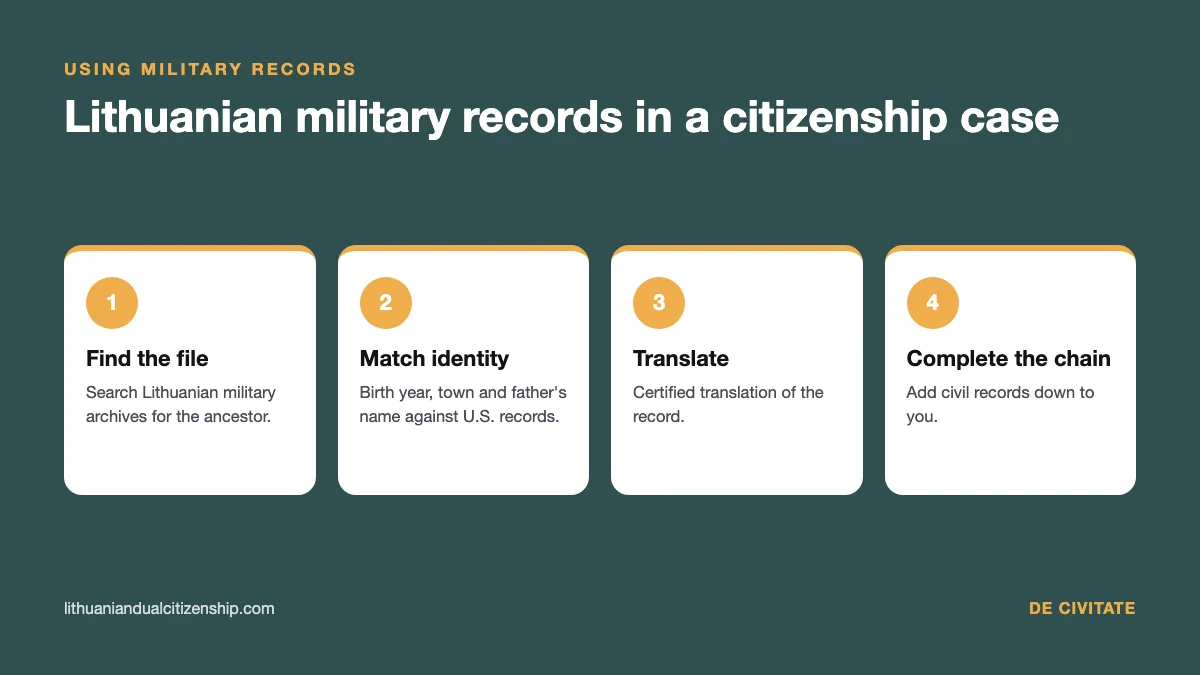
A military record should be presented in a way that makes its relevance clear. It is not enough to simply include an archival document without context. The document should be connected to the ancestor’s identity, the relevant time period, and the family line.
If the record is in Lithuanian, Russian, Polish, German, or another language, an official translation may be needed depending on the requirements of the procedure. If the document comes from an archive, it may also need to be issued or certified in an acceptable form. Requirements can vary depending on the document type, issuing country, and how the application is submitted.
It is also important to avoid overclaiming what the record proves. If the document shows service in the Lithuanian army, it may be described as evidence of service in the Lithuanian armed forces. If it only shows registration for conscription, it should not be presented as confirmed active service unless the record clearly says so.
A careful document package distinguishes between direct evidence and supporting evidence. Direct evidence may show citizenship or service in a way that directly supports the claim. Supporting evidence may help prove identity, residence, family connection, or continuity between records. Both types can matter, but they should not be treated as identical.
Military Records and U.S. Documents Should Be Read Together
For U.S.-based applicants, Lithuanian military records often become more useful when compared with American documents. U.S. naturalization records may show the ancestor’s date of arrival, former nationality, birthplace, name variation, or previous citizenship. Passenger lists may show a last residence or closest relative in the old country. Draft registration cards may show birth date and birthplace.
These American documents do not replace Lithuanian citizenship evidence, but they can help identify the correct person and establish a timeline. When a Lithuanian military record and U.S. records point to the same person, the overall case can become clearer.
This is especially important when the ancestor’s name changed after immigration. A military file may use the original Lithuanian form, while U.S. records may use an Americanized version. The connection between the two forms should be documented rather than assumed.
Conclusion
Lithuanian military records can be important evidence for citizenship by descent, especially when they show service in the Lithuanian armed forces or connect an ancestor to Lithuanian state institutions during the relevant historical period. They may help prove identity, residence, military service, and sometimes a legally meaningful connection to the Republic of Lithuania.
At the same time, military records should be used carefully. Not every military-related document proves Lithuanian citizenship, and records from foreign armies usually serve a different evidentiary purpose. The strongest cases typically combine Lithuanian military records with civil, church, passport, naturalization, and family records that show both the ancestor’s status and the applicant’s direct descent.
For descendants in the United States, these records can be a valuable part of the research process. They may not answer every question on their own, but when properly interpreted and connected to the wider document chain, they can help support Lithuanian citizenship by descent proof of ancestry.
FAQ
Can Lithuanian military records prove citizenship by descent?
Lithuanian military records may help prove citizenship by descent if they show that an ancestor served in the Lithuanian armed forces or was otherwise recorded by Lithuanian authorities during the relevant period. However, they usually need to be combined with documents proving the family line from the ancestor to the applicant.
Are Lithuanian army records the same as Lithuanian conscription records?
Not necessarily. Lithuanian army records may refer to actual service, while Lithuanian conscription records may show registration, eligibility, or administrative handling for possible service. Both can be useful, but they may prove different things depending on the wording of the document.
Do foreign military records prove Lithuanian citizenship?
Foreign military records usually do not prove Lithuanian citizenship by themselves. Records from the Russian Empire, Soviet Union, Germany, Poland, or other authorities may be useful for genealogy and identity research, but they do not automatically show citizenship of the Republic of Lithuania.
What if no Lithuanian military service records can be found?
If no Lithuanian military service records can be found, other documents may still support a citizenship by descent case. These may include Lithuanian passports, internal passport files, birth or marriage records, residence documents, naturalization papers, refugee records, or other archival materials that help prove citizenship and descent.
Find out if you qualify — free
Send us your family details and a Lithuanian citizenship specialist will review your case and explain your options.
Start free eligibility check