For many Americans with Lithuanian ancestry, the most difficult part of a citizenship by descent case is not always proving the family relationship. Birth, marriage, death, and naturalization records may show a clear line from the applicant to a Lithuanian-born ancestor. The harder question is often whether that ancestor can be shown to have held citizenship of the Republic of Lithuania before June 15, 1940.
Lithuanian internal passport records can be highly relevant in this context. These records come from the interwar period, when Lithuania existed as an independent state before Soviet occupation. They may help connect a person to a specific identity, place of residence, family status, and in many cases, the civic documentation used inside Lithuania at the time.
For citizenship by descent, internal passport records are usually not just genealogical records. They can form part of the evidentiary foundation used to show that an ancestor was connected to the Republic of Lithuania before 1940. Their value depends on the content of the specific file, the person named in the record, and how well the record can be connected to the applicant’s family line.
In short
- Internal passports were identity documents used inside interwar Lithuania, not international travel passports.
- Internal passport files can be strong evidence of citizenship before 15 June 1940.
- Files may include name, birth date and place, residence, occupation, family status, maiden name and a photograph.
- Their value depends on how clearly the file identifies your ancestor.
- You still need civil records proving your descent from that person.
What Lithuanian Internal Passport Records Were
Lithuanian internal passport records relate to personal identification documents used inside Lithuania during the interwar period. They should not be confused with modern travel passports or foreign passports used for international movement. An internal passport was primarily an identification document for use within the country.
The phrase Lithuania internal passports 1919 1940 usually refers to records created during the period after Lithuania established independence and before the Soviet occupation in 1940. In many cases, these records were connected to adults who needed official identification, people who reached the relevant age for documentation, women whose surnames changed after marriage, or individuals who needed a replacement document.
For descendants researching Lithuanian citizenship, the importance of these records lies in their timing and administrative context. A document issued by Lithuanian authorities before June 15, 1940 may help show that the ancestor was recognized within the legal and civic framework of interwar Lithuania. This can be especially useful when the family no longer has an original Lithuanian passport, citizenship certificate, or other obvious proof of pre-1940 citizenship.
Why Internal Passport Records Matter for Citizenship by Descent
Lithuanian citizenship by descent usually requires more than a general connection to Lithuanian ancestry. In many cases, the applicant must show that a parent, grandparent, or great-grandparent held citizenship of the Republic of Lithuania before June 15, 1940, and that the applicant descends from that person through a documented family line.
This is where Lithuanian internal passport records citizenship by descent research becomes important. An internal passport file may help establish that the ancestor was documented by Lithuanian authorities during the relevant period. If the record clearly identifies the person and relates to an internal or foreign passport of the Republic of Lithuania issued before 1940, it may be stronger than a record that merely shows birth, residence, or ethnic origin.
At the same time, internal passport records should be treated carefully. They may support a case, but their legal value depends on what the record actually says. A record showing residence in Lithuania is not always the same as a record proving citizenship. A record that directly identifies the person as a citizen or relates to the issuance of a Lithuanian internal passport may be more useful than a general local administrative entry.
For that reason, Lithuanian passport records for citizenship by descent are often reviewed together with other documents. The goal is not only to locate a historical file, but to understand whether it helps prove identity, citizenship, descent, and continuity of the family chain.
What Information May Appear in Lithuanian Internal Passport Files
Lithuanian internal passport files can vary significantly. Some records may contain only basic identifying information, while others may include applications, photographs, supporting certificates, affidavits, or references to family members. The content depends on the archive, locality, year, and surviving file.
A typical file may include the person’s given name and surname, date and place of birth, place of residence, occupation, religion, nationality or ethnicity as recorded at the time, marital status, and sometimes information about children or family relationships. Some files may include a photograph, which can be helpful when connecting the record to other family evidence.
For Lithuanian internal passport records genealogy research, these details can be extremely valuable. A place of birth may help identify the correct town or parish. A maiden name may help connect a married woman to her birth family. A residence address may help distinguish between people with similar names. A photograph or signature may support identity research when names were later changed, shortened, transliterated, or Americanized after immigration to the United States.
However, not every internal passport file contains the same level of detail. Some records may be incomplete. Some may exist as cards rather than full files. Some may reference supporting documents that are not preserved in the same place. The evidentiary value of a file must therefore be assessed document by document.
Internal Passport Records vs. Birth and Marriage Records
Birth and marriage records are often necessary in a Lithuanian citizenship by descent case, but they usually serve a different function. Civil, church, or vital records help prove identity and family relationship. They may show that a person was born in a Lithuanian town, married under a particular surname, or belonged to a particular family line.
Internal passport records may serve a different purpose. They may help show that the person was documented by Lithuanian state authorities during the period when the Republic of Lithuania existed before June 15, 1940. This can make them especially important when the issue is how to prove Lithuanian citizenship before 1940.
A birth record alone may show that an ancestor was born in Lithuania or in territory historically associated with Lithuania. But birth in the territory is not always the same as proof of citizenship of the Republic of Lithuania. Similarly, a U.S. death certificate or census record may say that a person was born in Lithuania, Russia, Poland, Kovno, or Vilna, but that wording may reflect historical borders, immigrant memory, or American recordkeeping rather than formal citizenship.
This is why documents proving Lithuanian citizenship before 1940 often need to be more specific than general birthplace evidence. Internal passport records can help fill that gap when they directly connect the ancestor to Lithuanian state documentation.
| Internal passport records | Birth and marriage records | |
|---|---|---|
| Main value | Link the ancestor to the interwar Lithuanian state | Prove parentage and the family line |
| Typical details | Identity, residence, occupation, family status, photograph | Dates, places, parents, spouses |
| Proof of citizenship before 1940 | Can be strong evidence | Usually not by itself |
| Limitations | Not available for everyone; quality varies | Spelling and place-name variations |
How Internal Passport Records Fit Into a Citizenship Evidence File
A citizenship by descent file usually needs to answer several separate questions. First, who was the ancestor? Second, did that ancestor hold Lithuanian citizenship before June 15, 1940? Third, how is the applicant related to that ancestor? Fourth, do name changes, migration events, or foreign naturalization records affect the analysis?
Lithuanian internal passport records can help mainly with the first and second questions. They may identify the ancestor and support the argument that the ancestor was documented as part of interwar Lithuania’s citizen population. If the record includes family details, it may also support the descent chain, but it usually does not replace U.S. birth, marriage, and name change records needed to connect each generation.
A strong evidence file often combines Lithuanian archive records for citizenship by descent with U.S. civil records. Lithuanian archive records may show the ancestor’s identity and pre-1940 status. U.S. records may show immigration, naturalization, marriage, children, and later name changes. Together, these records help create a coherent documentary chain.
The key is consistency. Names, dates, places, and family relationships do not need to be perfectly identical in every historical document, because older records often contain spelling variations. But the differences should be explainable. If the internal passport file says one date of birth and the U.S. naturalization record says another, the file may still be useful, but the discrepancy may need to be addressed with additional supporting records.
Where Lithuanian Internal Passport Records May Be Found
Pre 1940 Lithuanian citizenship records may be held in Lithuanian state archives, regional archives, or indexed genealogy databases depending on the locality, record group, and type of document. Internal passport records are not always centralized in one simple searchable place, and coverage can vary by town or district.
Some databases and indexes may help identify whether a record exists, but an index is not always enough for a citizenship case. For legal or administrative use, applicants often need certified archival copies, official archive responses, or properly prepared documents rather than only a database entry. The required form may depend on the specific procedure and the authorities reviewing the application.
When requesting a search, it is usually important to provide as much identifying information as possible. Useful details may include the ancestor’s full name, possible spelling variants, maiden name, approximate date and place of birth, town of residence, religion, occupation, spouse’s name, parents’ names, and known migration history. Even partial information can help, but broad searches may be slower or less reliable when the family name is common.
Because Lithuanian names were often recorded in Lithuanian, Polish, Russian, Yiddish, German, or Americanized forms, research may require checking multiple spellings. A person known in the United States as William, Joseph, John, Anna, or Mary may appear under a different given name in Lithuanian or earlier European records. Surname endings may also change depending on gender, marital status, language, or transliteration.
Common Problems With Lithuanian Internal Passport Records
One common issue is that a family knows the ancestor was “from Lithuania,” but the U.S. records list the birthplace as Russia, Poland, Kovno, Kovna, Vilna, or another historical region. This does not automatically make the case impossible. Borders and administrative labels changed over time, and American records often reflected the empire, province, or political situation at the time the document was created.
Another issue is missing or incomplete records. Not every internal passport file survived, and not every ancestor applied in the expected town. Some people may have left before the relevant records were created. Others may have lived in territories with complicated administrative histories. In these situations, alternative Lithuanian archive records may become important.
Name variation is also a frequent problem. Lithuanian internal passport files may use a spelling that differs from U.S. immigration papers, naturalization records, marriage certificates, or death records. A woman may appear under a maiden name in one record and a married surname in another. A surname may lose diacritics after immigration. A patronymic, middle name, or Hebrew/Yiddish name may appear in some records but not others.
These issues do not necessarily prevent the use of internal passport records. They do mean that the file should be interpreted in the context of the full documentary chain. The stronger the connection between the internal passport record and the U.S. family records, the more useful the file may be.
What If No Internal Passport Record Can Be Found
An internal passport record can be valuable, but it is not the only possible type of evidence. If no Lithuanian internal passport file is found, the applicant may still need to look for other documents proving Lithuanian citizenship before 1940 or indirectly supporting the ancestor’s status.
Other potentially relevant records may include foreign passports of the Republic of Lithuania, military service documents, civil service records, personal certificates, birth records with a direct citizenship reference, residence records, school or employment records, archive certificates, or other documents connected to life in Lithuania before June 15, 1940. The usefulness of each record depends on whether it directly or indirectly supports the specific legal question.
In many cases, the absence of one document shifts the focus to building a broader evidence package. A single weak record may not be enough, but several records that point to the same identity, residence, family line, and civic status may help create a stronger case. The final assessment depends on the applicant’s facts and the position of the relevant Lithuanian authorities.
How to Use Internal Passport Records Carefully
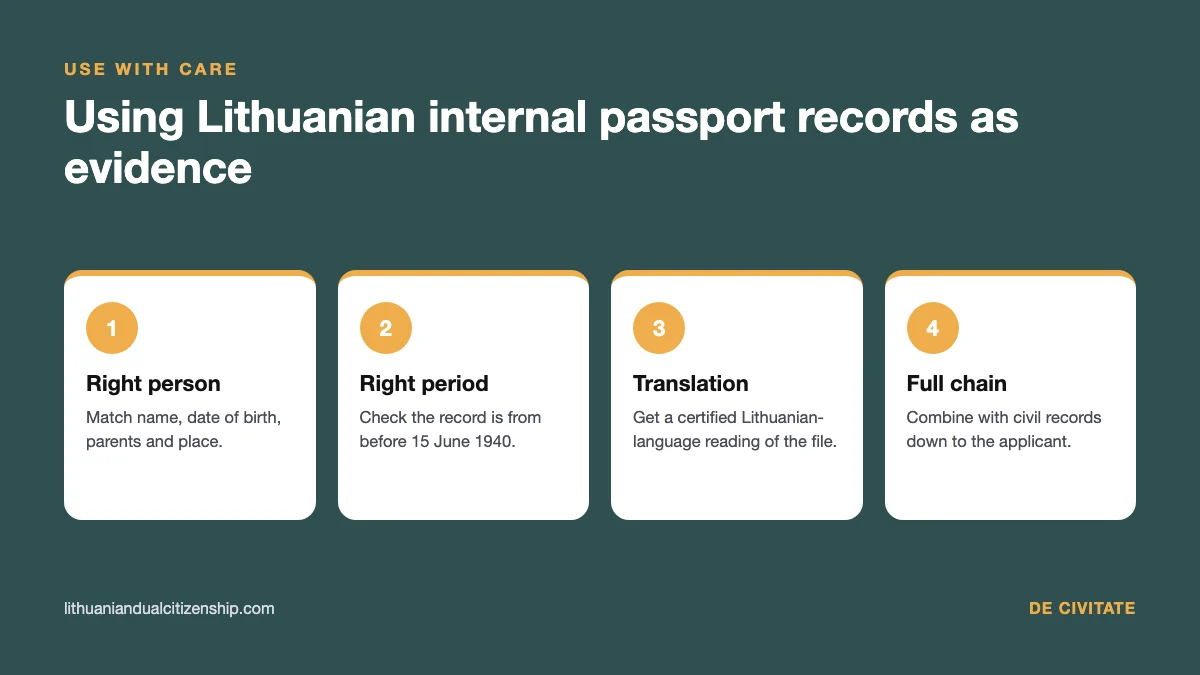
Lithuanian internal passport records should be used as evidence, not simply as family history material. Before relying on a record, it is important to confirm that the person in the file is the correct ancestor. Similar names were common, and many families lived in the same towns for generations. A match should be checked against birth dates, places, spouse names, parents’ names, children, occupation, address, and migration timeline.
It is also important to distinguish between an index entry and the underlying file. An index may help locate a record, but the original or archival copy may contain additional details that change the interpretation. A file may include supporting documents, handwritten notes, photographs, or references to other records. These details can be highly relevant when preparing a citizenship by descent file.
Translation and certification may also matter. Records in Lithuanian, Russian, Polish, German, or Yiddish may need to be translated accurately, especially when names, places, and citizenship-related wording are involved. A mistranslated term can weaken the evidentiary value of a document or create confusion in the application.
For U.S.-based applicants, internal passport records should usually be reviewed alongside American records. Passenger lists, naturalization records, marriage certificates, birth certificates of children, Social Security records, and court name change documents can help explain how the same person appears across different countries and decades.
Why These Records Are Especially Useful for U.S. Descendants
Many Lithuanian-American families have fragmentary documentation. The original Lithuanian passport may have been lost, destroyed, or never passed down. Family names may have changed after immigration. Later U.S. records may describe the ancestor’s birthplace in broad or inconsistent terms. In such cases, Lithuanian internal passport records may provide a more precise connection to interwar Lithuania.
These records can be especially useful when they identify the ancestor before emigration or during the period when Lithuanian citizenship must be proven. They may also help clarify whether the person lived in Lithuania during the relevant period, what town they were connected to, and whether additional archive searches should be directed to a specific locality.
For citizenship by descent, the best use of these records is strategic. They should not be treated as isolated discoveries. Instead, they should be integrated into a complete documentary narrative showing identity, citizenship evidence, emigration history, and descent from the ancestor to the applicant.
FAQ
Are Lithuanian internal passport records proof of citizenship by descent?
Lithuanian internal passport records may be strong evidence in a citizenship by descent case, especially if they relate to an internal passport of the Republic of Lithuania issued before June 15, 1940. However, their value depends on the specific record and how clearly it identifies the ancestor. The applicant usually still needs documents proving the family line from the ancestor to the present generation.
What is the difference between a Lithuanian internal passport and a travel passport?
A Lithuanian internal passport was an identification document used inside Lithuania during the interwar period. It was not the same as a modern travel passport used for international travel. For citizenship research, internal passport records matter because they may show that a person was documented by Lithuanian authorities before 1940.
Can Lithuanian internal passport records help with genealogy?
Yes. Lithuanian internal passport records genealogy research can be very useful because these files may include names, dates and places of birth, residence, occupation, family status, maiden names, photographs, and sometimes supporting records. These details can help identify the correct ancestor and connect European records with later U.S. documents.
What if my ancestor’s U.S. records say Russia or Poland instead of Lithuania?
This can happen because Lithuania’s historical borders and political status changed over time. U.S. records may list Russia, Poland, Kovno, Vilna, or another regional label even when the family came from territory relevant to Lithuanian citizenship research. The issue should be analyzed through dates, places, maps, and Lithuanian archive records rather than by the U.S. birthplace label alone.
Are internal passport records enough if I do not have an old Lithuanian passport?
They may help, but whether they are enough depends on the content of the file and the rest of the evidence. If the internal passport record clearly supports pre-1940 Lithuanian citizenship and the applicant can prove descent, it may be highly relevant. If the record is incomplete or only indirect, additional archive, civil, military, residence, or U.S. records may be needed.
Find out if you qualify — free
Send us your family details and a Lithuanian citizenship specialist will review your case and explain your options.
Start free eligibility check