Yes, Lithuanian citizenship by descent can pass through the maternal line. A person’s eligibility is not generally determined by whether the Lithuanian ancestor was male or female. The relevant questions are whether the ancestor held Lithuanian citizenship, whether the applicant is a direct descendant, and whether the historical and documentary requirements for the applicable citizenship route can be satisfied.
This means that an applicant may potentially pursue Lithuanian citizenship through a mother, maternal grandmother, or maternal great-grandmother. The same principle may apply when the Lithuanian ancestor on the mother’s side was a maternal grandfather or great-grandfather.
Gender does not normally make the maternal line less valid than the paternal line. However, maternal-line applications can involve additional documentary work because surnames, civil status records, and identifying information may have changed through marriage, migration, translation, or naturalization.
In short
- Lithuanian citizenship by descent can pass through the maternal line — the ancestor’s gender does not decide eligibility.
- You may apply through a mother, maternal grandmother or maternal great-grandmother.
- Your mother does not need to obtain Lithuanian citizenship first, but her records are part of the chain.
- Maternal lines often need extra documents: maiden names, married surnames and female surname endings change.
- Eligibility to restore citizenship and eligibility to keep dual citizenship are separate questions.
The Maternal and Paternal Lines Are Generally Treated Equally
Lithuanian citizenship rules focus on direct descent rather than on a preference for the father’s family. A qualifying ancestor may therefore be found on either side of the applicant’s family tree.
For example, an applicant may trace the relevant connection through a Lithuanian mother, the mother’s Lithuanian parent, or the mother’s Lithuanian grandparent. The ancestor does not have to be male, and the family surname does not have to pass unchanged from the Lithuanian ancestor to the applicant.
The central issue is whether every generation in the line can be connected through reliable records. A maternal line may be legally relevant even when the applicant and the Lithuanian ancestor have completely different surnames.
The question “does Lithuanian citizenship follow the maternal line?” should therefore be separated into two parts. The maternal line itself can qualify, but the applicant must still prove that the ancestor had the necessary Lithuanian citizenship status and that the applicant is that person’s direct descendant.
Lithuanian Citizenship Through a Mother
A claim for Lithuanian citizenship through a mother may arise in different circumstances.
In one situation, the applicant’s mother was already a Lithuanian citizen when the applicant was born. Citizenship by birth may then be relevant, depending on the law in force at the time of birth and the family’s individual circumstances.
In another situation, the mother was born outside Lithuania and never obtained Lithuanian citizenship, but one of her parents or grandparents was a Lithuanian citizen. The applicant may then need to examine whether citizenship can be reinstated through the earlier Lithuanian ancestor.
Therefore, the answer to “can I claim Lithuanian citizenship through my mother?” does not depend only on the mother’s birthplace or ethnicity. It may be necessary to establish whether she held citizenship, had a right to citizenship, or forms part of a direct line leading to a qualifying former Lithuanian citizen.
A mother does not necessarily need to possess a current Lithuanian passport for her child to have a potentially valid ancestry-based case. The applicant may be able to rely on the citizenship of an earlier direct ancestor, provided the complete family connection and the applicable legal conditions can be demonstrated.
Lithuanian Citizenship Through a Maternal Grandmother
Lithuanian citizenship through a maternal grandmother may be possible when the grandmother was a citizen of the Republic of Lithuania and the applicant can document the direct line from the grandmother to the applicant’s mother and then to the applicant.
The grandmother’s birth in Lithuania may be important evidence, but birthplace alone does not always prove citizenship. Lithuania’s borders and political status changed substantially during the twentieth century, and not every person born or residing in the territory automatically held citizenship of the independent Republic of Lithuania.
Applicants commonly need records that directly establish or strongly support the grandmother’s citizenship status. These may include Lithuanian passports, citizenship records, identity documents, military or public service records, Lithuanian archival records, or other official documents referring to citizenship.
The next stage is proving the family relationship. The applicant may need the grandmother’s birth record, the mother’s birth certificate, the applicant’s birth certificate, and any marriage or name-change records connecting the identities shown in those documents.
As a result, a person asking “can I claim Lithuanian citizenship through my grandmother?” should investigate both the grandmother’s legal status and the documentary chain. Lithuanian heritage, family stories, and a Lithuanian surname may support genealogical research, but they do not replace official evidence.
Lithuanian Citizenship Through a Great-Grandmother
Lithuanian citizenship through a great-grandmother may also be possible. Official reinstatement guidance generally recognizes qualifying descendants such as children, grandchildren, and great-grandchildren of former Lithuanian citizens.
A typical case may involve a great-grandmother who held citizenship of the Republic of Lithuania before June 15, 1940, later left Lithuania, and established a family in the United States. The applicant would need to prove the great-grandmother’s citizenship and connect each subsequent generation through civil records.
The required chain may run from the great-grandmother to the applicant’s grandmother, from the grandmother to the applicant’s mother, and from the mother to the applicant. Missing records, inconsistent spellings, or unexplained surname changes can make the case more difficult even when the biological relationship is clear to the family.
Being born in Lithuania or identifying as Lithuanian is not necessarily the same as having held Lithuanian citizenship. This distinction can be particularly important when a great-grandmother left the region before Lithuania restored its statehood in 1918 or lived in an area affected by changing borders.
An applicant should therefore avoid assuming eligibility solely because a great-grandmother came from Lithuania. Her citizenship status, migration history, and relationship to the applicant must be examined together.
| You apply through | Key documents |
|---|---|
| Mother | Your birth certificate; her citizenship status when you were born |
| Maternal grandmother | Her proof of citizenship; your mother’s and your birth certificates |
| Maternal great-grandmother | Her citizenship before 15 June 1940; birth records for every generation |
| Any maternal line | Marriage and name-change records linking maiden and married surnames |
Lithuanian Ancestry and Lithuanian Citizenship Are Not the Same
Citizenship by descent cases frequently begin with evidence that an ancestor was born in Lithuania. That information is useful, but it may not be sufficient by itself.
An ancestor may have been ethnically Lithuanian, spoken Lithuanian, attended a Lithuanian church, or lived in a Lithuanian town without necessarily being documented as a citizen of the Republic of Lithuania. Conversely, a person may have held Lithuanian citizenship even when later American records describe the birthplace as Russia, Poland, the Russian Empire, Kovno, Vilna, or another historical geographic designation.
The relevant status must be evaluated in its historical context. For reinstatement cases, particular attention is usually given to whether the ancestor was a citizen of the Republic of Lithuania before June 15, 1940.
Applicants whose ancestors emigrated before February 16, 1918 may face a different issue because the independent Republic of Lithuania had not yet been restored when the ancestor departed. Such cases require careful examination rather than an assumption based only on the ancestor’s place of birth.
What Must Be Proved Along the Maternal Line?
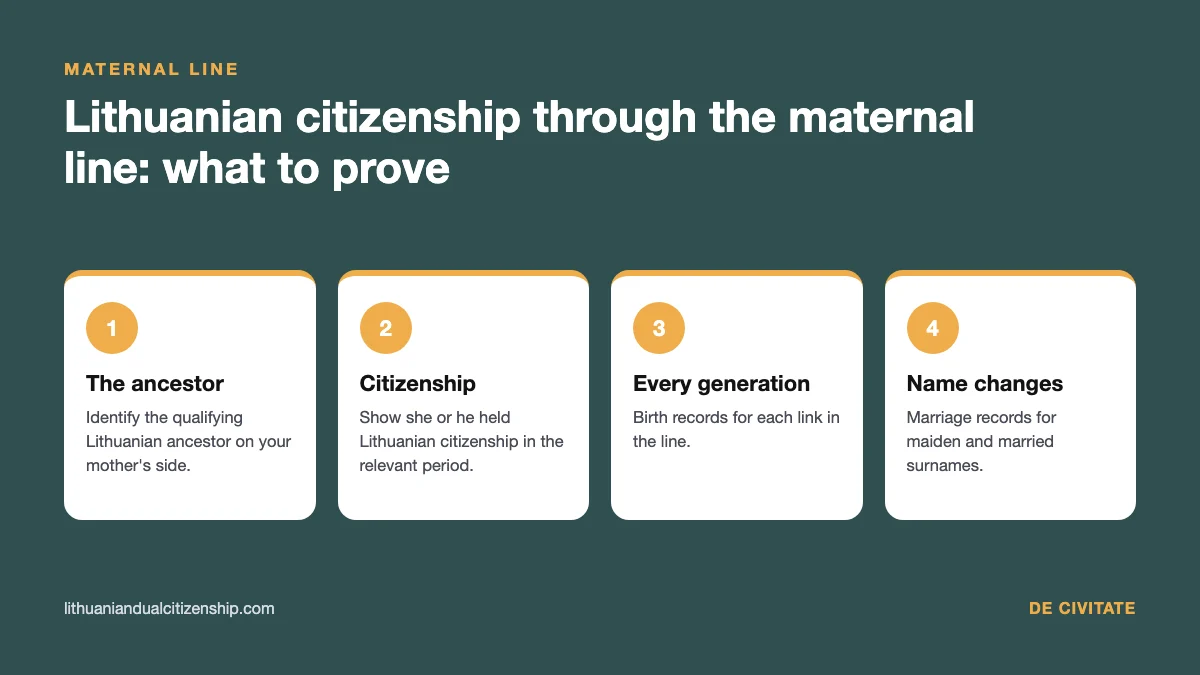
A maternal-line case normally depends on several connected elements.
First, the applicant must identify the qualifying Lithuanian ancestor. It must then be established that this person held Lithuanian citizenship during the legally relevant period. A record showing only Lithuanian ethnicity, residence, or birthplace may not be enough.
Second, the applicant must prove direct descent. Each generation between the Lithuanian ancestor and the applicant should be supported by birth certificates or comparable civil records. Marriage certificates, court orders, adoption records, or other documents may be necessary when names or legal family relationships changed.
Third, the ancestor’s departure, exile, residence, or migration history may be relevant, particularly when the applicant intends to retain another citizenship. Eligibility for reinstatement and eligibility to hold dual citizenship are related but separate questions.
Finally, the documents must identify the same people consistently. Differences involving names, birth dates, locations, or surnames may need to be explained through additional evidence.
A strong family tree is useful for organizing the case, but the application is evaluated through documentary evidence rather than the family tree alone.
Why Maternal-Line Cases May Require More Documentary Research
The law does not generally disadvantage a maternal ancestor, but historical recordkeeping can make maternal lines harder to document.
Women’s surnames frequently changed after marriage. A Lithuanian surname may also have been shortened, translated, transliterated, or Americanized after immigration. The same woman might therefore appear under a Lithuanian maiden name, a married surname, and one or more English-language variations.
Lithuanian female surnames can also contain endings that differ from the corresponding male surname. An American clerk unfamiliar with Lithuanian naming conventions may have recorded the name phonetically or treated different forms as unrelated surnames.
Birth dates and places can create similar problems. Records may use different calendars, translated place names, historical jurisdictions, or approximate birth years. A person born in Kaunas may appear in another document as having been born in Kovno, Lithuania, Russia, or the Russian Empire.
These discrepancies do not automatically make a claim invalid. However, they should not be ignored. The evidence should show why records with different names or details refer to the same ancestor.
Does the Applicant’s Mother Need to Obtain Citizenship First?
In many reinstatement cases, an intermediate relative does not need to obtain Lithuanian citizenship before the next descendant applies.
For example, a person relying on a Lithuanian maternal grandmother may not necessarily need the applicant’s mother to complete her own citizenship application first. The applicant may be able to demonstrate the direct relationship by submitting the relevant records for all three generations.
Similarly, an applicant relying on a maternal great-grandmother may be able to apply without requiring the grandmother and mother to become citizens beforehand.
This does not mean that the intermediate generations can be omitted from the evidence. Their civil records remain essential because they establish the direct chain between the applicant and the qualifying ancestor.
The appropriate approach may depend on the citizenship route, the available evidence, and whether any adoption, parentage, or civil-status issues affect the family line.
Does Gender Affect Dual Citizenship Eligibility?
Gender does not generally determine whether a descendant may qualify to retain another citizenship together with Lithuanian citizenship.
Dual citizenship is a separate legal issue. It may depend on circumstances such as when the Lithuanian citizen left Lithuania, whether the person was exiled, where the person lived, and whether the applicant falls within a statutory exception.
A person may therefore have a valid right to reinstate Lithuanian citizenship through a maternal ancestor but still need a separate analysis of whether another citizenship can be retained.
For US applicants, this distinction is important. Lithuanian citizenship through a mother or grandmother does not automatically guarantee that every applicant can hold both US and Lithuanian citizenship. The ancestor’s citizenship and migration history must be reviewed against the dual-citizenship conditions.
How US Records Can Support a Maternal-Line Case
American civil and immigration records can be important when reconstructing a maternal family line.
Birth certificates may connect the applicant to a mother, grandmother, or great-grandmother. Marriage certificates can explain surname changes. Death certificates, census records, passenger lists, Social Security records, and naturalization files may help establish identity, residence, migration dates, or family relationships.
Naturalization records can be particularly useful because they may contain an ancestor’s former nationality, date of arrival, original name, place of birth, and date of naturalization. However, the legal effect of naturalization cannot be determined from the certificate alone without considering the relevant dates and Lithuanian citizenship rules.
American records may contain errors or simplified geographic descriptions. A US document describing an ancestor as Russian or Polish does not necessarily exclude Lithuanian citizenship, especially when the record refers to a period of foreign rule or changing borders.
The records should be considered collectively. One document may establish a name change, another may confirm a parent-child relationship, and a Lithuanian archival record may provide the evidence of citizenship.
How the Application Process Generally Works
Applications for reinstatement of Lithuanian citizenship are generally submitted electronically through the Lithuanian Migration Information System, known as MIGRIS.
The applicant uploads the application and supporting documents for review. Depending on the selected submission method and instructions received through the system, the applicant may later need to present original documents or properly certified copies to a Lithuanian diplomatic or consular post.
Foreign civil documents generally need to meet Lithuanian document-authentication requirements. For US documents, this may involve obtaining an apostille from the appropriate state or federal authority. Foreign-language documents may also require an official translation into Lithuanian.
Document requirements can vary according to the applicant’s situation. A case based on a mother who is already recognized as a Lithuanian citizen may not require the same historical evidence as a reinstatement case based on a great-grandmother who emigrated many decades ago.
How to Evaluate a Maternal-Line Claim Before Applying
The first step is to identify the closest potentially qualifying Lithuanian ancestor on the mother’s side.
The applicant should determine when and where the ancestor was born, whether the ancestor lived in independent Lithuania, when the ancestor left, and whether any Lithuanian citizenship documents survive. It is also useful to establish when the ancestor acquired US citizenship and whether records exist for every generation connecting the ancestor to the applicant.
Particular attention should be given to maiden names, married surnames, alternative spellings, and translated place names. Resolving these issues before submission can help prevent gaps in the documentary chain.
The applicant should also distinguish between proving Lithuanian citizenship, proving direct descent, and qualifying for dual citizenship. Evidence that answers one of these questions may not answer the others.
Common Maternal-Line Scenarios
A person whose mother is currently a Lithuanian citizen may have a relatively direct citizenship-by-birth question. The decisive facts can include the mother’s citizenship status when the person was born and the legal rules applicable at that time.
A person whose maternal grandmother was a Lithuanian citizen may need to establish the grandmother’s citizenship, the mother’s relationship to the grandmother, and the applicant’s relationship to the mother. The mother’s failure to apply for Lithuanian citizenship does not necessarily prevent the applicant from pursuing an individual claim.
A person whose maternal great-grandmother was born in Lithuania may have a potential reinstatement case, but Lithuanian birth alone does not establish eligibility. The applicant should verify that the great-grandmother held citizenship and that the applicant falls within the qualifying descendant category.
A person whose records contain different surnames or birthplaces may still have a viable maternal-line case. The key is to connect the variations through official records and a coherent documentary history.
Key Takeaway
Lithuanian citizenship by descent can pass through the maternal line. Lithuanian citizenship through a mother, maternal grandmother, or maternal great-grandmother may be possible when the ancestor had the required citizenship status and the applicant can prove a direct family connection.
The sex of the ancestor does not generally determine eligibility. The most important factors are the ancestor’s citizenship, the number of generations separating the applicant from that ancestor, the family’s migration history, the availability of records, and the rules governing dual citizenship.
Each case should be evaluated through its specific historical facts and documents rather than through the family surname, birthplace, or maternal relationship alone.
FAQ
Does Lithuanian citizenship follow the maternal line?
Yes. Lithuanian citizenship may pass through the maternal line because eligibility is generally based on direct descent rather than whether the qualifying ancestor was male or female. The applicant must still prove the ancestor’s Lithuanian citizenship and the relationship between each generation.
Can I claim Lithuanian citizenship through my mother?
You may be able to claim Lithuanian citizenship through your mother if she was a Lithuanian citizen when you were born or if she connects you to an earlier qualifying Lithuanian citizen. The applicable route depends on the family’s citizenship history and supporting documents.
Can I claim Lithuanian citizenship through my maternal grandmother?
You may be eligible through a maternal grandmother if she held qualifying Lithuanian citizenship and you can document the direct relationship from her to your mother and from your mother to you. Her Lithuanian birthplace alone may not be sufficient to prove citizenship.
Can I claim Lithuanian citizenship through my great-grandmother?
A claim through a great-grandmother may be possible because qualifying great-grandchildren can generally seek reinstatement through a former Lithuanian citizen. You must prove that she held Lithuanian citizenship and provide records connecting every generation.
Does my mother need to obtain Lithuanian citizenship before I apply?
In many reinstatement cases, your mother does not need to obtain Lithuanian citizenship first. You may apply through the qualifying ancestor directly, but you must still provide records establishing your mother’s place in the continuous family line.
Does gender affect Lithuanian citizenship by descent?
Gender does not generally affect whether a maternal or paternal ancestor can provide the basis for a citizenship claim. Eligibility depends more heavily on the ancestor’s citizenship status, the direct family relationship, the relevant historical circumstances, and the available evidence.
Find out if you qualify — free
Send us your family details and a Lithuanian citizenship specialist will review your case and explain your options.
Start free eligibility check